If you are looking for a simple, safe and completely free way to enjoy movies and series on your cell phone, tablet or TV, Tubi – Free Movies and Series stands out as one of the best options available in 2026 . With an impressive collection, a clean interface, and support for Portuguese subtitles, the app offers access to thousands of titles free of charge. And best of all, it's available for direct download from the official stores:

Tubi: Free Movies & Live TV
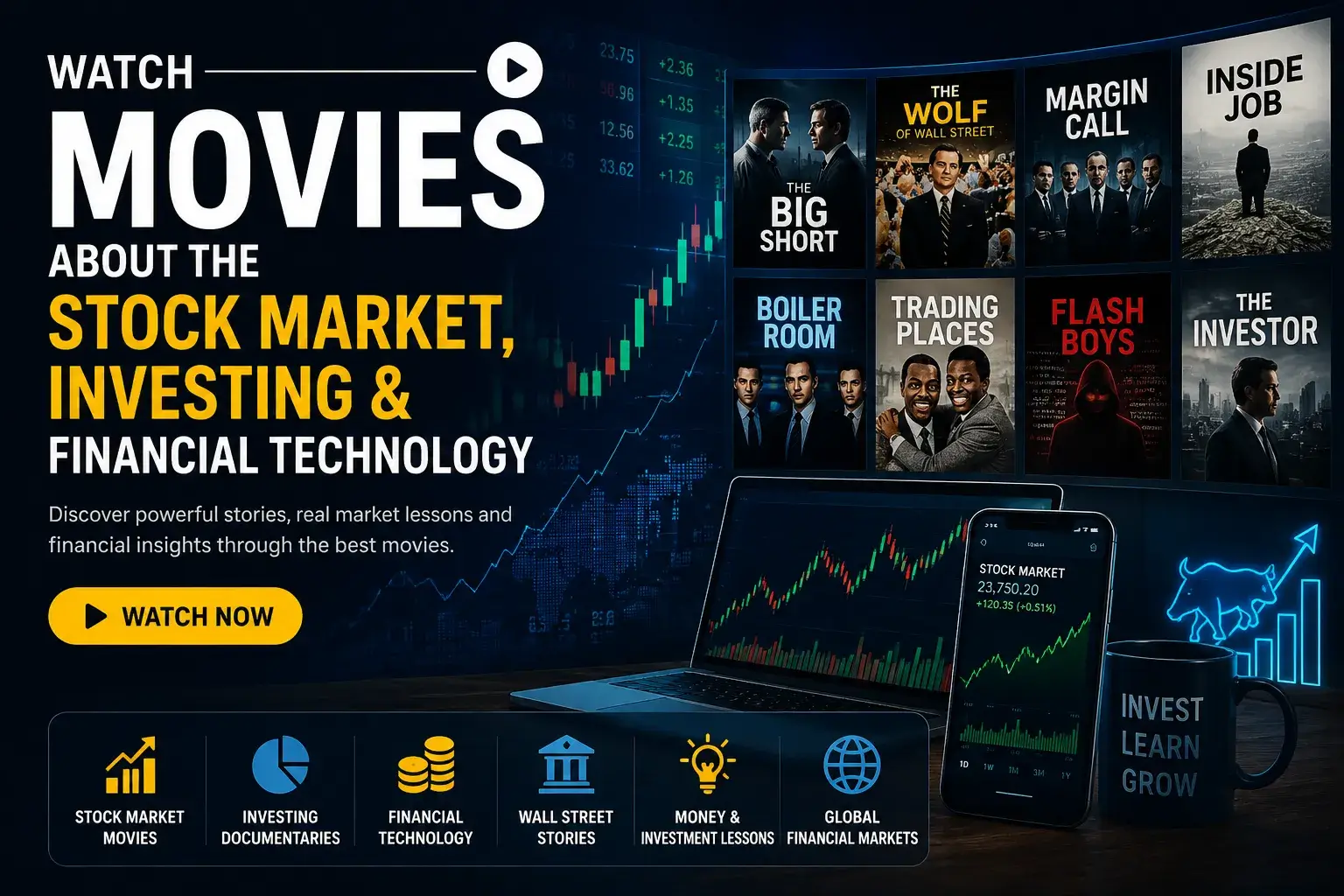
Watch Movies About the Stock Market, Investing & Financial Technology
Financial markets have become one of the most important parts of the modern global economy. Stock exchanges, investment platforms, banks, asset managers, financial technology companies and digital payment networks connect businesses and individuals across countries every day. At the same time, movies, documentaries and educational videos have become an engaging way to understand complicated financial subjects.
This guide explores stock market movies, investing documentaries, financial technology videos and educational content about global financial markets. The goal is to make important financial concepts easier to understand through visual storytelling while introducing readers to topics such as stocks, stock exchanges, IPOs, financial technology, digital investing, portfolio management, market analytics, wealth management technology and financial education.
Financial markets can appear complicated when they are first introduced. Terms such as equity, market capitalization, dividends, ETFs, bonds, portfolio diversification, volatility, financial statements and capital markets may sound technical. A well-designed documentary or educational movie can put these concepts into a real-world context and help viewers understand how businesses, investors and financial institutions interact.
This page is intended for general educational and informational purposes. It does not provide personalized investment advice, specific securities recommendations, guaranteed returns or instructions to buy or sell financial products. Viewers should conduct their own research and consult appropriately qualified professionals when they require personal financial guidance.
Why Watch Movies and Documentaries About the Stock Market?
The stock market is more than a collection of prices moving up and down on a screen. Behind every publicly traded company are employees, customers, products, financial statements, management teams, investors and economic conditions.
Stock market documentaries can bring these elements together through real-world stories. A documentary might examine how a company became publicly traded, how a stock exchange operates, how investors responded to an economic event or how technology changed the way financial markets operate.
Visual content can also make abstract concepts easier to understand. For example, a beginner may understand the concept of market capitalization more easily after seeing how companies of different sizes are valued than by reading a mathematical definition alone.
Similarly, an educational video about an IPO can explain the journey from a privately owned business to a publicly traded company, including the role of investment banks, investors, regulators and stock exchanges.
For students, entrepreneurs, technology professionals and anyone interested in financial markets, documentaries can therefore provide useful context alongside traditional educational resources.
Understanding the Stock Market
The stock market is a broad term used to describe markets where shares and other securities can be bought and sold. A share represents an ownership interest in a company, although the rights attached to different classes of shares can vary.
Public companies can raise capital by issuing shares to investors. Investors may subsequently trade those shares through regulated exchanges and other market venues.
The value of a stock can change because of many factors, including company performance, expectations about future earnings, interest rates, economic conditions, industry developments, investor sentiment and broader market conditions.
A stock market documentary can explore these factors through the history of individual companies, major market events and the evolution of financial institutions.
How Stock Exchanges Work
Stock exchanges provide organized marketplaces for trading securities. Modern financial markets use sophisticated electronic systems to match orders and facilitate transactions.
Well-known exchanges around the world include markets such as the New York Stock Exchange, Nasdaq, London Stock Exchange, Toronto Stock Exchange, Deutsche Börse, Euronext, Japan Exchange Group and other regulated exchanges.
Each market has its own rules, listing requirements, trading hours and regulatory framework.
Technology has transformed exchanges significantly. Earlier financial markets relied heavily on physical trading floors and human communication. Modern markets use electronic order-management systems, data feeds, algorithmic processes, market surveillance systems and high-speed communication infrastructure.
Financial technology documentaries can provide an interesting perspective on this transition from traditional financial markets to highly automated digital infrastructure.
What Is an IPO?
An Initial Public Offering, or IPO, occurs when a private company offers shares to public investors for the first time through a public offering process.
An IPO can provide a company with access to capital that may be used for expansion, research and development, acquisitions, debt reduction or other corporate purposes.
The IPO process can involve company executives, investment banks, lawyers, accountants, regulators, institutional investors and stock exchanges.
After a company becomes publicly traded, investors can generally buy and sell its shares through the relevant market subject to applicable rules.
IPO documentaries can be particularly useful for understanding the business and financial decisions involved in becoming a public company.
Understanding Equity Markets
Equity markets allow investors to participate in the ownership of publicly traded companies. Companies can use equity markets as one source of long-term capital, while investors may use them as part of broader financial portfolios.
Equity markets include companies from many industries, such as technology, healthcare, financial services, manufacturing, energy, consumer products, communications and transportation.
This diversity means that stock market education can connect with almost every part of the global economy.
A technology company may be influenced by software demand and cloud computing. A financial company may be influenced by interest rates and credit conditions. A manufacturing company may depend on supply chains, commodity prices and consumer demand.
Understanding these relationships is an important part of financial education.
What Is Market Capitalization?
Market capitalization is commonly calculated by multiplying a company's share price by the number of outstanding shares.
It provides a market-based indication of the company's equity value and is commonly used to categorize companies by approximate size.
Market capitalization can be useful when comparing companies, constructing indexes and analyzing the composition of financial markets.
However, market capitalization is only one measurement. Investors and researchers may also examine revenue, profitability, cash flow, debt, growth expectations, valuation metrics and other financial information.
Dividends and Shareholder Returns
Some companies distribute part of their profits to shareholders through dividends. Dividend policies vary significantly between companies and industries.
Companies may choose to retain earnings for expansion, research, acquisitions or other business activities instead of distributing them.
Dividend-focused financial documentaries can help explain why mature companies may have different capital-allocation strategies from rapidly growing companies.
Understanding dividends also introduces concepts such as dividend yield, payout ratios, earnings and corporate cash flow.
Importantly, historical dividend payments do not guarantee future payments.
Stock Market Indexes
A stock market index tracks a selected group or segment of securities according to a defined methodology.
Indexes are widely used to understand market performance, create financial products and provide benchmarks for investment portfolios.
Examples of globally recognized indexes include the S&P 500, Nasdaq Composite and Dow Jones Industrial Average in the United States, as well as major indexes in Europe, Asia and other regions.
Indexes can be weighted using different methodologies. Some are influenced more heavily by larger companies, while others may use equal weighting or other approaches.
Financial market documentaries can explain how index providers select constituents, calculate index values and periodically rebalance their benchmarks.
Financial Technology Is Changing Investing
Financial technology, commonly called FinTech, has changed how people and businesses interact with financial services.
Modern financial technology can include digital banking, online brokerage platforms, electronic payments, financial analytics, automated portfolio tools, financial data platforms, identity verification, fraud detection and investment research systems.
Technology has also lowered many barriers to accessing financial information. Investors can now access market data, company filings, financial news and educational resources through computers and mobile devices.
However, easier access to financial information does not eliminate investment risk. Technology can improve convenience while markets remain uncertain and securities can lose value.
Digital Investing Platforms
Digital investing platforms allow users to access financial markets through online interfaces. Depending on the jurisdiction and service, platforms may provide market information, portfolio tools, research features and access to different financial products.
Modern platforms increasingly use sophisticated interfaces, automated reporting, real-time or delayed market data, alerts and analytical tools.
When evaluating financial technology, users should consider security, regulatory status, fees, data protection, account controls and the specific services offered.
Artificial Intelligence in Financial Technology
Artificial intelligence is becoming an increasingly important technology across financial services.
Financial institutions and technology companies can use AI for areas such as fraud detection, customer support, document processing, cybersecurity, risk analysis, financial forecasting and data classification.
AI can also assist financial professionals with research and information processing. Large datasets can be analyzed to identify patterns that may be difficult to detect manually.
However, AI systems can make mistakes and should not automatically be treated as reliable sources of personalized financial advice. Financial decisions can involve significant risks, and human oversight, appropriate governance and reliable data remain important.
Financial Data and Market Analytics
Financial markets generate enormous amounts of information every day.
Market prices, transaction volumes, company financial statements, economic indicators, interest rates and corporate announcements can all contribute to financial analysis.
Financial analytics refers to the use of data and analytical techniques to understand financial information.
Professional financial institutions may use sophisticated data infrastructure, analytics platforms and research systems to monitor markets and organizations.
Educational documentaries about financial analytics can demonstrate how financial professionals turn large quantities of information into structured research.
Fundamental Analysis
Fundamental analysis generally focuses on the underlying financial and economic characteristics of a company or security.
Common areas of analysis can include:
- Revenue
- Profitability
- Earnings
- Cash flow
- Assets
- Liabilities
- Debt
- Competitive position
- Industry conditions
- Growth expectations
Financial statements are particularly important because they provide structured information about a company's financial condition and performance.
Educational content can explain these concepts without turning the discussion into a recommendation to purchase a particular security.
Technical Analysis
Technical analysis studies market data such as historical prices and trading volume to identify patterns and trends.
Common concepts include support and resistance, moving averages, price trends, volatility and chart patterns.
Technical analysis is widely discussed in financial education, but historical patterns do not guarantee future outcomes.
A responsible educational article should explain the concepts rather than presenting technical indicators as guaranteed prediction tools.
Understanding Financial Statements
Financial statements are essential sources of information for understanding businesses.
The three commonly discussed financial statements are the income statement, balance sheet and cash-flow statement.
The income statement provides information about revenue, expenses and profit over a specified period.
The balance sheet provides information about assets, liabilities and shareholders' equity at a particular point in time.
The cash-flow statement provides information about cash movements associated with operating, investing and financing activities.
Financial education videos can make these statements easier to understand by using examples of real business operations.
What Is a P/E Ratio?
The price-to-earnings ratio, commonly called the P/E ratio, compares a company's share price with its earnings per share.
It is one of several valuation metrics used in financial analysis.
P/E ratios can vary between industries, companies and market conditions. Comparing a P/E ratio without considering the company's growth, profitability, industry and other financial characteristics can provide an incomplete picture.
For educational purposes, valuation metrics are best understood as tools for analysis rather than automatic signals to buy or sell securities.
Understanding EPS
Earnings per share, or EPS, is a commonly used financial metric that relates a company's earnings to its shares.
EPS can be useful when analyzing company performance and calculating valuation measures such as the P/E ratio.
Different forms of EPS can be presented depending on accounting treatment and share-count calculations, so financial analysis should consider the definitions used in company reports.
ETFs and Investment Funds
Exchange-traded funds, commonly called ETFs, are investment funds that trade on exchanges.
Different ETFs can provide exposure to different asset classes, sectors, geographic regions, strategies or indexes.
Some ETFs track broad market indexes, while others focus on specific themes or asset categories.
Financial education content can explain how ETFs are structured, how their prices trade during market hours and how expenses and tracking differences can affect performance.
Investors should understand the objectives, risks, fees and structure of any financial product before making decisions.
Bonds and Fixed-Income Markets
Bonds represent debt obligations issued by governments, corporations or other entities.
Bond markets are a major component of the global financial system and play an important role in corporate financing and government funding.
Important bond concepts include maturity, coupon payments, credit risk, interest-rate risk and yield.
Bond prices and yields can move in opposite directions, and different types of bonds can have very different risk characteristics.
Documentaries about fixed-income markets can help explain how governments and companies use debt markets to finance their activities.
Portfolio Diversification
Diversification is a widely discussed concept in financial education.
Instead of concentrating exposure in a single asset, sector or company, diversification involves spreading exposure across different investments or categories.
The objective is generally to reduce the impact that one particular investment or market segment can have on an overall portfolio.
Diversification does not eliminate investment risk and cannot guarantee that a portfolio will not lose value.
Educational videos can explain diversification using examples involving different asset classes, industries and geographic markets.
Understanding Market Volatility
Market volatility refers to the degree to which prices fluctuate over time.
Volatility can increase during periods of economic uncertainty, geopolitical events, significant corporate announcements, changes in monetary policy or major market developments.
High volatility can create both rapid gains and rapid losses. It is therefore important to understand that market prices can change significantly in either direction.
Financial documentaries covering historical market events can provide useful context for understanding volatility without attempting to predict future market movements.
Global Financial Markets
Financial markets operate across multiple regions and time zones.
North America, Europe, Asia-Pacific and emerging markets each have important financial centers, exchanges and financial institutions.
Global investors may monitor economic developments across multiple countries because changes in interest rates, currencies, commodity prices, trade policies and economic growth can influence markets.
Global financial documentaries can therefore provide a broader understanding of how economies and markets interact.
Wealth Management Technology
Wealth management has increasingly adopted digital technology.
Modern wealth-management platforms can provide portfolio reporting, financial dashboards, digital onboarding, document management, analytics and communication tools.
Financial institutions may also use technology for compliance, risk monitoring, customer relationship management and investment research.
As financial services become more digital, cybersecurity and data privacy remain essential considerations.
Cybersecurity in Financial Services
Financial institutions manage highly sensitive information, making cybersecurity a critical component of modern financial infrastructure.
Security technologies can include identity verification, multi-factor authentication, encryption, fraud detection, transaction monitoring and security analytics.
Financial institutions also need strong controls around access management, data protection and operational resilience.
Cybersecurity documentaries can provide valuable educational context by showing how digital threats can affect banks, exchanges, payment platforms and financial technology providers.
Financial Fraud and Market Security
Financial fraud can take many forms, including identity theft, payment fraud, phishing, account takeover and other forms of financial crime.
Financial institutions increasingly use technology to identify suspicious transactions and unusual activity.
Fraud detection can involve rules-based systems, statistical analysis, machine learning and other technologies.
Educational documentaries about financial fraud can help viewers understand why security awareness and responsible handling of financial information are important.
Financial Regulation and Investor Education
Financial markets operate within regulatory frameworks designed to promote market integrity, transparency, investor protection and orderly market operations.
Regulatory requirements differ by country and financial product.
For this reason, educational financial content should avoid presenting generalized information as personalized legal or financial advice.
When researching financial products, viewers should use reliable sources, review official disclosures and understand the rules applicable to their jurisdiction.
Financial Technology and the Future of Investing
The future of financial technology is likely to involve continued development in artificial intelligence, automation, digital identity, cybersecurity, financial analytics, cloud infrastructure and data platforms.
Financial institutions are investing in technologies that can improve operational efficiency, customer experience, security and data analysis.
Cloud computing has also become important because financial organizations need scalable infrastructure for applications, data processing and analytics.
At the same time, technology introduces new challenges involving privacy, cybersecurity, regulatory compliance and operational resilience.
How to Choose Educational Financial Content
Not every financial video or documentary provides reliable information.
When watching stock market movies, investing documentaries or financial technology videos, viewers should consider the source and purpose of the content.
High-quality educational content should distinguish between historical facts, financial concepts, opinions and predictions.
Viewers should be particularly cautious about content that promises guaranteed profits, claims to know future prices or pressures people to make immediate investment decisions.
Reliable educational material generally focuses on concepts, evidence, historical events, financial literacy and clearly explained risks.
Stock Market Movies and Financial Documentaries as Educational Tools
Movies and documentaries can make financial subjects more accessible because they combine storytelling with real-world examples.
A documentary about a financial crisis can explain how interconnected banks, businesses, governments and investors can become. A film about entrepreneurship can demonstrate how companies raise capital and build businesses. A technology documentary can show how electronic trading and financial data systems changed markets.
These stories can complement formal financial education and help viewers develop a broader understanding of economic systems.
Important Financial Topics to Explore
Readers interested in stock market and financial technology content can explore several related areas:
- Stock market fundamentals
- Global stock exchanges
- IPO education
- Equity markets
- Market indexes
- Financial statements
- Corporate finance
- Capital markets
- ETFs
- Bonds
- Portfolio concepts
- Market volatility
- Financial technology
- Digital banking
- Payment technology
- Wealth management technology
- Financial analytics
- AI in finance
- Cybersecurity
- Fraud prevention
- Financial data platforms
- Investment research technology
Financial Technology for Businesses
FinTech is not limited to individual investors. Businesses also rely on financial technology for accounting, payments, payroll, expense management, invoicing, treasury operations and financial reporting.
Cloud-based financial software can help organizations automate repetitive processes and access financial information from multiple locations.
Enterprise financial systems can also connect accounting, procurement, customer management and business intelligence.
This creates an important connection between financial technology and broader enterprise software.
AI and Financial Data Analytics
Artificial intelligence and machine learning can process large quantities of structured and unstructured data.
Financial organizations can use these technologies in areas such as document processing, fraud detection, customer service, cybersecurity and risk analytics.
Natural-language interfaces are also changing how users interact with business and financial information. Instead of manually searching through large datasets, users may increasingly ask analytical questions using conversational interfaces.
However, data quality remains critical. Incorrect or incomplete financial information can lead to unreliable analysis regardless of how sophisticated the underlying technology is.
Responsible Financial Education
Financial education should help people understand concepts and risks rather than encourage impulsive decisions.
A responsible educational approach explains that financial markets involve uncertainty and that past performance does not guarantee future results.
It is also important to distinguish educational information from personalized financial advice.
This article therefore focuses on the history, technology, concepts and infrastructure behind financial markets rather than recommending particular securities or promising financial returns.
Frequently Asked Questions
What are stock market movies?
Stock market movies can include fictional films, documentaries, educational videos and business stories that explore financial markets, companies, investing concepts, economic events and the people involved in finance.
Are stock market documentaries useful for beginners?
They can be useful as supplementary educational resources because visual storytelling can make complicated financial concepts easier to understand. Beginners should also use reliable educational and regulatory resources for detailed information.
What is financial technology?
Financial technology, or FinTech, refers broadly to technology used to provide, manage, analyze or improve financial services. Examples include digital banking, payments, financial analytics, online financial platforms and automated financial processes.
What is an IPO?
An IPO is an Initial Public Offering through which a private company offers shares to public investors as part of becoming publicly traded.
What is a stock exchange?
A stock exchange is an organized marketplace and financial infrastructure through which securities can be traded under defined rules and procedures.
What is market capitalization?
Market capitalization generally represents the market value of a company's outstanding equity and is commonly calculated by multiplying the share price by the number of outstanding shares.
What is an ETF?
An ETF, or exchange-traded fund, is an investment fund whose shares trade on an exchange. ETFs can provide exposure to different indexes, asset classes, sectors or strategies.
What is financial analytics?
Financial analytics involves analyzing financial and market data to understand performance, trends, risks and other financial information.
Can AI be used in financial services?
Yes. AI can be used for applications including fraud detection, cybersecurity, customer service, document processing, financial analytics and other operational tasks. Appropriate controls and human oversight remain important.
Is this article investment advice?
No. This article is designed as general educational information about financial markets, investment concepts and financial technology. It does not recommend specific securities, provide personalized investment advice or guarantee financial results.
Final Thoughts
The world of finance combines economics, technology, business and human decision-making. Stock exchanges provide infrastructure for securities markets, companies use capital markets to raise funding, financial institutions provide services and technology continues to transform the way financial information is created and consumed.
Stock market movies, investing documentaries and financial technology videos can provide an engaging way to explore these subjects. They can introduce viewers to market history, financial institutions, business models, investment concepts and the technology behind modern financial systems.
For people interested in financial education, the most useful approach is to build knowledge gradually. Start with basic concepts such as stocks, exchanges, indexes and financial statements. Then explore ETFs, bonds, portfolio concepts, market volatility, corporate finance and financial technology.
As technology develops, areas such as artificial intelligence, financial analytics, cloud computing, cybersecurity and digital banking will continue to influence financial services.
The financial world is increasingly digital, data-driven and interconnected. Understanding the technology behind markets can therefore be just as valuable as understanding the financial concepts themselves.
Explore legitimate and authorized financial documentaries, educational movies, business videos and technology content, compare information from reliable sources and continue developing financial literacy through responsible education.
Explore More Financial Technology Topics
Stock Markets • Investing Education • Financial Technology • FinTech • Digital Banking • Stock Exchanges • IPOs • Equity Markets • ETFs • Bonds • Financial Analytics • Wealth Management • Portfolio Concepts • Capital Markets • AI in Finance • Cybersecurity • Financial Data • Digital Payments
Explore Financial Markets Through Movies and Educational Content
Discover documentaries, business stories and educational videos that explain the stock market, global financial systems, investing concepts and the technology transforming modern finance.
Watch. Learn. Understand. Explore.