If you are looking for a simple, safe and completely free way to enjoy movies and series on your cell phone, tablet or TV, Tubi – Free Movies and Series stands out as one of the best options available in 2026 . With an impressive collection, a clean interface, and support for Portuguese subtitles, the app offers access to thousands of titles free of charge. And best of all, it's available for direct download from the official stores:

Tubi: Free Movies & Live TV
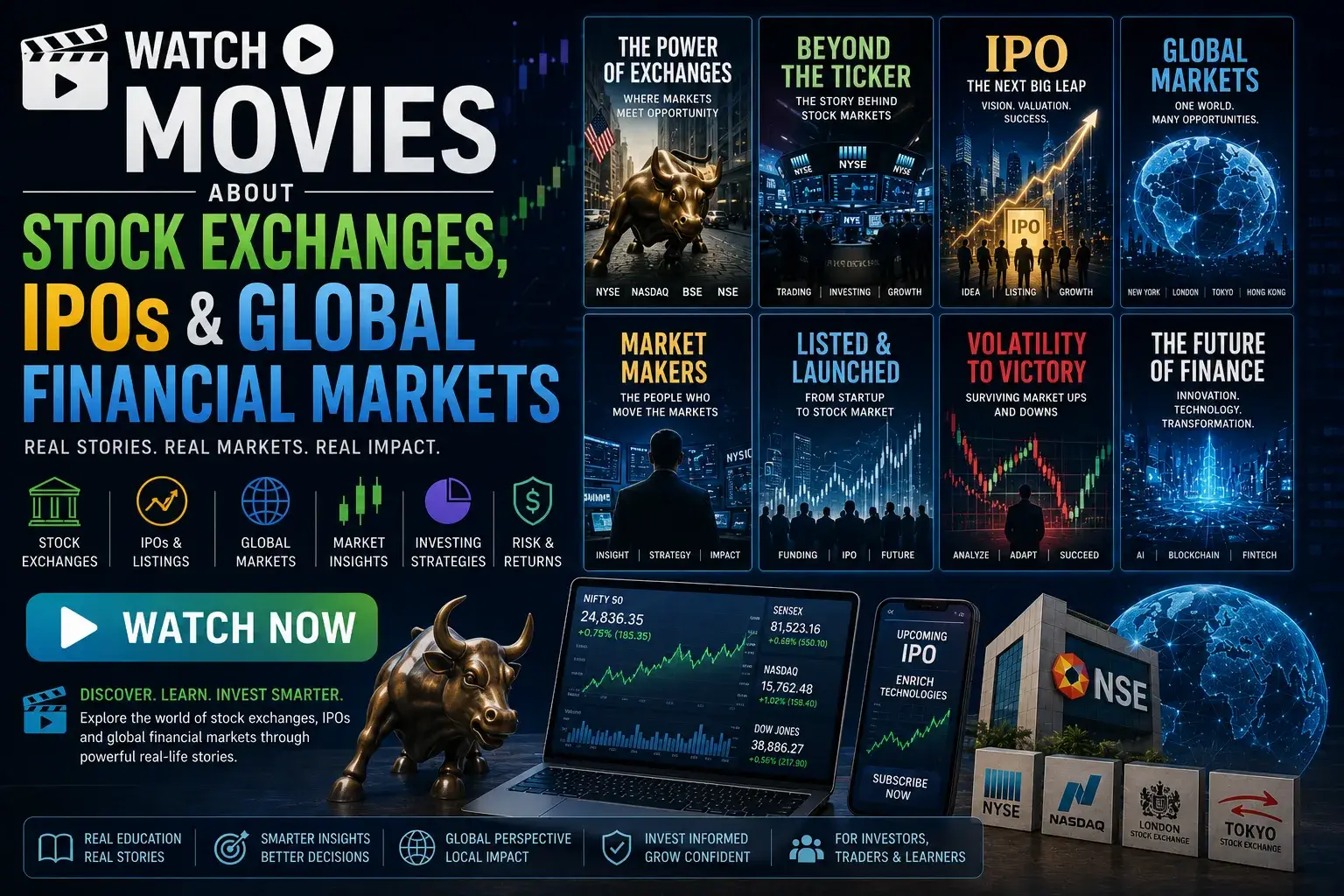
Watch Movies About Stock Exchanges, IPOs & Global Financial Markets
Stock exchanges and global financial markets are among the most important pieces of infrastructure in the modern economy. They connect companies seeking capital with investors seeking opportunities, facilitate the trading of securities, help establish market prices and provide mechanisms through which businesses and governments can raise and allocate capital.
This collection of stock exchange movies, IPO documentaries and stock market documentaries explores the history, technology and economics behind public markets. Discover educational content covering equity markets, securities trading, investment banking, initial public offerings, capital markets technology, market analytics, financial technology and investor education.
From the historic development of major exchanges to the rise of electronic trading and sophisticated financial technology, global markets have continuously evolved. Today's market infrastructure combines exchanges, brokerages, clearing organizations, custodians, banks, asset managers, market-data providers and technology platforms.
What Is a Stock Exchange?
A stock exchange is a marketplace and market infrastructure through which securities can be bought and sold according to established rules and procedures.
Public equity markets allow investors to trade shares of companies that are publicly listed. Exchanges and associated market infrastructure support price discovery, liquidity, transparency and orderly trading.
Modern exchanges are highly automated. Electronic order matching, market-data systems, surveillance technology and sophisticated connectivity allow transactions to take place at extremely high speeds.
Why Stock Exchanges Matter
Stock exchanges play an important role in capital formation. Companies can access public markets to raise capital, while investors can obtain ownership interests in publicly traded businesses.
Public markets also provide mechanisms for investors to buy and sell securities after their initial issuance.
Primary Markets vs. Secondary Markets
The primary market is where securities are initially issued to investors. The secondary market is where investors subsequently trade those securities with one another.
| Market | Purpose | Example |
|---|---|---|
| Primary Market | Raises new capital for issuers | Initial public offering or new share issuance |
| Secondary Market | Allows existing securities to be traded | Buying and selling listed shares |
| Private Market | Capital raising before or outside public listing | Private company financing |
| Capital Markets | Broader ecosystem for raising and investing capital | Equity and fixed-income markets |
What Is an IPO?
IPO stands for Initial Public Offering. It is the process through which a private company offers shares to public investors and becomes publicly traded.
An IPO can provide a company with access to a larger pool of capital and create a public market for its shares.
IPO documentaries can help viewers understand the process behind taking a company from private ownership to public-market participation.
The IPO Process
An IPO typically involves extensive preparation, financial analysis, legal work, regulatory processes, investor communication and coordination among multiple financial institutions.
Investment banks may assist with underwriting, valuation, marketing and distribution of the securities.
| IPO Stage | General Activity |
|---|---|
| Preparation | Financial, legal and operational preparation |
| Due Diligence | Review of company information and risks |
| Regulatory Process | Required filings and disclosures |
| Valuation | Assessment of company value and offering considerations |
| Marketing | Communication with prospective investors |
| Pricing | Determination of offering terms |
| Listing | Shares begin trading on a public exchange |
| Post-IPO Market | Shares trade among investors in the secondary market |
IPO Education
Understanding IPOs requires knowledge of company valuation, financial statements, capital raising, market demand, underwriting and public-company disclosure.
Educational financial documentaries can introduce these concepts without requiring viewers to have professional investment experience.
Investment Banking and IPOs
Investment banking is closely connected with capital markets and public offerings.
Investment banks can advise companies on capital raising, securities offerings, mergers and acquisitions and other corporate finance activities.
Underwriting
Underwriting is an important part of many securities offerings.
Underwriters help issuers structure and distribute securities and may coordinate with institutional investors and other market participants.
IPO Valuation
Valuation is one of the most closely watched aspects of an IPO.
Investors and financial professionals may examine revenue, profitability, growth, cash flow, competitive position, industry conditions and other factors when evaluating a company.
Valuation methodologies can include discounted cash flow analysis, comparable-company analysis and other financial modeling approaches.
Public Companies
Public companies operate under additional disclosure and governance requirements compared with privately held companies, depending on the applicable jurisdiction.
Investors can use publicly available financial information to research businesses and evaluate their financial performance.
Corporate Finance and Public Markets
Corporate finance examines how companies make decisions involving capital, investment, financing and financial strategy.
Public markets can provide companies with access to equity capital and, indirectly, broader financing opportunities.
Equity Markets
Equity markets allow investors to obtain ownership interests in companies through shares.
Equity markets include individual stocks, indexes, exchange traded funds and other investment products that provide exposure to companies and sectors.
Global Financial Markets
Global financial markets connect investors, companies and financial institutions across countries and regions.
Investors can access developed and emerging markets through a wide range of financial products and investment platforms.
Global markets are influenced by economic growth, interest rates, inflation, corporate earnings, monetary policy, geopolitical developments and investor sentiment.
Developed Markets
Developed markets generally have mature financial infrastructure, established regulatory systems and large pools of institutional and retail capital.
They include major financial centers across North America, Europe, Asia-Pacific and other regions.
Emerging Markets
Emerging markets can offer exposure to economies with developing financial systems and potentially different growth characteristics and risks.
Investors studying emerging markets need to consider currency, liquidity, political, regulatory and economic risks.
International Investing
International investing allows investors to diversify across countries and economies.
However, international markets can involve additional considerations such as currency movements, foreign regulations, taxation, market liquidity and geopolitical risk.
Market History
The history of financial markets includes periods of rapid innovation, economic expansion, financial crises, technological transformation and regulatory change.
Stock market documentaries can provide historical context for understanding how today's market infrastructure developed.
Wall Street and Financial Markets
Wall Street has become a widely recognized symbol of the financial industry and US capital markets.
Financial documentaries about Wall Street often explore investment banking, securities trading, corporate finance, asset management and market history.
Market Participants
Financial markets involve many different types of participants.
| Participant | Typical Role |
|---|---|
| Retail Investors | Individuals investing personal capital |
| Institutional Investors | Organizations managing significant investment portfolios |
| Asset Managers | Manage investment portfolios for clients |
| Brokerages | Facilitate trading and investment services |
| Investment Banks | Capital raising, advisory and securities activities |
| Market Makers | Provide liquidity under applicable market structures |
| Exchanges | Operate organized securities markets |
| Regulators | Oversee markets and enforce applicable rules |
| Custodians | Safeguard securities and support settlement processes |
| Market Data Providers | Distribute financial and market information |
Price Discovery
Price discovery is the process through which market prices emerge from interactions between buyers and sellers.
Information, expectations, liquidity and supply and demand can influence the prices at which securities trade.
Market Liquidity
Liquidity refers broadly to how easily an asset can be bought or sold without causing a substantial change in its price.
Highly liquid markets can support efficient trading and tighter transaction conditions, although liquidity can change during periods of market stress.
Market Volatility
Market volatility describes fluctuations in asset prices over time.
Volatility can increase in response to economic news, company announcements, geopolitical developments, monetary policy changes and shifts in investor expectations.
Market Risk
Market risk refers to the possibility that investments may lose value because of movements in financial markets.
Equity, interest-rate, currency and commodity markets can all contribute to investment risk.
Investment Education
Investment education helps individuals understand financial markets, investment products, portfolio construction and risk.
Educational content should emphasize research, diversification, risk awareness and long-term financial planning rather than focusing exclusively on short-term price movements.
Financial Literacy
Financial literacy includes the ability to understand financial concepts and make informed decisions about money and investments.
Stock market documentaries can be useful supplementary educational resources for learning about market terminology and financial history.
Investment Research
Investment research involves analyzing companies, markets, economic conditions and investment opportunities.
Research can incorporate financial statements, market data, industry trends, company strategy and valuation analysis.
Fundamental Analysis
Fundamental analysis examines factors such as revenue, earnings, cash flow, debt, profitability and competitive position.
Investors may use fundamental analysis to understand the financial characteristics of companies and securities.
Technical Analysis
Technical analysis studies market price and trading data to identify historical patterns and trends.
It is one analytical approach among many used by market participants.
Financial Modeling
Financial modeling uses structured assumptions and financial data to analyze potential business or investment scenarios.
Models may incorporate revenue growth, margins, capital expenditure, cash flow, financing and valuation assumptions.
Market Analytics
Market analytics uses financial data and analytical tools to understand market behavior.
Institutional investors, asset managers, financial institutions and technology companies use analytics to support research and decision-making.
Financial Data
Financial markets depend on high-quality information.
Market data can include prices, trading volumes, company fundamentals, economic indicators, corporate actions and other information.
Real-Time Market Data
Modern trading systems can process large quantities of market information in real time.
Real-time data supports trading platforms, risk systems, market analytics and investment research.
Electronic Trading
Electronic trading transformed financial markets by replacing many traditional manual processes with automated systems.
Modern markets rely heavily on electronic order routing, matching engines and data networks.
Algorithmic Trading
Algorithmic trading uses computer programs to execute trading strategies according to predefined rules.
Algorithms can process market information quickly and execute orders according to specified parameters.
Trading Technology
Financial technology has transformed the infrastructure supporting modern markets.
Trading technology includes exchange matching systems, order management systems, market-data platforms, risk engines, analytics systems and electronic connectivity.
Brokerage Technology
Online brokerage platforms have made financial markets more accessible to individual investors.
Modern brokerage technology can provide account management, market data, research tools, portfolio information and electronic trading functionality.
Investment Platforms
Digital investment platforms provide investors with access to financial products and portfolio-management services.
These platforms can include brokerage accounts, automated investment services, financial planning tools and portfolio analytics.
Exchange Traded Funds
Exchange traded funds, or ETFs, are investment funds whose shares trade on exchanges.
ETFs can provide exposure to broad market indexes, sectors, countries, commodities, bonds and other asset categories.
ETF Education
Understanding ETFs involves learning about expense ratios, tracking, diversification, liquidity, underlying assets and market pricing.
ETF education can help investors understand how exchange-traded investment vehicles fit within broader portfolio strategies.
Index Investing
Index investing seeks to provide exposure to a particular market index or benchmark.
Index strategies are widely used by both individual and institutional investors.
Portfolio Management
Portfolio management involves selecting and monitoring investments based on objectives, risk tolerance, time horizon and other considerations.
Professional portfolio managers may use sophisticated research and analytics systems to monitor portfolios and market conditions.
Asset Allocation
Asset allocation refers to how investments are distributed across asset classes.
Common asset classes include equities, fixed income, cash and other investment categories.
Portfolio Diversification
Diversification involves spreading investments across different assets, sectors, issuers or geographic regions.
It is commonly used as a risk-management concept, although diversification cannot eliminate investment losses.
Fixed Income Markets
Fixed income markets include securities such as government and corporate bonds.
Bond markets play an important role in financing governments and businesses and in constructing diversified investment portfolios.
Interest Rates and Financial Markets
Interest rates influence borrowing costs, bond valuations, corporate financing and investor behavior.
Changes in monetary policy can therefore have significant effects across financial markets.
Inflation and Investing
Inflation affects purchasing power and can influence interest rates, corporate costs, consumer behavior and asset valuations.
Understanding inflation is an important component of studying global financial markets.
Economic Indicators
Investors and financial professionals monitor economic indicators such as employment, inflation, economic growth and interest rates.
These indicators can influence expectations about financial markets and corporate performance.
Corporate Earnings
Public companies periodically report financial results to investors.
Revenue, earnings, cash flow, margins and forward expectations can influence investor perceptions and market valuations.
Financial Reporting
Financial reporting provides information about a company's financial performance and position.
Investors can use financial reports as part of broader research and analysis.
Corporate Governance
Corporate governance concerns how companies are directed, managed and overseen.
Boards, executives, shareholders and other stakeholders can have different responsibilities and interests within corporate governance structures.
Investor Relations
Investor relations involves communication between public companies and investors.
Investor communications can include financial results, corporate presentations, earnings discussions and other disclosures.
Capital Markets
Capital markets connect businesses, governments and investors through mechanisms for raising and investing capital.
Equity and fixed-income markets are major components of the global capital-market ecosystem.
Securities Markets
Securities markets allow financial instruments to be issued and traded.
These markets support capital formation, investment and risk management across the global economy.
Financial Technology
FinTech has transformed brokerage, trading, payments, investment management and market infrastructure.
Cloud computing, artificial intelligence, data analytics and automation are increasingly used throughout financial services.
Capital Markets Technology
Capital markets technology supports trading, settlement, risk management, compliance, market data and portfolio management.
Financial institutions rely on high-performance technology to process large quantities of transactions and information.
Financial Analytics
Financial analytics transforms market and financial information into insights that can support investment research, risk management and portfolio decisions.
Analytics platforms can combine market data, company fundamentals, economic indicators and portfolio information.
Market Surveillance
Market surveillance uses technology and analytical processes to identify potentially unusual trading activity.
Surveillance is an important part of maintaining orderly and trustworthy financial markets.
Financial Regulation
Financial markets operate within regulatory frameworks designed to promote market integrity, transparency and investor protection.
Regulatory requirements vary by jurisdiction and financial product.
Market Infrastructure
Behind every modern securities transaction is a complex network of infrastructure.
Exchanges, clearing organizations, settlement systems, custodians, brokerages, banks and technology providers work together to support the financial system.
Clearing and Settlement
After a securities trade is executed, clearing and settlement processes help ensure that the transaction is completed appropriately.
These processes are critical to the stability and efficiency of financial markets.
Custody and Asset Servicing
Custodians safeguard financial assets and provide services supporting institutional investors and asset managers.
Technology is increasingly used to automate custody, reconciliation, reporting and asset servicing processes.
Institutional Investing
Institutional investors include organizations such as pension funds, asset managers, insurance companies and other large investment entities.
Institutional investors can use sophisticated research, portfolio analytics and risk-management systems.
Retail Investing
Retail investing refers to investment activity by individual investors.
Online brokerage platforms, educational resources and digital investment technology have increased access to market information and investment services.
Long-Term Investing
Long-term investing focuses on maintaining an investment strategy over an extended period rather than attempting to predict every short-term market movement.
Time horizon, diversification, costs and risk management are important concepts in long-term portfolio planning.
Value and Growth Investing
Value investing generally focuses on companies believed to trade below estimates of their underlying value, while growth investing focuses more heavily on companies expected to grow earnings or revenue significantly.
Both approaches involve different assumptions and risks.
Dividend Investing
Dividend-paying companies distribute part of their earnings or available cash to shareholders according to their policies.
Investors studying dividend strategies may evaluate dividend sustainability, cash flow, profitability and valuation.
Investment Risk
Every investment involves some degree of risk.
Market risk, company-specific risk, liquidity risk, interest-rate risk, currency risk and other factors can affect investment outcomes.
Risk Management
Financial risk management helps organizations and investors identify, measure and manage financial exposures.
Professional financial institutions use risk systems to monitor market, credit, liquidity and operational risks.
Global Market Connections
Financial markets are increasingly interconnected.
A development in one major economy can influence currencies, commodities, interest rates, equity markets and investor sentiment elsewhere.
Why Watch Stock Market Documentaries?
Stock market documentaries can turn complex financial concepts into accessible stories.
They can explore market history, corporate finance, investment banking, financial crises, technology, entrepreneurship and the people who built or participated in modern financial markets.
Rather than viewing financial markets only as daily price charts, documentaries can help explain the institutions, technologies and economic forces behind those prices.
Who Should Watch Financial Market Movies?
This educational content can be useful for investors, finance students, business professionals, entrepreneurs, technology professionals and anyone interested in the global economy.
It can also provide useful introductory context for people exploring careers in investment banking, asset management, equity research, financial technology, portfolio management, financial analytics, securities trading and capital markets.
Key Stock Exchange and IPO Topics
| Topic | Key Concepts |
|---|---|
| Stock Exchanges | Listings, trading, liquidity and market infrastructure |
| IPOs | Public offerings, underwriting, valuation and capital raising |
| Equity Markets | Stocks, indexes and public-company ownership |
| Capital Markets | Equity and fixed-income financing |
| Market Technology | Electronic trading, analytics and market-data systems |
| Investment Research | Fundamental analysis, valuation and financial modeling |
| Portfolio Management | Asset allocation, diversification and risk management |
| Global Markets | Developed markets, emerging markets and international investing |
How to Learn Financial Markets Through Movies
A useful approach is to begin with financial-market fundamentals and then explore more specialized subjects.
Start with stock exchanges and market history. Then explore IPOs, investment banking and corporate finance. After that, investigate portfolio management, ETFs, market analytics, trading technology and global markets.
From Physical Trading Floors to Electronic Markets
Financial markets have undergone a major technological transformation.
Traditional trading floors once played a prominent role in securities markets. Today, electronic systems handle a substantial amount of trading activity through automated order routing, matching and market-data infrastructure.
From Paper Certificates to Digital Assets
Financial markets have moved from physical certificates and manual records toward highly digitized systems.
Modern securities ownership, trading and settlement depend heavily on electronic databases and financial technology.
From Local Exchanges to Global Markets
Investors can now access financial markets across multiple countries through digital brokerage and investment platforms.
This connectivity has expanded investment opportunities while also increasing the importance of understanding international market and currency risks.
From Manual Research to Financial Analytics
Modern investment research uses large datasets, financial software and analytics platforms.
Technology can help professionals analyze companies, portfolios, markets and economic indicators more efficiently.
The Future of Stock Exchanges
Stock exchanges are likely to continue investing in cloud infrastructure, automation, cybersecurity, market analytics and advanced trading technology.
Operational resilience and secure market infrastructure will remain essential as financial markets become increasingly digital.
The Future of IPOs
Technology continues to transform how companies communicate with investors and manage the public-listing process.
Data analytics and digital investor-relations tools can help companies understand market participants and improve financial communication.
The Future of Financial Markets
The future of global financial markets will likely be shaped by artificial intelligence, cloud computing, automation, advanced analytics, digital assets and continued improvements in market infrastructure.
At the same time, financial institutions will need to maintain strong cybersecurity, regulatory compliance, operational resilience and risk management.
Questions to Explore While Watching
| Question | Why It Matters |
|---|---|
| How does a stock exchange work? | Explains the infrastructure behind public securities trading |
| How does an IPO raise capital? | Connects companies with public investors |
| How are stock prices discovered? | Introduces supply, demand, information and liquidity |
| Why do markets become volatile? | Explains changing expectations and financial risk |
| How does technology affect trading? | Explores electronic and algorithmic market infrastructure |
| How do investors research companies? | Introduces financial statements, valuation and market research |
| How are portfolios managed? | Connects asset allocation, diversification and risk |
| How are global markets connected? | Explains international financial relationships |
Stock Exchanges, IPOs & Global Financial Markets Education
Stock exchanges are much more than places where shares change hands. They are part of a sophisticated financial ecosystem that supports capital formation, investment, price discovery and economic growth.
IPOs connect private companies with public investors. Equity markets provide ownership opportunities. Investment banks support capital raising. Brokerages connect investors with markets. Asset managers construct portfolios. Financial technology companies build the infrastructure that allows these systems to operate at enormous scale.
Financial documentaries can make these complex systems easier to understand by connecting market concepts with real-world stories. Exploring stock exchange history can reveal how financial markets evolved. IPO documentaries can explain how companies transition into public ownership. Market technology documentaries can show how electronic trading and financial analytics transformed the industry.
For investors and students, these topics provide a foundation for understanding equity markets, capital markets, investment research, portfolio management, financial technology, market analytics and global financial markets.
Whether you are interested in investment banking, financial technology, asset management, corporate finance, securities trading or financial education, exploring the history and technology of public markets can provide valuable context.
Watch, learn and explore the people, technology and financial systems shaping global markets.
Educational notice: This content is provided for general educational and informational purposes and does not constitute investment, financial, tax or legal advice. Financial markets involve risk, and investment outcomes are not guaranteed. Investors should conduct appropriate research and consider consulting qualified financial professionals for advice based on their individual circumstances.