If you are looking for a simple, safe and completely free way to enjoy movies and series on your cell phone, tablet or TV, Tubi – Free Movies and Series stands out as one of the best options available in 2026 . With an impressive collection, a clean interface, and support for Portuguese subtitles, the app offers access to thousands of titles free of charge. And best of all, it's available for direct download from the official stores:

Tubi: Free Movies & Live TV
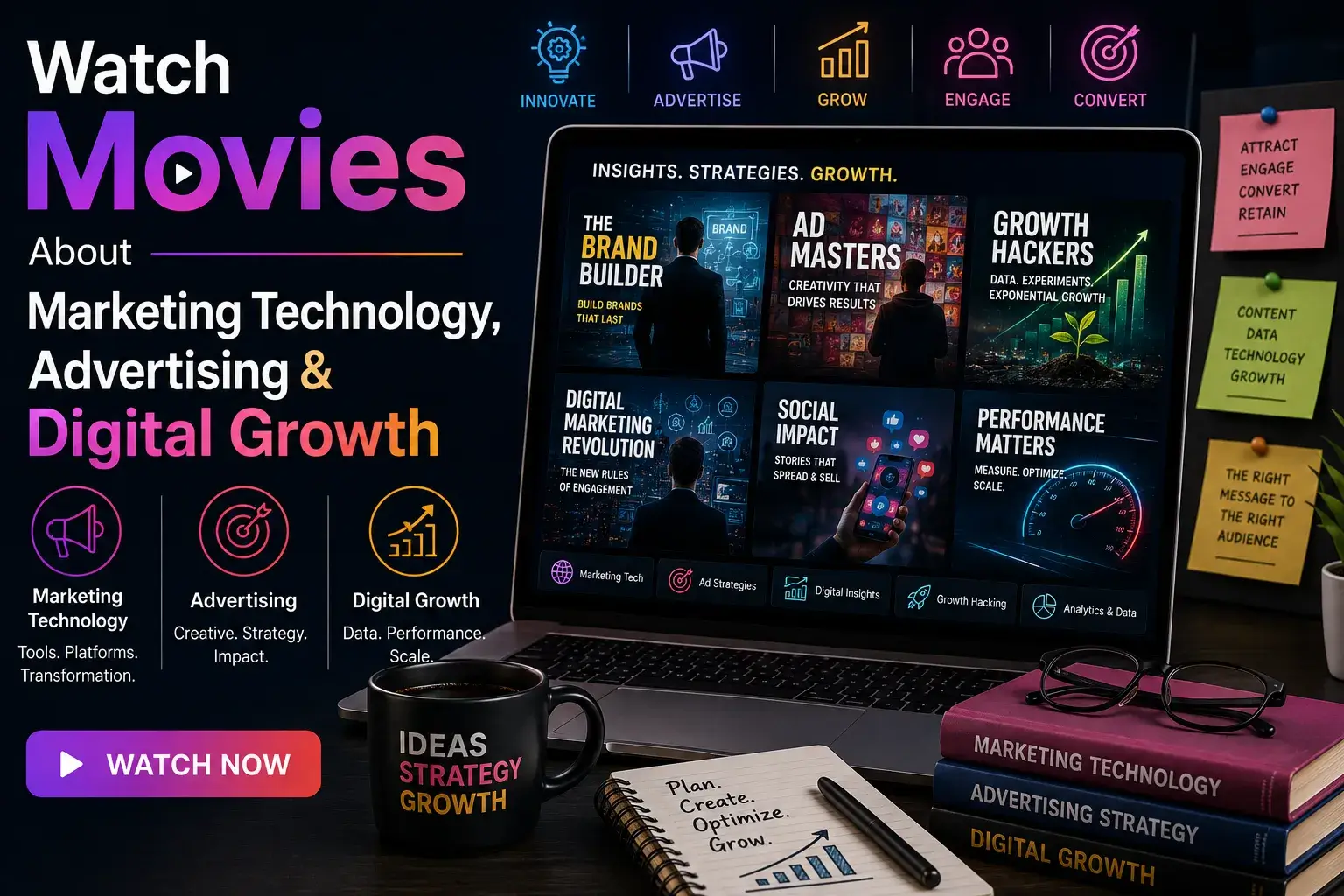
Watch Movies About Marketing Technology, Advertising & Digital Growth
Marketing has evolved from traditional advertising into a technology-driven business discipline. Modern organizations use marketing platforms, advertising technology, customer data, analytics, artificial intelligence, automation and digital channels to attract customers, build brands and generate measurable business growth.
This collection of marketing movies, advertising documentaries and digital marketing documentaries explores the technology behind modern customer acquisition. Discover educational content covering MarTech, AdTech, digital advertising, programmatic media buying, SEO, marketing automation, customer analytics, conversion optimization, email marketing, AI marketing and business growth.
Whether you are interested in advertising platforms, marketing software, search engine optimization, customer acquisition, performance marketing or emerging artificial intelligence technology, these topics provide a broader understanding of how modern marketing operates.
What Is Marketing Technology?
Marketing technology, commonly called MarTech, refers to software and technology used to plan, execute, measure and optimize marketing activities.
Modern marketing technology can include customer relationship management systems, marketing automation, customer data platforms, analytics software, email marketing tools, content management systems, advertising platforms and artificial intelligence applications.
Instead of managing every campaign manually, organizations can use integrated technology to collect information, segment audiences, personalize experiences, automate communication and measure business outcomes.
What Is Advertising Technology?
Advertising technology, or AdTech, refers to the software and infrastructure used to buy, sell, deliver, measure and optimize digital advertising.
AdTech can include demand-side platforms, supply-side platforms, ad exchanges, advertising networks, measurement systems, identity technologies and audience management solutions.
The advertising ecosystem allows businesses to reach relevant audiences across websites, mobile applications, search engines, social platforms, streaming services and other digital environments.
MarTech and AdTech
MarTech and AdTech increasingly overlap.
MarTech generally focuses on customer relationships and marketing operations, while AdTech is heavily focused on digital advertising and media transactions.
| Area | Primary Purpose |
|---|---|
| MarTech | Marketing operations, customer engagement and lifecycle management |
| AdTech | Digital advertising buying, selling and delivery |
| CRM | Customer relationship management |
| CDP | Customer data unification |
| Analytics | Performance measurement and business intelligence |
| Marketing Automation | Automating repetitive marketing workflows |
| SEO | Improving organic search visibility |
Digital Marketing
Digital marketing uses internet-connected channels to promote products, services and brands.
Important channels include search engines, websites, email, social media, online advertising, video platforms, content marketing and digital marketplaces.
Digital marketing gives businesses the ability to measure campaign activity and connect marketing efforts with customer actions.
Performance Marketing
Performance marketing emphasizes measurable outcomes such as leads, purchases, subscriptions, applications or other business actions.
Advertisers can use performance data to optimize campaigns, audiences, creative assets and landing pages.
Customer Acquisition
Customer acquisition is the process of attracting and converting new customers.
Technology can help organizations identify potential audiences, deliver targeted messages, capture leads, automate follow-up and measure acquisition costs.
Customer Acquisition Cost
Customer acquisition cost, commonly called CAC, measures how much a business spends to acquire customers.
Understanding CAC alongside customer lifetime value can help businesses evaluate whether acquisition strategies are economically sustainable.
Customer Lifetime Value
Customer lifetime value, or CLV, estimates the economic value of a customer over the relationship with a business.
Businesses can use customer lifetime value to evaluate acquisition channels, retention strategies and customer segments.
Marketing Funnels
A marketing funnel represents stages that potential customers may move through before and after making a purchase.
Typical stages include awareness, consideration, conversion, retention and advocacy.
Marketing technology can help businesses measure customer movement through each stage.
Lead Generation
Lead generation involves attracting potential customers and collecting information that allows a business to continue the relationship.
Lead-generation technology can include landing pages, forms, content offers, webinars, advertising campaigns and automated qualification workflows.
B2B Lead Generation
B2B organizations often have longer purchasing cycles and multiple decision-makers.
Marketing automation, CRM systems and account-based marketing technology can help B2B organizations coordinate lead generation and customer engagement.
Account-Based Marketing
Account-Based Marketing, or ABM, focuses marketing resources on specific companies or strategic accounts.
ABM technology can combine account data, advertising, content, sales activity and engagement analytics.
Marketing Automation
Marketing automation allows businesses to automate repetitive customer communication and marketing processes.
Examples include email sequences, lead nurturing, audience segmentation, campaign workflows, customer onboarding and re-engagement campaigns.
Lead Nurturing
Not every prospect is ready to purchase immediately.
Lead nurturing uses relevant communication to educate prospects and maintain engagement throughout the buying journey.
Email Marketing
Email marketing remains an important digital communication channel for businesses.
Modern email platforms can support segmentation, automation, personalization, transactional messages and campaign analytics.
Email Automation
Email automation can trigger messages based on customer behavior or lifecycle events.
Examples include welcome emails, abandoned-cart reminders, onboarding sequences, renewal reminders and post-purchase communication.
Customer Relationship Management
CRM software stores and manages information about customers and prospects.
CRM systems can provide sales and marketing teams with a shared view of customer interactions, opportunities and communication history.
Customer Data Platforms
A Customer Data Platform, or CDP, is designed to unify customer information from multiple sources.
Organizations can use customer data platforms to support segmentation, personalization, analytics and marketing activation.
Marketing Analytics
Marketing analytics transforms campaign and customer data into insights.
Analytics can help businesses understand traffic, leads, conversions, acquisition costs, revenue contribution and campaign performance.
Marketing Attribution
Marketing attribution attempts to understand how different marketing touchpoints contribute to customer outcomes.
Attribution can become complex because customers may interact with multiple advertisements, search results, emails, websites and other channels before converting.
Marketing ROI
Marketing teams increasingly need to demonstrate measurable business value.
Marketing ROI analysis can compare campaign costs with revenue or other measurable business outcomes.
Return on Advertising Spend
ROAS is a commonly used advertising performance metric that compares advertising revenue with advertising expenditure.
Businesses should evaluate ROAS alongside margins, customer lifetime value and other financial metrics rather than treating one metric as a complete measure of business success.
Search Engine Optimization
Search Engine Optimization, or SEO, involves improving the visibility and usefulness of websites in organic search results.
SEO can include technical optimization, content quality, information architecture, internal linking, structured information and user experience.
Technical SEO
Technical SEO focuses on the technical characteristics that influence how search engines discover, understand and access websites.
Important areas can include website performance, crawlability, indexation, mobile usability, site architecture and structured data.
Enterprise SEO
Enterprise SEO involves managing organic search across large websites with extensive content and potentially thousands or millions of pages.
Enterprise SEO teams often rely on automation, analytics and specialized SEO platforms to identify technical issues and opportunities.
Content Marketing
Content marketing uses useful and relevant content to attract audiences and support customer relationships.
Content may include articles, documentaries, videos, research reports, guides, case studies, newsletters and educational resources.
Search Engine Marketing
Search engine marketing can include paid search advertising designed to reach users when they search for relevant products, services or information.
Search advertising allows businesses to connect marketing campaigns with specific search intent.
Social Media Marketing
Social media provides businesses with channels for brand awareness, customer engagement, content distribution and advertising.
Social advertising platforms can use audience signals and campaign performance data to optimize delivery.
Video Advertising
Video advertising is used across websites, mobile applications, streaming platforms and social networks.
Video can combine visual storytelling with measurable digital campaign technology.
Display Advertising
Display advertising uses visual ad formats across digital properties.
Modern display advertising can use automated buying, audience targeting, contextual signals and performance measurement.
Programmatic Advertising
Programmatic advertising uses automated technology to buy and sell digital advertising inventory.
Programmatic infrastructure can evaluate advertising opportunities and make automated decisions based on campaign objectives and available signals.
Demand-Side Platforms
A Demand-Side Platform, or DSP, helps advertisers purchase digital advertising inventory through automated systems.
DSP technology can support audience selection, bidding, campaign management and performance reporting.
Supply-Side Platforms
A Supply-Side Platform, or SSP, helps publishers manage and monetize digital advertising inventory.
SSP technology can connect publishers with demand sources and provide tools for inventory management and yield optimization.
Ad Exchanges
Ad exchanges facilitate automated buying and selling of digital advertising inventory.
They form part of the infrastructure connecting publishers, advertisers and advertising technology platforms.
Advertising Measurement
Digital advertising generates large volumes of performance data.
Advertising measurement can include impressions, clicks, conversions, viewability, engagement, cost and revenue-related metrics.
Audience Segmentation
Audience segmentation divides customers or prospects into groups based on characteristics, behaviors or business attributes.
Segmentation can help businesses create more relevant marketing experiences.
Personalization Technology
Personalization systems can tailor content, offers, recommendations and communications based on customer signals.
Responsible personalization requires appropriate data governance and respect for customer privacy.
First-Party Data
First-party data is information collected directly by an organization through its own customer interactions and digital properties.
As privacy expectations and platform policies evolve, first-party data strategies have become increasingly important for marketers.
Privacy and Consent Management
Modern marketing systems must consider data privacy and consent requirements.
Consent management technology can help organizations record and manage user choices regarding certain data collection and marketing activities.
Identity Resolution
Identity resolution involves connecting information that may belong to the same customer across different interactions and systems.
Accurate identity management can improve customer experiences while requiring strong privacy and security controls.
Retail Media
Retail media allows retailers and commerce platforms to provide advertising opportunities using their digital properties and customer relationships.
Retail media has become an important intersection between ecommerce, advertising and customer data.
Connected TV Advertising
Connected TV advertising brings digital advertising capabilities to internet-connected television environments.
It combines the reach of television-style video with digital measurement and technology infrastructure.
Marketing Artificial Intelligence
Artificial intelligence is changing marketing technology.
AI systems can support customer segmentation, predictive analytics, content generation, campaign optimization, recommendation systems, customer service and marketing intelligence.
Generative AI in Marketing
Generative AI can assist marketers with content drafts, campaign concepts, product descriptions, customer communication and data summarization.
Human review remains important to maintain accuracy, brand consistency, originality and responsible use of customer information.
AI Advertising
AI can analyze large datasets and identify patterns that may be difficult to detect manually.
Advertising platforms can use machine learning to support audience selection, bidding, creative optimization and campaign performance.
Predictive Analytics
Predictive analytics uses historical information and statistical or machine-learning techniques to estimate future outcomes.
Marketing applications can include customer churn prediction, lead scoring, purchase propensity and demand forecasting.
Marketing Intelligence
Marketing intelligence combines data and analysis to help organizations understand markets, customers and competitive environments.
Business intelligence and marketing intelligence systems can provide dashboards and reports for strategic decision-making.
Conversion Rate Optimization
Conversion Rate Optimization, or CRO, focuses on improving the percentage of users who complete important actions.
These actions can include purchasing a product, submitting a lead form, starting a subscription or requesting a consultation.
Landing Page Optimization
Landing pages connect advertising campaigns with customer experiences.
Businesses can test messaging, page structure, calls to action, forms and other elements to improve conversion performance.
A/B Testing
A/B testing compares different versions of a digital experience to determine which performs better according to a predefined metric.
Testing can be used for landing pages, emails, advertisements, checkout flows and other customer experiences.
Growth Marketing
Growth marketing focuses on continuously testing and improving the customer lifecycle.
Growth teams can evaluate acquisition, activation, retention, referral and revenue opportunities.
Demand Generation
Demand generation focuses on creating awareness and interest in a company's products or services.
It can combine content marketing, SEO, advertising, events, social media and other channels.
Sales Enablement
Marketing technology can support sales teams by providing customer insights, content, lead information and engagement history.
Sales enablement platforms can help organizations coordinate marketing and sales activities.
Revenue Operations
Revenue Operations, or RevOps, brings together processes, data and technology across marketing, sales and customer success.
The objective is to create better alignment around revenue generation and customer lifecycle management.
Marketing Operations
Marketing operations teams manage the systems and processes that support marketing organizations.
This can include technology administration, data management, campaign workflows, reporting, integrations and governance.
Marketing Technology Integration
Modern organizations often use dozens of marketing applications.
Integration technology helps connect CRM, advertising platforms, analytics, email systems, customer data platforms and business intelligence tools.
| Technology | Typical Marketing Function |
|---|---|
| CRM | Customer and prospect management |
| CDP | Customer data unification |
| Marketing Automation | Campaign and lifecycle workflows |
| Analytics | Performance measurement |
| DSP | Programmatic advertising purchases |
| SEO Platform | Organic search optimization |
| Email Platform | Email communication and automation |
| BI Platform | Business reporting and decision support |
Marketing Dashboards
Marketing dashboards provide centralized views of campaign and business performance.
Executives may monitor acquisition costs, revenue contribution, conversion rates, customer growth and marketing efficiency.
Campaign Management
Campaign management technology helps marketers plan, launch and monitor marketing initiatives.
Modern systems can coordinate audiences, creative assets, channels, budgets and performance reporting.
Media Planning
Media planning involves determining where and how advertising budgets should be allocated.
Digital media planning can consider audience reach, cost, performance, customer intent and campaign objectives.
Media Buying
Media buying is the process of acquiring advertising placements.
Technology has transformed media buying from largely manual processes into increasingly automated systems.
Advertising Optimization
Advertising optimization uses campaign performance data to improve targeting, bidding, creative and budget allocation.
Automated systems can evaluate large numbers of advertising opportunities and adjust campaign parameters based on defined objectives.
Content Distribution
Creating content is only one part of digital marketing.
Businesses also need distribution strategies that connect useful content with relevant audiences through search, social media, email, advertising and other channels.
Influencer Marketing
Influencer marketing uses creators and online personalities to communicate with audiences.
Technology platforms can help businesses discover creators, manage campaigns, track engagement and measure performance.
Affiliate Marketing
Affiliate marketing uses third-party partners to promote products or services in exchange for performance-based compensation under agreed arrangements.
Affiliate technology can track referrals, conversions and commissions.
E-Commerce Marketing
Ecommerce marketing combines acquisition, conversion and retention strategies for online commerce.
It can include paid advertising, SEO, email marketing, social commerce, personalization, loyalty programs and customer analytics.
SaaS Marketing
SaaS businesses often use digital channels to acquire customers and communicate product value.
Marketing technology can support free trials, product-led growth, lead nurturing, lifecycle messaging and subscription retention.
Enterprise Marketing Technology
Large organizations require marketing systems that can manage complex teams, markets, brands, customer segments and regulatory requirements.
Enterprise marketing technology often includes advanced integrations, governance, security, analytics and workflow automation.
Marketing Data Governance
As marketing systems collect and process more information, data governance becomes increasingly important.
Organizations need appropriate controls around data quality, access, security, retention, privacy and responsible usage.
Cybersecurity in Marketing Technology
Marketing platforms can contain valuable customer and business information.
Security practices such as strong authentication, role-based access, monitoring and secure integrations can help reduce operational risk.
Digital Marketing Education
Marketing documentaries can provide context for understanding how advertising evolved from traditional media into data-driven digital ecosystems.
They can also demonstrate how technology changed customer acquisition, advertising measurement and business growth.
Why Watch Marketing and Advertising Documentaries?
Marketing documentaries can connect business strategy with real-world technology.
Instead of learning only individual marketing concepts, viewers can explore how advertising platforms, customer data, creative strategy, analytics and business economics interact.
Technology-focused videos can also help viewers understand why modern marketing increasingly depends on software, data infrastructure and automation.
Who Should Watch These Movies?
This collection can be useful for digital marketers, advertising professionals, entrepreneurs, startup founders, business owners, marketing managers, product managers, sales professionals, technology professionals, students and anyone interested in digital business.
It can also provide useful background for people exploring careers in MarTech, AdTech, SEO, marketing analytics, advertising operations, performance marketing, CRM, customer data, marketing automation and AI marketing.
Key Marketing Technology Topics to Explore
| Topic | What You Can Learn |
|---|---|
| MarTech | How software supports modern marketing operations |
| AdTech | How digital advertising ecosystems operate |
| SEO | How businesses build organic search visibility |
| Marketing Automation | How repetitive customer workflows are automated |
| Analytics | How marketing performance is measured |
| AI Marketing | How artificial intelligence supports marketing decisions |
| Customer Data | How organizations manage customer information |
| Growth Marketing | How companies optimize acquisition and retention |
The Future of Marketing Technology
The future of marketing will likely involve deeper integration between artificial intelligence, customer data, advertising platforms, analytics and automation.
AI-powered systems may increasingly assist marketers with research, segmentation, content creation, campaign optimization and customer service.
The Future of Advertising
Advertising technology continues to evolve as consumers use multiple devices and digital channels.
Advertisers increasingly need measurement systems that balance performance, privacy, transparency and customer trust.
The Future of Search
Search behavior is changing as users interact with conversational interfaces, AI systems and increasingly sophisticated search experiences.
Businesses will need to continue producing useful, accurate and accessible information while adapting to changing discovery technologies.
The Future of Customer Acquisition
Customer acquisition is moving toward increasingly data-driven and automated processes.
Organizations can combine advertising, content, CRM, analytics and AI to create more connected customer journeys.
The Future of Marketing Analytics
Marketing analytics is moving beyond basic reporting toward predictive and decision-support systems.
Future platforms may increasingly identify trends, forecast outcomes and recommend actions automatically.
The Importance of Human Creativity
Technology can automate many marketing processes, but creativity remains central to effective communication.
Brand positioning, storytelling, customer empathy and strategic thinking require human judgment.
The strongest marketing organizations are likely to combine AI and automation with human creativity, ethical decision-making and strong customer understanding.
How to Learn Marketing Through Movies
Start with documentaries about the history of advertising and the evolution of digital media.
Then explore specialized subjects such as programmatic advertising, SEO, marketing automation, customer analytics and digital transformation.
For viewers interested in emerging technology, explore AI marketing, generative AI, predictive analytics, personalization and automated campaign optimization.
From Traditional Advertising to Digital Advertising
Traditional advertising relied heavily on broad media channels and audience research.
Digital advertising introduced new capabilities for measurement, audience segmentation, automated buying and campaign optimization.
This transformation created an enormous technology ecosystem around digital media.
From Campaigns to Customer Journeys
Modern marketing increasingly focuses on the complete customer journey rather than individual advertisements.
Organizations can connect awareness, consideration, conversion, onboarding, retention and advocacy using integrated marketing technology.
From Data to Intelligence
Marketing platforms generate enormous quantities of data.
Analytics and AI can transform that data into insights that support decisions about customers, campaigns, products and business growth.
From Manual Marketing to Automation
Marketing automation allows businesses to scale communication and workflows without manually performing every task.
Automation can improve consistency and efficiency while allowing marketing teams to focus more attention on strategy and creative work.
Responsible Digital Marketing
Technology provides powerful marketing capabilities, but responsible use is essential.
Businesses should consider privacy, transparency, security, accurate communication, consent and appropriate use of customer data when designing marketing systems.
Explore Marketing Technology, Advertising & Digital Growth
Modern marketing sits at the intersection of technology, advertising, data, creativity and business strategy.
From MarTech and AdTech to SEO, programmatic advertising, marketing automation, customer analytics, AI marketing and conversion optimization, technology continues to reshape how organizations find, understand and serve customers.
Explore documentaries and educational videos covering marketing technology, advertising technology, digital advertising, SEO, marketing automation, customer acquisition, analytics, AI, business growth and digital transformation.
Whether you are a marketer, entrepreneur, technology professional, business owner, student or advertising enthusiast, these topics provide valuable insight into the systems driving modern digital growth.
Watch, learn and explore the technology shaping the future of marketing and advertising.
Educational notice: This content is provided for general informational and educational purposes. Marketing, advertising, privacy, technology and business decisions should be evaluated according to applicable laws, platform policies, contractual requirements and professional guidance.