If you are looking for a simple, safe and completely free way to enjoy movies and series on your cell phone, tablet or TV, Tubi – Free Movies and Series stands out as one of the best options available in 2026 . With an impressive collection, a clean interface, and support for Portuguese subtitles, the app offers access to thousands of titles free of charge. And best of all, it's available for direct download from the official stores:

Tubi: Free Movies & Live TV
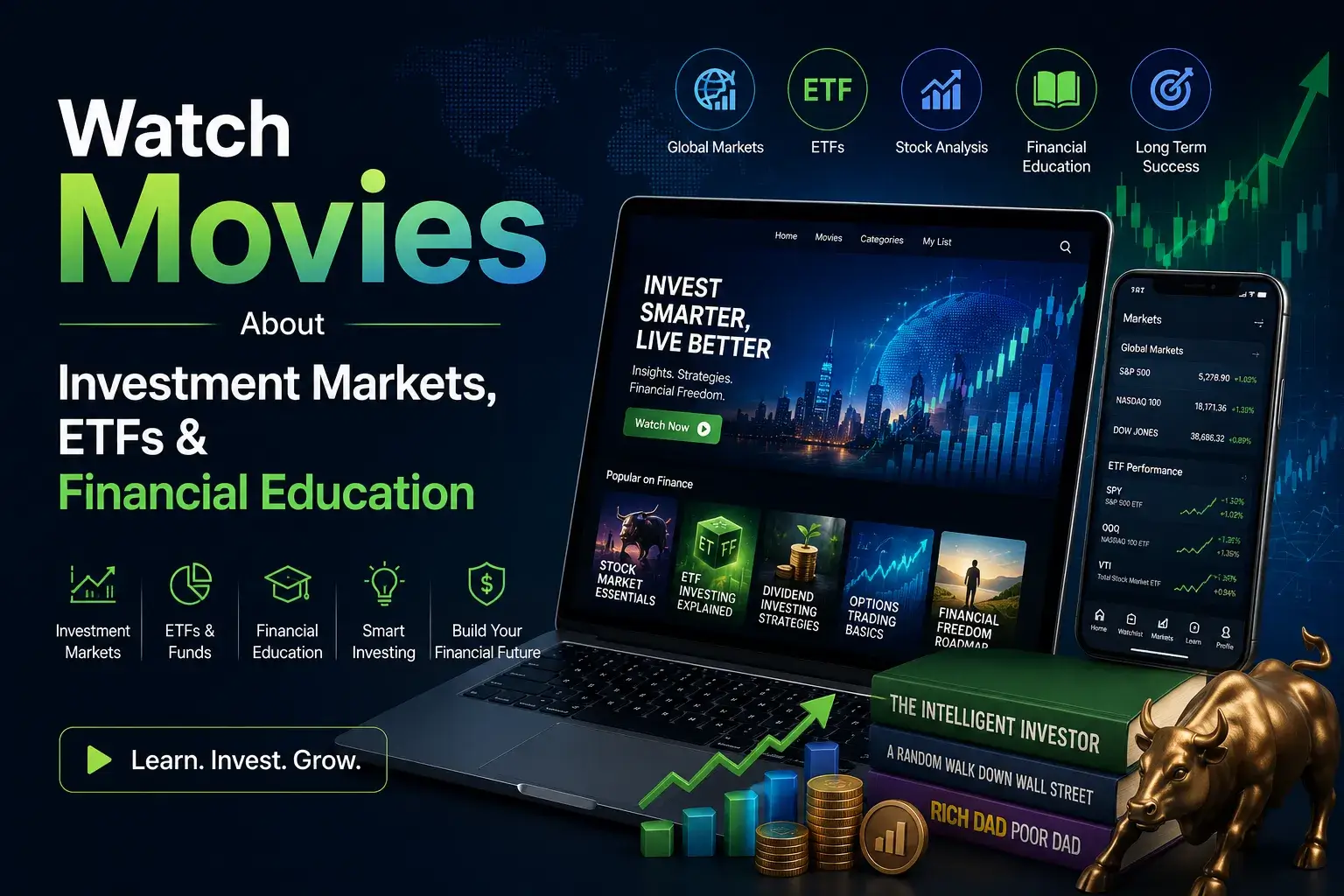
Watch Movies About Investment Markets, ETFs & Financial Education
Investment markets influence businesses, governments, retirement plans, financial institutions and millions of individual investors around the world. From publicly traded companies and government bonds to exchange traded funds, index funds and modern digital investment platforms, today's financial markets connect capital with businesses and investment opportunities across global economies.
Our collection of investment movies, investment documentaries and financial education videos explores the systems, strategies, technologies and economic principles behind modern investing. Learn about stock markets, ETFs, bonds, portfolio management, asset allocation, investment research, financial analytics, market data, wealth management technology and the evolution of digital investing.
Investment documentaries can make complex financial concepts easier to understand by placing market events, investment strategies and financial technology into a broader historical and economic context. They can also help viewers understand the difference between an investment product and an investment strategy, why diversification matters, how market prices are formed and how technology is transforming the investment industry.
Why Watch Investment Market Documentaries?
Financial markets can appear complicated because they involve economics, business performance, investor behavior, monetary policy, interest rates, technology and global events.
Documentaries provide an engaging way to explore these topics without limiting financial education to technical textbooks.
A high-quality investment documentary may explain how stock exchanges operate, why companies issue shares, how bonds work, how ETFs track indexes, how institutional investors manage portfolios and how technology has changed access to financial markets.
For students, these videos can provide useful background before studying finance more formally. For entrepreneurs, understanding capital markets can provide insight into how businesses raise capital. For technology professionals, investment technology demonstrates how data, analytics, automation and software are being applied to financial services.
Documentaries should be treated as educational resources rather than personalized investment recommendations. Financial markets involve risk, and investment decisions should be based on appropriate research and individual circumstances.
What Are Financial Markets?
Financial markets are systems where financial assets can be issued, bought and sold.
Major financial markets include equity markets, bond markets, foreign exchange markets and markets for commodities and other financial instruments.
These markets help direct capital between investors, businesses and governments.
Companies can access capital to fund expansion, research, acquisitions and operations. Governments can issue debt to finance public spending. Investors can obtain exposure to different asset classes based on their objectives and risk tolerance.
How Stock Markets Work
Stock markets provide organized venues and electronic systems through which shares of publicly traded companies can be bought and sold.
When an investor purchases a share, the investor obtains an ownership interest in the company, subject to the characteristics of the specific security.
Stock prices can change because of company earnings, expectations about future growth, interest rates, economic conditions, investor sentiment, market liquidity and other factors.
Investment documentaries often examine major market cycles to demonstrate how these factors can interact.
Equity Markets
Equity markets are an important component of global capital markets.
Public companies can use equity markets to raise capital, while investors can gain exposure to businesses across sectors and geographic regions.
Equity investing can involve significant price fluctuations. Historical performance does not guarantee future results.
Understanding company fundamentals, valuation, industry conditions and market risks can help investors develop a more informed understanding of equity markets.
Stock Market Education
Stock market education covers the fundamentals required to understand publicly traded securities.
Important concepts include market capitalization, earnings, revenue, profitability, dividends, valuation, liquidity, volatility and risk.
Investors may also study financial statements and company filings to better understand the businesses behind publicly traded securities.
Educational videos can introduce these concepts before viewers move toward more detailed financial research.
Exchange Traded Funds
Exchange traded funds, commonly called ETFs, are investment funds whose shares trade on exchanges.
Many ETFs are designed to track an index, sector, asset class or investment strategy, although ETF structures and objectives vary significantly.
ETFs can provide investors with exposure to a diversified group of securities through a single traded vehicle.
The structure, costs, holdings, tracking methodology, liquidity and risks of an ETF should be reviewed before making an investment decision.
ETF Education
ETF education involves understanding how funds are structured, what they hold and how their prices behave in the market.
Important ETF concepts include expense ratios, tracking differences, bid-ask spreads, liquidity, assets under management, index methodology and portfolio composition.
Some ETFs track broad market indexes, while others focus on sectors, regions, bonds, commodities or specific investment themes.
Index Funds
Index funds seek to provide investment exposure that follows a particular market index or benchmark.
Index investing is commonly associated with passive investment strategies, where the objective is to track a benchmark rather than actively select securities to outperform it.
Index funds can be structured as mutual funds or ETFs.
Understanding the benchmark is essential because an index fund's characteristics depend heavily on the index it follows.
Passive Investing
Passive investing generally focuses on tracking a selected benchmark rather than attempting to outperform the market through frequent security selection.
One potential benefit is that a passive strategy can provide broad market exposure while reducing the need for frequent portfolio decisions.
However, passive investing still involves market risk, and the performance of a passive fund will generally be affected by the performance of the underlying investments and associated costs.
Active Investing
Active investing involves selecting securities or managing portfolio exposure with the objective of achieving a particular investment outcome or outperforming a benchmark.
Active managers may analyze companies, industries, economic conditions and market valuations.
Active strategies can involve higher research requirements, trading activity and costs depending on the approach.
Investment documentaries can provide useful historical examples of both active and passive approaches.
Portfolio Management
Portfolio management involves selecting and monitoring investments as part of a broader portfolio.
Portfolio managers may consider asset allocation, diversification, risk, liquidity, investment objectives and time horizons.
Institutional portfolio management can involve sophisticated research, risk models and technology platforms.
Individual investors may use brokerage and digital wealth platforms that simplify portfolio monitoring and reporting.
Asset Allocation
Asset allocation refers to how investments are distributed among different asset classes.
Common asset classes include equities, fixed income, cash and cash equivalents, real estate and certain alternative investments.
Asset allocation is important because different asset classes can have different risk and return characteristics.
An allocation appropriate for one investor may not be appropriate for another. Time horizon, objectives, financial circumstances and tolerance for losses can all influence an investment plan.
Portfolio Diversification
Diversification involves spreading investments across different securities, sectors, industries, geographic markets or asset classes.
The objective is to reduce reliance on the performance of any single investment.
Diversification does not eliminate investment risk, and assets that appear different can sometimes decline together during periods of market stress.
Investment Risk
Every investment involves some level of risk.
Equity investments can experience substantial price volatility. Bonds can be affected by interest rates, credit quality and market conditions. Alternative investments may have additional liquidity and valuation risks.
Understanding risk is therefore a fundamental component of investment education.
Market Volatility
Market volatility describes fluctuations in the price of financial assets.
Volatility can increase during periods of economic uncertainty, geopolitical events, financial stress or rapidly changing expectations.
Long-term investment education should distinguish between normal market fluctuations and permanent changes in the value or fundamentals of an investment.
Bonds and Fixed Income
Bonds are debt securities through which an issuer typically borrows money from investors.
Issuers can include governments, municipalities and corporations.
Bond investors generally receive interest according to the terms of the security and repayment of principal according to the applicable structure and maturity, subject to issuer and market risks.
Bond prices can change as interest rates and market expectations change.
Government Bonds
Governments issue bonds and other debt securities to finance public spending and manage funding requirements.
Government securities vary significantly by country, maturity and credit characteristics.
Many investors use government bonds as part of broader fixed-income portfolios.
Corporate Bonds
Corporations can issue bonds to raise capital.
Corporate bonds generally expose investors to interest-rate risk and credit risk, among other risks.
Credit ratings, financial strength, maturity and market conditions can influence the pricing of corporate debt.
Interest Rates and Investments
Interest rates can have a major influence on financial markets.
Changes in interest rates can affect borrowing costs, corporate earnings expectations, bond valuations, consumer spending and investor preferences.
Higher interest rates can influence the relative attractiveness of different asset classes, while declining rates can produce different effects.
Investment documentaries often use historical interest-rate cycles to explain broader market movements.
Inflation and Investment Markets
Inflation affects the purchasing power of money and can influence corporate costs, consumer behavior, interest rates and investment returns.
Investors may therefore consider inflation when evaluating long-term financial goals.
Different asset classes can respond differently to inflationary conditions, making diversification and financial planning important topics in investment education.
Market Indexes
Market indexes measure the performance of a selected group of securities according to a defined methodology.
Well-known indexes are used as benchmarks for investment products and portfolio performance.
An index is not necessarily representative of the entire economy or every company in a market.
Understanding index construction is particularly important when evaluating index funds and ETFs.
Global Stock Markets
Investment markets extend far beyond a single country.
Global investors can gain exposure to businesses across North America, Europe, Asia-Pacific and emerging markets.
International investing can introduce additional considerations including currency movements, political conditions, regulatory differences, market structure and economic cycles.
Emerging Markets
Emerging markets represent economies and financial markets that are generally considered to be in various stages of economic and capital-market development.
These markets can offer different growth opportunities but may also involve higher volatility, currency risk, liquidity considerations and political or regulatory risks.
Investment education can help viewers understand why geographic diversification requires careful analysis.
Investment Research
Investment research involves gathering and analyzing information about securities, companies, markets and economic conditions.
Fundamental research may examine revenue, earnings, cash flow, balance sheets, competitive positioning and valuation.
Market research can also include macroeconomic indicators, interest rates, employment, inflation and consumer activity.
Fundamental Analysis
Fundamental analysis evaluates factors that may influence the underlying value or financial condition of an investment.
For companies, analysis can include revenue growth, margins, profitability, debt, cash flow, competitive advantages and valuation.
Fundamental analysis is not a guarantee of future performance, but it can provide a structured framework for evaluating investments.
Technical Analysis
Technical analysis studies historical price and trading information to identify patterns and market trends.
Some traders use charts, indicators and volume data when making trading decisions.
Technical analysis differs from fundamental analysis because it focuses primarily on market behavior and price information.
Investment Analytics
Investment analytics uses financial data and quantitative techniques to evaluate securities and portfolios.
Portfolio analytics can measure performance, volatility, asset allocation, exposure and other investment characteristics.
Institutional investment organizations often use sophisticated analytical systems to manage large portfolios.
Portfolio Analytics Software
Portfolio management platforms can aggregate holdings from multiple accounts and calculate performance metrics.
Professional systems can provide attribution analysis, risk analytics, scenario analysis and portfolio optimization tools.
Digital investment platforms increasingly make simplified versions of these capabilities available to individual investors.
Investment Technology
Investment technology, sometimes called wealth technology or investment fintech, has transformed how investors access financial markets.
Online brokerages, mobile investment applications, robo-advisors, digital wealth management platforms and automated portfolio systems have expanded access to financial information and investment services.
Technology has also changed how professional asset managers research securities and monitor portfolios.
Digital Investing Platforms
Digital investment platforms allow customers to research securities, monitor portfolios and place transactions through online interfaces.
Some platforms provide educational content, financial planning tools and portfolio analytics.
Investors should evaluate fees, security, regulatory status, product availability and account protections when selecting a financial platform.
Robo-Advisors
Robo-advisors use automated technology to provide portfolio construction or investment-management services based on predefined models and user information.
Automated portfolio management can make certain investment processes more accessible.
However, robo-advisory services vary considerably, and users should understand the underlying investment methodology, fees, risks and limitations.
Wealth Management Technology
Wealth management technology supports financial planning, portfolio management, investment reporting and client communication.
Professional wealth management platforms can integrate account information and provide advisors with tools for portfolio analysis and financial planning.
Digital wealth technology is increasingly focused on automation, analytics and personalized financial experiences.
Asset Management Technology
Asset managers use technology to manage portfolios, analyze securities, monitor risk and communicate performance information.
Modern asset management technology can integrate market data, research, portfolio accounting and risk analytics.
Artificial intelligence and machine learning are also being explored for research and operational workflows.
Financial Data and Market Information
Investment decisions depend heavily on financial information.
Market data can include security prices, trading volume, company financial information, economic indicators and corporate announcements.
Institutional investors may use specialized data platforms to process enormous amounts of information.
Data quality and timeliness are particularly important in financial markets.
Algorithmic Investing
Algorithmic investing uses predefined rules, mathematical models or computer programs to make or support investment decisions.
Institutional firms may use algorithms for portfolio construction, trading, risk management and execution.
Quantitative strategies can process large datasets quickly, but models can also produce unexpected results when assumptions fail or market conditions change.
Quantitative Investing
Quantitative investing applies mathematical and statistical methods to financial markets.
Quantitative strategies may evaluate factors such as valuation, momentum, quality, volatility or other measurable characteristics.
Quantitative finance demonstrates how mathematics, statistics, programming and financial theory can intersect.
Institutional Investing
Institutional investors include pension funds, insurance companies, endowments, sovereign wealth organizations and asset management firms.
These organizations may manage significant portfolios and often have dedicated teams for research, risk management, trading and portfolio construction.
Institutional investing provides an important perspective on how professional investment organizations operate.
Mutual Funds
Mutual funds pool money from multiple investors and invest according to a defined strategy.
Funds can focus on equities, bonds, money-market instruments or combinations of assets.
Investors should review a fund's objectives, holdings, expenses, risks and historical information before making investment decisions.
ETFs Versus Mutual Funds
ETFs and mutual funds can both provide diversified exposure to portfolios of securities, but their structures and trading mechanisms can differ.
ETFs generally trade throughout the trading day on exchanges, while mutual fund transactions are generally processed according to the applicable fund structure and valuation methodology.
Fees, tax considerations, liquidity, investment strategy and fund structure should all be considered when comparing products.
Dividend Investing
Dividend investing focuses on companies or funds that distribute income to shareholders.
Dividends can change or be reduced, and a high dividend yield does not automatically mean an investment is attractive.
Investors studying dividend strategies may examine company cash flow, payout ratios, profitability and financial sustainability.
Growth Investing
Growth investing generally focuses on companies expected to increase revenue, earnings or other business metrics at relatively high rates.
Growth-oriented investments can experience significant valuation changes when expectations about future performance change.
Understanding valuation is therefore an important part of growth-investing education.
Value Investing
Value investing generally seeks securities that appear inexpensive relative to certain measures of financial value.
Value investors may analyze earnings, cash flow, assets, debt and valuation ratios.
A security can remain undervalued for extended periods, and apparent low valuations can sometimes reflect genuine business risks.
Retirement Investing
Retirement investing involves building assets intended to support future financial needs.
Time horizon is particularly important because retirement portfolios may need to support withdrawals over many years.
Retirement planning can involve asset allocation, diversification, taxes, inflation, contribution levels and withdrawal strategies.
Individuals should consider their own circumstances and consult qualified professionals where appropriate.
Long-Term Investing
Long-term investing focuses on holding investments over extended periods rather than attempting to profit from short-term price movements.
Long investment horizons can change how investors think about market volatility, compounding and portfolio diversification.
Long-term investing does not eliminate risk, and investment values can decline substantially during market downturns.
Financial Literacy
Financial literacy is the ability to understand fundamental financial concepts and make informed financial decisions.
Investment literacy includes understanding risk, diversification, fees, taxes, asset classes, investment products and market behavior.
Educational documentaries can complement books, courses and other reliable financial education resources.
Investment Fees and Costs
Investment costs can influence long-term results.
Potential costs include fund expenses, brokerage charges, trading costs, advisory fees and bid-ask spreads.
Even relatively small recurring costs can compound over long periods.
Investors should review all applicable fees before selecting financial products or services.
Portfolio Risk Management
Portfolio risk management involves identifying and managing potential sources of loss.
Risk can arise from market movements, concentration, credit quality, interest rates, currencies, liquidity and other factors.
Professional portfolio managers may use quantitative risk models, scenario analysis and stress testing to understand potential outcomes.
Behavioral Finance
Investment decisions are influenced not only by financial information but also by human psychology.
Investors can experience emotions such as fear, overconfidence and regret, particularly during periods of extreme market volatility.
Behavioral finance studies how psychological factors can influence financial decisions.
Understanding behavioral biases is an important component of investor education.
Market Cycles
Financial markets move through periods of expansion, contraction, optimism and pessimism.
Economic growth, interest rates, corporate earnings, liquidity and investor expectations can influence market cycles.
Historical market documentaries can provide useful context for understanding how investors responded to previous market environments.
Financial Crises and Investment Markets
Financial crises demonstrate how interconnected financial markets can become.
Credit markets, banks, corporations, governments and investors can influence one another during periods of financial stress.
Studying previous crises can help viewers understand concepts such as leverage, liquidity, credit risk and systemic risk.
Alternative Investments
Alternative investments can include private equity, venture capital, real estate, commodities, hedge funds and other specialized strategies.
These investments can have different liquidity, valuation, fee and risk characteristics compared with publicly traded securities.
Investors should carefully evaluate suitability and risks before considering alternative investment products.
Real Estate as an Investment
Real estate is an important asset class in many investment portfolios.
Real estate investing can involve direct property ownership, real estate investment trusts and specialized investment vehicles.
Returns can be influenced by property values, rental income, interest rates, economic conditions and local markets.
Commodities and Financial Markets
Commodities include assets such as energy products, agricultural products and precious metals.
Commodity prices can be influenced by supply, demand, weather, geopolitics, economic activity and currency movements.
Commodity exposure can be obtained through different investment structures, each with its own risks.
Investment Research Technology
Technology has dramatically increased the amount of financial information available to investors.
Modern research platforms can provide company financials, market data, analyst information, news, economic indicators and portfolio analytics.
Institutional systems may also use alternative datasets and advanced analytical models.
Artificial Intelligence in Investing
Artificial intelligence is increasingly being explored across investment research and portfolio management.
AI systems can analyze large datasets, summarize documents, identify patterns and support research workflows.
Machine learning models can process complex datasets, although their results depend heavily on data quality, model design and assumptions.
AI-generated analysis should be reviewed carefully, especially when used for financial decisions.
Financial Analytics
Financial analytics transforms market and portfolio data into measurable insights.
Analytics platforms can calculate returns, volatility, correlations, exposures, drawdowns and other portfolio characteristics.
Professional investment organizations rely heavily on analytics to monitor risk and performance.
Portfolio Construction
Portfolio construction involves selecting investments and determining how much exposure to allocate to each position.
Professional approaches can use diversification, risk constraints, expected returns, liquidity requirements and investment objectives.
Portfolio construction is closely connected to asset allocation and risk management.
Investment Performance Measurement
Measuring investment performance requires comparing portfolio results with appropriate benchmarks and considering costs and risk.
Professional investors may examine absolute returns, benchmark-relative performance, volatility, drawdowns and risk-adjusted metrics.
A single return number rarely provides a complete picture of investment performance.
Financial Markets and Technology
Technology now supports nearly every stage of the investment process.
Electronic trading platforms provide market access, financial data systems distribute information, portfolio software tracks holdings and analytics systems evaluate risk.
Cloud computing, APIs, automation and artificial intelligence are further accelerating the digital transformation of investment management.
Digital Wealth Management
Digital wealth management platforms combine investment services with online financial tools.
These platforms may offer portfolio monitoring, financial planning, automated investing and investment research.
The growth of digital wealth technology has made financial information and portfolio tools more accessible through computers and mobile devices.
Investment Security and Cybersecurity
Digital investment platforms must protect sensitive customer information and financial accounts.
Security technologies can include encryption, multi-factor authentication, fraud monitoring and access controls.
Investors should use strong account security practices and carefully evaluate communications that request credentials or financial information.
Understanding Investment Scams
Financial education also includes recognizing fraudulent investment opportunities.
Warning signs can include guaranteed high returns, pressure to invest immediately, requests for unusual payment methods and claims that an investment has no risk.
Investors should independently verify financial services providers and avoid making decisions based solely on social media posts or unsolicited messages.
Investment Education for Beginners
Beginners can start by learning fundamental concepts before exploring complex investment strategies.
A useful learning sequence can include understanding saving, inflation, compound growth, stocks, bonds, ETFs, diversification, risk, fees and asset allocation.
Once these concepts are understood, learners can explore portfolio construction, financial statements, valuation and investment research.
Investment Education for Professionals
Finance professionals can use documentaries to supplement their knowledge of capital markets, asset management and financial technology.
Advanced learners may explore quantitative finance, portfolio analytics, risk management, derivatives, alternative investments and institutional asset management.
Technology professionals can also study how investment platforms use APIs, data pipelines, cloud infrastructure and machine learning.
Important Investment Topics to Explore
- Stocks and Equities: Ownership interests in publicly traded companies.
- ETFs: Exchange-traded funds providing exposure to portfolios or defined investment strategies.
- Bonds: Debt securities issued by governments, corporations and other entities.
- Index Funds: Funds designed to track defined market indexes.
- Asset Allocation: Distribution of investments across different asset classes.
- Diversification: Spreading exposure across investments to reduce concentration risk.
- Portfolio Management: Managing investments according to defined objectives and constraints.
- Investment Research: Analysis of securities, companies, markets and economic conditions.
- Financial Analytics: Quantitative analysis of market and portfolio data.
- Wealth Management: Financial planning and investment management services.
- Asset Management: Professional management of investment portfolios.
- Investment Technology: Software and infrastructure supporting financial markets and investing.
- Robo-Advisory: Automated technology for portfolio management and investment services.
- Quantitative Investing: Data-driven investment strategies using mathematical and statistical models.
- Risk Management: Identifying and managing potential sources of portfolio loss.
How Investment Documentaries Can Improve Financial Knowledge
Investment documentaries can connect financial theory with real-world events.
Instead of studying stocks, bonds or market cycles only as definitions, viewers can observe how these concepts have influenced companies, investors and economies.
Historical documentaries can also demonstrate why diversification, risk management and disciplined decision-making are important.
Technology-focused documentaries provide an additional perspective by explaining how digital brokerages, financial data platforms and portfolio management systems have transformed the investment industry.
How to Evaluate Investment Information
Not every investment video or financial article provides reliable information.
Viewers should distinguish between educational content, market commentary, advertising and personalized financial advice.
When evaluating investment information, consider the source, evidence, date of publication, methodology and potential conflicts of interest.
Market conditions change quickly, so historical information should not automatically be interpreted as a prediction of future performance.
Investment Markets and the Global Economy
Capital markets are closely connected to economic activity.
Businesses use capital to expand, governments raise funding through debt markets and investors allocate capital according to expectations about risk and return.
Economic growth, inflation, employment, interest rates and corporate profitability can all influence financial markets.
Understanding this relationship can make investment documentaries more meaningful and provide a stronger foundation for financial education.
The Future of Investment Technology
The investment industry is continuing to move toward greater automation, data integration and digital access.
Artificial intelligence, cloud computing, APIs, real-time analytics and automated portfolio management are likely to remain important areas of financial technology development.
Investment platforms may increasingly provide personalized analytics and natural-language interfaces for financial information.
At the same time, cybersecurity, privacy, regulatory compliance and data governance will remain critical considerations.
The Future of ETFs
ETFs have become an important part of modern investment markets because they can provide convenient access to diversified portfolios and specialized strategies.
The ETF ecosystem continues to include products covering broad indexes, sectors, fixed income, international markets and specialized investment themes.
As with any financial product, investors should understand an ETF's objective, holdings, fees, liquidity and risks before investing.
The Future of Financial Education
Financial education is becoming increasingly accessible through online courses, documentaries, educational platforms, financial data tools and digital investment applications.
Technology can make complex financial information easier to access, but accessibility does not automatically mean that information is accurate.
Strong financial education combines accessible explanations with reliable sources, critical thinking and an understanding of uncertainty.
Build a Strong Foundation in Investing
A strong foundation in investment education begins with understanding the relationship between risk and return.
From there, learners can explore stocks, bonds, ETFs, index funds, asset allocation, diversification and portfolio management.
Advanced topics can include valuation, quantitative investing, alternative investments, derivatives, financial analytics and institutional asset management.
Technology adds another dimension by showing how financial markets are increasingly managed through sophisticated digital platforms.
Explore Investment Movies and Financial Education Videos
Our collection of investment movies, ETF documentaries, stock market education videos and financial technology documentaries provides an engaging way to explore modern capital markets.
Discover educational content about equity markets, fixed income, exchange traded funds, portfolio management, asset allocation, investment research, financial analytics, wealth management technology and digital investing.
Whether you are a student learning financial markets, an entrepreneur interested in capital formation, a finance professional exploring investment technology or simply interested in understanding how global markets work, investment documentaries can provide valuable historical and educational context.
Watch, Learn and Explore Financial Markets
Financial markets are constantly evolving. New investment products, digital platforms, analytical technologies and regulatory frameworks continue to change how capital is managed.
Understanding these developments requires continuous learning.
Explore documentaries covering stocks, ETFs, bonds, portfolio management, asset allocation, investment research, financial analytics, wealth technology and global financial markets.
Use these videos as educational resources alongside reliable financial publications, official market information and professional guidance when appropriate.
Watch, learn and explore the technology, economics and investment concepts shaping modern financial markets.