If you are looking for a simple, safe and completely free way to enjoy movies and series on your cell phone, tablet or TV, Tubi – Free Movies and Series stands out as one of the best options available in 2026 . With an impressive collection, a clean interface, and support for Portuguese subtitles, the app offers access to thousands of titles free of charge. And best of all, it's available for direct download from the official stores:

Tubi: Free Movies & Live TV
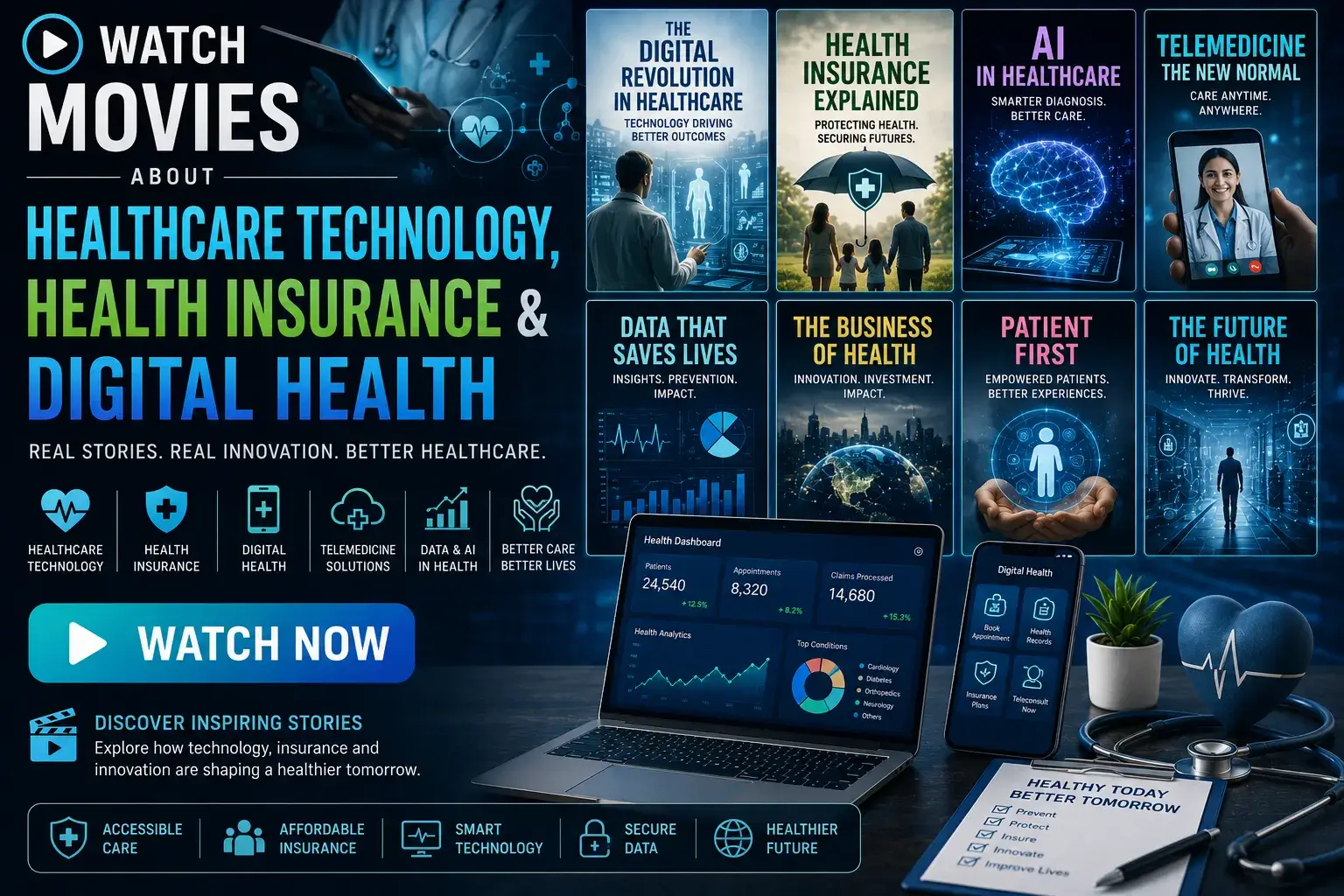
Watch Movies About Healthcare Technology, Health Insurance & Digital Health
Healthcare is becoming increasingly connected, digital and technology-driven. Hospitals, health insurers, medical organizations, technology companies and patients now interact with sophisticated software platforms, electronic health records, connected medical devices, analytics systems, telehealth services, artificial intelligence and digital health applications.
This collection of healthcare technology movies, healthcare documentaries and digital health documentaries explores the technology transforming modern healthcare. Discover educational content covering healthcare software, health information systems, electronic health records, health insurance technology, healthcare analytics, telehealth, medical technology, healthcare automation, connected healthcare and health data infrastructure.
Healthcare technology is a broad industry that combines medicine, information technology, financial services, cybersecurity, cloud computing, artificial intelligence, data analytics and enterprise software. Understanding these systems can provide useful insight into how modern healthcare organizations operate and how digital transformation is changing healthcare delivery and administration.
Whether you are interested in digital health, healthcare IT, health insurance technology, medical software, healthcare analytics, telehealth, health data or emerging healthcare innovation, documentaries and educational videos can provide a valuable introduction to the technologies influencing this rapidly evolving industry.
What Is Healthcare Technology?
Healthcare technology includes the digital systems, software, medical devices, communication infrastructure and data technologies used to support healthcare organizations and services.
The healthcare technology ecosystem can include electronic health records, hospital management platforms, medical imaging systems, laboratory information systems, pharmacy systems, patient portals, telehealth platforms, insurance software, claims management systems, analytics platforms and connected medical devices.
Healthcare technology is not limited to clinical applications. A large part of modern healthcare depends on enterprise software for scheduling, billing, insurance administration, supply chain management, compliance, workforce management and financial operations.
What Is Digital Health?
Digital health describes the use of digital technologies to support healthcare-related activities.
Digital health can include telehealth, mobile health applications, wearable devices, remote monitoring, electronic health records, digital therapeutics, health analytics, patient portals and connected healthcare platforms.
The broader objective is to use technology and information systems to improve the way healthcare information and services are accessed, managed and coordinated.
Healthcare Information Technology
Healthcare IT refers to the information technology infrastructure supporting healthcare organizations.
Healthcare IT departments may manage servers, cloud platforms, networks, software applications, cybersecurity systems, databases, user access, integrations and data governance.
Because healthcare organizations process highly sensitive information, technology infrastructure must be designed with strong security, privacy and availability considerations.
Electronic Health Records
Electronic Health Records, commonly called EHRs, are digital systems used to store and manage health-related information.
EHR platforms can connect information across different parts of a healthcare organization and may integrate with laboratory systems, imaging systems, pharmacies, patient portals and other healthcare applications.
EHR technology has become one of the most important components of modern healthcare information infrastructure.
Electronic Medical Records
Electronic Medical Records, or EMRs, are digital versions of medical records used within healthcare environments.
Modern healthcare organizations increasingly rely on digital records to support documentation, information management and communication between authorized healthcare professionals.
EHR and EMR Technology
| Technology | Primary Purpose |
|---|---|
| EHR | Digital management and sharing of patient health information across appropriate healthcare workflows |
| EMR | Digital medical records within a healthcare environment |
| Patient Portal | Digital access to selected healthcare information and services |
| Health Information Exchange | Exchange of healthcare information between connected systems |
| Healthcare Analytics | Analysis of healthcare and operational data |
Health Information Systems
Health Information Systems, or HIS, are technology systems used to manage healthcare information and operational processes.
They can support patient registration, scheduling, clinical documentation, laboratory services, pharmacy operations, billing, reporting and administrative workflows.
Hospital Management Software
Hospitals require technology for managing complex operational environments.
Hospital management software can support appointment scheduling, patient registration, bed management, billing, inventory, staff workflows, reporting and other administrative processes.
Patient Management Software
Patient management systems help healthcare organizations organize information related to patient interactions and administrative workflows.
These platforms can integrate scheduling, communication, registration and other operational functions.
Healthcare Software
The healthcare software market includes a broad range of specialized applications.
Examples include EHR systems, medical billing platforms, practice management software, hospital information systems, laboratory software, pharmacy management systems, healthcare CRM platforms and analytics solutions.
Healthcare SaaS
Healthcare SaaS refers to cloud-based software delivered as a service to healthcare organizations.
Cloud software can reduce the need for organizations to maintain certain types of local infrastructure while providing centralized application management and remote access capabilities.
Healthcare organizations must nevertheless evaluate security, compliance, availability, integration and data governance requirements when adopting cloud platforms.
Cloud Computing in Healthcare
Cloud computing provides infrastructure and software services through internet-connected platforms.
Healthcare organizations can use cloud infrastructure for applications, analytics, storage, backup, collaboration and other technology requirements.
Cloud adoption can also support scalable healthcare data processing and connected digital health applications.
Healthcare Data
Healthcare data can come from many sources, including EHR systems, laboratory systems, medical devices, insurance claims, imaging systems, patient portals, pharmacies and connected health applications.
The increasing volume and diversity of healthcare information has created significant opportunities for data analytics and artificial intelligence.
Healthcare Data Analytics
Healthcare analytics uses data analysis techniques to identify patterns, trends and operational insights.
Organizations can use analytics for administrative reporting, resource planning, financial analysis, quality improvement, population health management and operational decision-making.
Healthcare Business Intelligence
Healthcare business intelligence provides dashboards, reports and analytical tools for healthcare organizations.
Executives and administrators can use business intelligence platforms to understand operational performance, financial metrics, utilization patterns and other organizational indicators.
Predictive Analytics in Healthcare
Predictive analytics uses historical and current data to estimate potential future outcomes.
In healthcare organizations, predictive analytics can support operational planning, resource forecasting, population-level analysis and other decision-support applications.
Predictive models should be evaluated carefully because healthcare data can contain bias, missing information and other limitations that affect model performance.
Artificial Intelligence in Healthcare
Artificial intelligence is one of the most important emerging technologies in healthcare.
AI systems can assist with areas such as medical imaging analysis, administrative automation, documentation support, data analysis, workflow optimization and research.
AI applications in healthcare require appropriate validation, governance, security and human oversight because healthcare decisions can have significant consequences.
Machine Learning in Healthcare
Machine learning uses algorithms that can identify patterns in data.
Healthcare organizations and researchers can use machine learning for analytical applications involving clinical, operational or administrative datasets.
The quality of training data, model validation and appropriate oversight are critical considerations when developing healthcare AI systems.
Healthcare Automation
Healthcare automation uses software and technology to reduce repetitive manual processes.
Automation can support administrative workflows such as scheduling, billing, claims processing, document management, data entry and reporting.
Automating administrative work can allow healthcare organizations to focus resources on higher-value activities while maintaining appropriate controls.
Healthcare Workflow Automation
Healthcare workflows can involve many departments and technology systems.
Workflow automation can connect tasks between registration, scheduling, billing, insurance verification, documentation, claims and reporting systems.
Healthcare Revenue Cycle Management
Revenue Cycle Management, or RCM, covers the financial processes associated with healthcare services.
RCM technology can support patient registration, insurance verification, coding, billing, claims processing, payment posting, denial management and financial reporting.
Medical Billing Software
Medical billing software helps healthcare organizations manage billing and payment-related workflows.
Modern platforms may integrate with EHR systems, insurance systems, payment processors and accounting applications.
Healthcare Payments
Healthcare payments involve patients, providers, insurers and financial institutions.
Technology is increasingly used to simplify payment processing, billing communication, electronic statements and financial administration.
Health Insurance Technology
Health insurance technology combines insurance operations with modern software, analytics and digital platforms.
Insurance organizations use technology to manage members, policies, claims, provider networks, billing, risk analysis, customer service and regulatory reporting.
Insurance Claims Technology
Claims management technology helps insurers process and manage healthcare claims.
Digital claims platforms can support intake, validation, workflow management, documentation, payment processing and reporting.
Health Insurance Claims
Health insurance claims can involve multiple organizations and large volumes of information.
Automated claims systems can help insurers manage data and workflows while applying business rules and appropriate review processes.
Insurance Analytics
Insurance analytics can help health insurers understand claims, utilization, costs, member behavior and operational performance.
Advanced analytics can support forecasting, fraud detection, risk analysis and business intelligence.
Healthcare Underwriting Technology
Insurance underwriting technology uses information systems and analytics to support risk assessment and policy-related processes.
Modern insurance platforms can integrate data sources, workflow automation and analytics to improve operational efficiency.
Healthcare InsurTech
InsurTech refers to technology-driven innovation within the insurance industry.
In health insurance, InsurTech can include digital enrollment, automated claims, member portals, analytics, artificial intelligence, payment technology and customer engagement platforms.
Telehealth
Telehealth uses communication technologies to support healthcare interactions remotely.
Telehealth platforms can include video communication, secure messaging, appointment scheduling, digital documentation and connected technology.
Availability and suitability of telehealth services depend on healthcare providers, applicable regulations, technology infrastructure and individual circumstances.
Telemedicine Technology
Telemedicine focuses on delivering certain healthcare services through telecommunications technology.
Modern telemedicine platforms can integrate video consultations, patient information, scheduling, digital communication and other healthcare systems.
Remote Patient Monitoring
Remote patient monitoring uses connected devices and digital systems to collect information outside traditional healthcare facilities.
Connected monitoring can create new data streams that healthcare organizations may analyze through appropriate clinical and technology systems.
Wearable Health Technology
Wearable devices can collect various types of user-generated health and activity information.
Smartwatches, fitness devices and specialized sensors have expanded the amount of health-related information available through consumer technology.
Data accuracy, privacy, security and appropriate interpretation are important considerations when using wearable health information.
Connected Healthcare
Connected healthcare describes an ecosystem in which healthcare devices, applications, information systems and organizations communicate through digital infrastructure.
Interconnected systems can reduce information silos and support more coordinated digital workflows.
Healthcare Interoperability
Healthcare interoperability refers to the ability of different healthcare systems to exchange and use information appropriately.
Interoperability remains a major technology challenge because healthcare organizations may use many different applications, databases and standards.
HL7 and FHIR
HL7 and FHIR are important standards and frameworks within healthcare information exchange.
FHIR, or Fast Healthcare Interoperability Resources, provides a modern approach for representing and exchanging healthcare information through standardized resources and APIs.
Interoperability standards can help technology providers build systems capable of communicating across healthcare environments.
Health Information Exchange
Health Information Exchange, or HIE, enables healthcare information to be exchanged between authorized organizations and systems.
Effective information exchange can help reduce fragmented data environments and improve access to appropriate information within healthcare workflows.
Patient Portals
Patient portals provide digital interfaces through which patients may access selected healthcare information and services.
Depending on the platform, features can include appointment scheduling, messages, documents, billing information and access to portions of health records.
Patient Engagement Technology
Digital tools can help healthcare organizations communicate with patients and provide access to administrative services.
Patient engagement platforms can include portals, mobile applications, messaging systems, reminders and digital education resources.
Healthcare Cybersecurity
Healthcare cybersecurity is increasingly important because healthcare organizations manage sensitive information and operate critical systems.
Cybersecurity programs can include identity management, endpoint security, network protection, encryption, monitoring, backup systems, incident response and employee security awareness.
Healthcare Data Security
Healthcare data requires strong protection against unauthorized access, accidental disclosure, data loss and cyber threats.
Organizations can use access controls, encryption, monitoring, security testing and appropriate governance to protect digital information.
Healthcare Privacy
Healthcare privacy involves protecting personal and health-related information and managing how it is collected, accessed, used and shared.
Privacy requirements vary by jurisdiction and organization, making legal and compliance expertise important when designing healthcare technology systems.
Healthcare Compliance Technology
Healthcare organizations operate within complex regulatory environments.
Compliance technology can support documentation, auditing, access controls, reporting, policy management and other governance processes.
Medical Technology
Medical technology includes devices, software and systems used in healthcare environments.
Medical technology can range from diagnostic equipment and imaging systems to connected devices and advanced surgical technologies.
Medical Imaging Technology
Medical imaging technology creates digital representations that healthcare professionals can use as part of appropriate clinical workflows.
Modern imaging environments can generate large datasets and increasingly integrate with cloud infrastructure, analytics and artificial intelligence.
Robotic Healthcare Technology
Robotics is another area of healthcare innovation.
Robotic systems can support certain medical and surgical workflows, rehabilitation, logistics and other applications.
These technologies require specialized development, testing, training and regulatory oversight.
Digital Therapeutics
Digital therapeutics use software-based interventions for specific healthcare purposes.
This emerging area combines software development, healthcare research, behavioral science and clinical validation.
Healthcare Mobile Applications
Mobile applications are becoming an important interface for digital health services.
Applications can support appointment management, health information access, communication, monitoring and other digital healthcare experiences.
Healthcare APIs
Application Programming Interfaces, or APIs, allow software systems to communicate with each other.
Healthcare APIs are increasingly important for connecting EHRs, patient applications, insurance platforms, analytics systems and digital health services.
Healthcare Data Integration
Healthcare organizations often operate multiple systems from different vendors.
Data integration technology helps move appropriate information between these systems while maintaining security, reliability and governance.
Healthcare Artificial Intelligence and Automation
AI and automation are increasingly being combined to create intelligent healthcare workflows.
For example, organizations can use AI-assisted systems for document processing, data classification, workflow prioritization, administrative support and analytics.
Healthcare AI should be implemented with appropriate validation and human oversight rather than assuming that automated outputs are always accurate.
Healthcare Data Analytics and Business Strategy
Healthcare technology is not only about clinical systems.
Healthcare organizations are also businesses that need to manage budgets, workforce resources, facilities, supply chains, insurance relationships and financial performance.
Business analytics can help leaders understand operational trends and make better-informed organizational decisions.
Healthcare Supply Chain Technology
Hospitals and healthcare organizations require complex supply chains involving pharmaceuticals, medical equipment, consumables and other products.
Supply chain software can support inventory management, procurement, forecasting and logistics.
Healthcare Workforce Technology
Workforce management software can help organizations coordinate schedules, staffing, credentials, training and administrative processes.
Large healthcare organizations can benefit from integrated workforce and enterprise management systems.
Healthcare CRM
Healthcare CRM technology can help organizations manage communication and relationships with patients, members, providers and other stakeholders.
CRM systems can support engagement campaigns, service communication, customer data and workflow management.
Healthcare Marketing Technology
Healthcare organizations may use digital marketing technology to communicate services, educational resources and organizational information.
Because healthcare involves sensitive information and regulated environments, marketing activities require careful consideration of privacy and applicable requirements.
Healthcare Digital Transformation
Digital transformation involves more than replacing paper with software.
Healthcare transformation can require changes to workflows, organizational processes, data infrastructure, cybersecurity, employee training and customer experiences.
The most successful technology initiatives generally align software implementation with clearly defined organizational objectives.
Healthcare Technology Investment
Healthcare organizations make significant investments in technology infrastructure and software.
Technology investment decisions can involve evaluating total cost of ownership, implementation complexity, integration requirements, security, scalability, vendor support and long-term business value.
Healthcare Software Market
The healthcare software ecosystem includes specialized vendors serving hospitals, clinics, insurers, pharmaceutical companies, laboratories and patients.
Software categories can include clinical applications, financial systems, insurance platforms, analytics tools, patient engagement systems and enterprise infrastructure.
Healthcare Technology Vendors
Healthcare technology vendors can range from specialized startups to large enterprise software companies.
When evaluating healthcare technology, organizations typically need to consider interoperability, security, compliance, scalability, implementation requirements and user experience.
Healthcare Technology and Cloud Security
Cloud-based healthcare applications create opportunities for scalability and remote access but also require strong security architecture.
Important considerations can include identity and access management, encryption, logging, network security, data backup and incident response.
Healthcare Technology and Artificial Intelligence
AI represents a major investment area across healthcare technology.
Organizations are exploring AI for administrative efficiency, research, medical imaging, analytics, documentation, patient engagement and operational decision support.
The future of healthcare AI will depend not only on model performance but also on governance, transparency, safety, security, interoperability and responsible deployment.
Healthcare Technology Documentaries
Documentaries can provide a broader perspective on the relationship between healthcare and technology.
Instead of focusing exclusively on individual devices or software products, documentary content can explore how technological changes affect healthcare organizations, patients, insurance companies, medical professionals and society.
Why Watch Healthcare Technology Movies?
Healthcare technology documentaries can make complex technology easier to understand by placing it in a real-world context.
Viewers can explore the evolution from paper-based healthcare administration toward interconnected digital ecosystems.
They can also learn how software, cloud computing, data analytics, cybersecurity and artificial intelligence are changing healthcare infrastructure.
Who Should Watch These Healthcare Technology Documentaries?
This collection can be useful for healthcare professionals, technology professionals, hospital administrators, insurance professionals, entrepreneurs, software developers, students, business leaders, healthcare investors and anyone interested in digital health.
It can also be useful for people exploring careers in healthcare IT, health insurance technology, medical software, healthcare analytics, digital health, healthcare cybersecurity, health data management and healthcare AI.
Major Healthcare Technology Categories
| Category | Technology Examples |
|---|---|
| Healthcare IT | EHR, EMR, hospital information systems and enterprise software |
| Digital Health | Telehealth, mobile health and connected healthcare |
| Health Insurance Technology | Claims, member management, billing and insurance analytics |
| Healthcare Analytics | Business intelligence, reporting and predictive analytics |
| Healthcare AI | Machine learning, intelligent automation and decision-support systems |
| Medical Technology | Medical devices, imaging and connected equipment |
| Healthcare Cybersecurity | Identity, endpoint, network and data security |
| Interoperability | APIs, health information exchange and healthcare standards |
The Future of Digital Health
The future of digital health is likely to involve increasingly connected healthcare ecosystems.
Patients may interact with healthcare organizations through mobile applications, online portals, remote monitoring devices and virtual services, while healthcare organizations increasingly rely on integrated data platforms and cloud infrastructure.
The Future of Healthcare Software
Healthcare software is expected to become increasingly integrated.
Instead of isolated systems, organizations are working toward connected environments in which clinical, financial, administrative and analytical applications can exchange appropriate information.
The Future of Health Insurance Technology
Health insurance technology is also moving toward greater automation and digital engagement.
Claims management, member services, analytics, payment processing and administrative workflows can increasingly use cloud platforms, automation and artificial intelligence.
The Future of Healthcare Analytics
Healthcare analytics is moving from basic reporting toward more advanced intelligence.
Organizations can use data platforms to identify trends, forecast operational needs and support strategic decision-making.
The Future of Healthcare AI
AI will likely remain one of the most significant areas of healthcare technology investment and experimentation.
Future systems may become better at processing large amounts of structured and unstructured information, supporting administrative workflows and assisting professionals with data-intensive tasks.
However, healthcare AI requires responsible implementation, appropriate validation and human oversight because technology should complement qualified professionals rather than replace appropriate professional judgment.
The Importance of Healthcare Cybersecurity
As healthcare becomes increasingly digital, cybersecurity becomes increasingly important.
Healthcare organizations must protect systems, devices, applications and data while maintaining reliable access to essential services.
Security programs can include identity protection, access controls, encryption, endpoint security, network monitoring, vulnerability management, backups, employee training and incident response.
The Importance of Healthcare Data Privacy
Healthcare data is among the most sensitive categories of information handled by modern organizations.
Strong privacy practices require organizations to understand what data they collect, why it is needed, who can access it, how long it is retained and how it is protected.
Healthcare Technology and Business Innovation
Digital healthcare creates opportunities for technology companies to develop new business models and services.
Cloud software, healthcare analytics, telehealth platforms, medical devices, insurance technology and AI systems are contributing to a rapidly expanding healthcare technology ecosystem.
How to Learn Healthcare Technology Through Movies
A useful approach is to begin with broad documentaries about healthcare innovation and digital transformation.
After understanding the fundamentals, viewers can explore specialized topics such as electronic health records, healthcare cybersecurity, health insurance technology, telehealth, healthcare analytics, medical devices and artificial intelligence.
Technology-focused documentaries can be especially valuable because they show how technical systems interact with real organizations, professionals and business processes.
Healthcare Technology: From Paper Records to Digital Ecosystems
Healthcare has undergone a significant transformation from paper-based information management to sophisticated digital systems.
Today, healthcare organizations can use interconnected software platforms to manage information, appointments, billing, insurance, analytics and communication.
This transformation has created new opportunities while also introducing new challenges involving cybersecurity, privacy, interoperability and technology governance.
From Isolated Systems to Connected Healthcare
Historically, healthcare systems could operate as disconnected technology environments.
Modern interoperability initiatives increasingly focus on connecting information systems so that appropriate information can move between authorized applications and organizations.
From Manual Processes to Intelligent Automation
Healthcare organizations perform thousands of administrative tasks every day.
Automation can help streamline repetitive processes such as document processing, appointment workflows, claims administration, billing and reporting.
Combining automation with analytics and AI can create more intelligent workflows while maintaining appropriate human oversight.
From Data Storage to Healthcare Intelligence
Healthcare organizations have accumulated enormous volumes of digital information.
The next stage of digital transformation involves turning data into useful insights through analytics, visualization, machine learning and decision-support technology.
Healthcare Technology Careers
The expansion of healthcare technology has created demand for professionals across many disciplines.
Career areas can include healthcare IT, software engineering, cybersecurity, data analytics, cloud infrastructure, health informatics, healthcare product management, insurance technology and AI engineering.
Healthcare Technology Education
Students and professionals can use healthcare documentaries as a starting point for understanding the intersection of technology and healthcare.
After learning the broader concepts, more specialized education can cover health informatics, healthcare data management, medical software, cybersecurity, cloud computing, analytics and healthcare administration.
Important Healthcare Technology Topics to Explore
| Topic | Key Areas |
|---|---|
| Digital Health | Telehealth, mobile health and connected services |
| Health Insurance Technology | Claims, billing, member services and analytics |
| Healthcare IT | EHR, EMR, hospital software and infrastructure |
| Healthcare AI | Machine learning, automation and analytics |
| Health Data | Data management, interoperability and analytics |
| Cybersecurity | Privacy, identity, security and risk management |
| Medical Technology | Devices, imaging and connected systems |
| Healthcare Finance | Billing, payments, RCM and insurance administration |
Explore Healthcare Technology, Health Insurance & Digital Health
Healthcare technology sits at the intersection of medicine, software, finance, data and digital infrastructure.
From electronic health records and healthcare analytics to telehealth, health insurance technology, medical devices, cybersecurity, cloud computing and artificial intelligence, technology is transforming how healthcare organizations manage information and services.
Explore documentaries and educational videos covering digital health, healthcare software, health insurance technology, medical technology, healthcare analytics, healthcare automation, health data, interoperability, healthcare cybersecurity and AI in healthcare.
Whether you are a healthcare professional, technology professional, business leader, insurance specialist, student, entrepreneur or simply interested in the future of healthcare, these subjects provide an opportunity to understand the technology infrastructure behind modern healthcare.
Watch, learn and explore the technologies shaping the future of digital healthcare and health insurance.
Educational notice: This page is intended for general educational and informational purposes. It does not provide medical diagnosis, treatment or personalized healthcare advice. Healthcare technology, insurance, privacy, compliance and financial decisions should be evaluated using appropriate professional guidance and applicable laws and regulations.