If you are looking for a simple, safe and completely free way to enjoy movies and series on your cell phone, tablet or TV, Tubi – Free Movies and Series stands out as one of the best options available in 2026 . With an impressive collection, a clean interface, and support for Portuguese subtitles, the app offers access to thousands of titles free of charge. And best of all, it's available for direct download from the official stores:

Tubi: Free Movies & Live TV
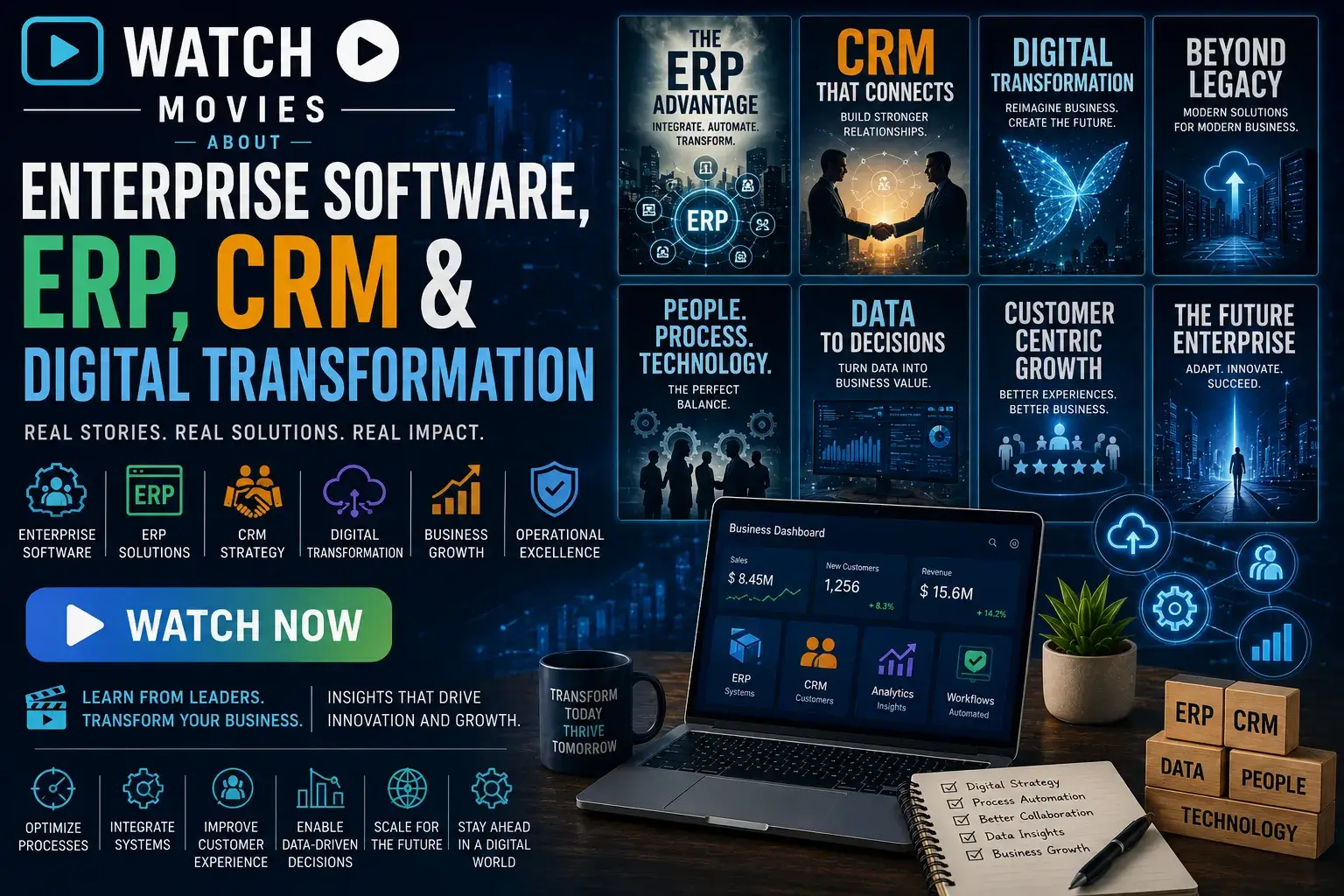
Watch Movies About Enterprise Software, ERP, CRM & Digital Transformation
Enterprise software has become the digital foundation of modern business. Organizations use ERP software, CRM software, SaaS platforms, cloud applications, business intelligence and automation technology to manage financial operations, customers, employees, supply chains, inventory and increasingly complex business processes.
This collection of enterprise software movies and technology documentaries explores how business software has evolved from traditional on-premise applications into connected cloud platforms capable of supporting global organizations.
Explore educational videos covering enterprise resource planning, customer relationship management, cloud ERP, cloud CRM, SaaS, workflow automation, enterprise AI, business intelligence and digital transformation.
Whether you are a business owner, technology professional, student, entrepreneur or enterprise decision-maker, understanding enterprise software can provide valuable insight into how organizations operate in an increasingly digital economy.
What Is Enterprise Software?
Enterprise software refers to applications designed to support the operations of organizations. Unlike consumer applications that primarily serve individual users, enterprise platforms often support multiple departments, complex workflows, large datasets and organizational controls.
Enterprise applications can manage finance, accounting, sales, customer service, procurement, inventory, human resources, manufacturing, supply chains, analytics and other business functions.
Modern enterprise software is increasingly delivered through cloud computing and subscription-based SaaS models.
Enterprise Resource Planning
Enterprise Resource Planning (ERP) software integrates business processes into a centralized platform.
ERP systems can connect accounting, procurement, inventory, manufacturing, supply chain, sales and human resources operations.
The objective is to create a consistent source of business information while reducing disconnected spreadsheets and isolated systems.
Why ERP Software Matters
Large organizations generate enormous amounts of operational and financial data. Without integrated systems, information can become fragmented between departments.
ERP software can provide centralized data and standardized workflows.
For example, a customer order can potentially connect sales, inventory, warehouse operations, shipping, invoicing and accounting within one integrated business process.
Cloud ERP
Cloud ERP delivers enterprise resource planning capabilities through cloud infrastructure.
Cloud deployment can reduce the need for organizations to maintain all application infrastructure internally while providing scalable access to business applications.
Cloud ERP platforms can also support distributed workforces and geographically diverse organizations.
ERP Modules
Modern ERP platforms commonly contain multiple functional modules.
| ERP Module | Primary Function | Typical Business Use |
|---|---|---|
| Financial Management | Manage financial operations | Accounting, reporting and financial planning |
| Procurement | Manage purchasing | Supplier management and purchase orders |
| Inventory | Track products and materials | Stock management and replenishment |
| Supply Chain | Coordinate supply operations | Planning, logistics and fulfillment |
| Human Resources | Manage workforce information | Employee administration and payroll |
| Manufacturing | Manage production | Production planning and quality management |
| Project Management | Manage projects | Budgets, resources and project performance |
| Analytics | Analyze enterprise data | Reporting and business intelligence |
Customer Relationship Management
Customer Relationship Management (CRM) software helps organizations manage interactions with customers and prospects.
CRM platforms can centralize customer information, sales opportunities, communication history and service interactions.
Sales teams can use CRM software to manage leads, opportunities, pipelines and customer relationships.
Why CRM Software Matters
Customer data can become fragmented when sales, marketing and customer service teams use separate systems.
CRM platforms provide a shared environment where teams can access customer information and coordinate activities.
This can improve customer visibility and help organizations build more consistent customer experiences.
Cloud CRM
Cloud CRM provides customer management capabilities through internet-accessible software platforms.
Cloud CRM can support remote teams, mobile workers and organizations operating across multiple locations.
Subscription-based CRM platforms can also allow companies to scale users and functionality as their business grows.
CRM Software Features
- Contact management
- Lead management
- Sales pipeline management
- Opportunity tracking
- Customer service management
- Email and communication management
- Sales forecasting
- Marketing automation
- Customer analytics
- Workflow automation
- AI-assisted productivity
ERP and CRM Integration
ERP and CRM systems serve different primary purposes, but integrating them can create significant operational advantages.
CRM systems can manage customer-facing processes while ERP systems manage financial and operational processes.
When connected, sales teams can potentially access inventory and financial information while finance teams can receive customer and order information automatically.
SaaS and Enterprise Software
Software as a Service (SaaS) has changed how organizations purchase and use business applications.
Instead of purchasing software licenses and managing all infrastructure internally, companies can subscribe to cloud-hosted applications.
SaaS platforms can provide automatic software updates, centralized infrastructure and flexible subscription models.
Enterprise SaaS
Enterprise SaaS platforms are designed to support larger organizations with advanced security, administration, integration and governance requirements.
Enterprise SaaS can cover CRM, ERP, human resources, accounting, cybersecurity, collaboration, analytics and many other business functions.
The growth of SaaS has created a large ecosystem of specialized enterprise applications.
Business Automation
Business automation uses technology to reduce repetitive manual processes.
Automation can range from simple workflow rules to sophisticated AI-powered systems.
Businesses can automate processes such as invoice approvals, employee onboarding, customer notifications, lead assignment, procurement approvals and reporting.
Workflow Automation
Workflow automation connects multiple steps in a business process.
For example, a new sales order could automatically trigger inventory checks, fulfillment tasks, invoice generation and customer notifications.
Automated workflows can improve consistency and reduce manual data entry.
Business Process Management
Business Process Management (BPM) focuses on analyzing, designing and improving business processes.
BPM software can help organizations model workflows, assign responsibilities, monitor performance and automate repetitive steps.
Process optimization is often a key part of successful digital transformation.
Intelligent Automation
Intelligent automation combines traditional workflow automation with technologies such as artificial intelligence, machine learning and natural language processing.
This allows organizations to automate processes involving documents, language, classification and decision support.
For example, an intelligent system can analyze an invoice, extract relevant information and route it through an approval workflow.
Enterprise AI
Enterprise AI refers to the use of artificial intelligence within organizational applications and workflows.
AI can assist with customer service, document processing, financial analysis, sales forecasting, cybersecurity, software development and business intelligence.
Modern enterprise platforms increasingly incorporate AI assistants and generative AI capabilities.
Generative AI in Enterprise Software
Generative AI can help employees summarize documents, generate reports, analyze information, draft communications and interact with business data using natural language.
Enterprise implementations must consider data security, access controls, accuracy, privacy and governance.
AI Agents for Business
AI agents are increasingly being explored for multi-step enterprise workflows.
An AI agent can potentially interpret a goal, access approved tools, perform several actions and provide a result.
Enterprise agent deployments require carefully controlled permissions and monitoring because automated actions can affect important business systems.
Business Intelligence
Business Intelligence (BI) software helps organizations transform operational data into useful insights.
BI platforms can provide dashboards, reports, analytics and data visualization.
Executives and managers can use BI systems to monitor revenue, expenses, sales performance, inventory, customer activity and operational metrics.
Enterprise Data Analytics
Modern organizations generate data across ERP, CRM, marketing, finance, supply chain and operational systems.
Data analytics can combine these sources to identify trends and support business decisions.
Advanced analytics can include predictive models, anomaly detection and AI-assisted analysis.
Predictive Analytics
Predictive analytics uses historical and current information to estimate potential future outcomes.
Businesses can apply predictive analytics to demand forecasting, customer retention, financial planning, inventory management and risk analysis.
Enterprise Data Integration
Enterprise applications often need to exchange information with each other.
APIs, integration platforms and data pipelines can connect ERP, CRM, payment systems, analytics platforms and other applications.
Effective integration reduces duplicate data entry and helps create consistent business information.
API Integration
Application Programming Interfaces (APIs) allow different software systems to communicate.
API integration can connect enterprise applications and enable automated data exchange.
For example, a CRM platform can send customer information to an ERP system while an ERP system can return order or invoice information.
Digital Transformation
Digital transformation involves using digital technology to improve business processes, products, services and organizational models.
It is broader than simply replacing old software.
Successful transformation often involves process redesign, data modernization, cloud adoption, automation, cybersecurity and organizational change.
Why Digital Transformation Matters
Customers increasingly expect fast digital experiences, while organizations need efficient operations and reliable access to information.
Digital transformation can help businesses modernize outdated processes and improve their ability to respond to changing markets.
Legacy System Modernization
Many organizations continue to operate legacy applications that are critical to business operations.
Modernization can involve replacing old systems, migrating workloads to the cloud, creating APIs or gradually transforming individual components.
Legacy modernization requires careful planning because business continuity and data integrity are important considerations.
Cloud Computing and Enterprise Applications
Cloud computing provides scalable infrastructure for enterprise applications.
Organizations can use cloud infrastructure for application hosting, databases, analytics, AI workloads, storage and disaster recovery.
Cloud technology has become a major component of modern enterprise IT strategies.
Cloud Migration
Cloud migration involves moving applications, data or infrastructure from traditional environments to cloud platforms.
Migration strategies can include rehosting, replatforming, refactoring and replacing applications with SaaS alternatives.
Businesses typically evaluate security, performance, cost, compliance and operational requirements when planning migration.
Enterprise Cloud Security
Cloud adoption increases the importance of cybersecurity.
Organizations need to manage identity, access permissions, encryption, network security, monitoring and compliance.
Security should be incorporated into enterprise architecture rather than treated as an afterthought.
Identity and Access Management
Identity and Access Management (IAM) controls who can access applications and data.
Enterprise IAM systems can support authentication, authorization, single sign-on and role-based access controls.
Strong identity management is especially important as organizations adopt cloud applications and remote work environments.
Enterprise Software and Cybersecurity
ERP and CRM platforms often contain highly valuable business information.
Financial data, customer information, employee records and operational data require appropriate protection.
Organizations should use security controls, access management, monitoring and appropriate data governance.
Enterprise Compliance
Organizations operating in regulated industries may need to comply with financial, privacy, security and industry-specific requirements.
Enterprise software can support compliance through audit trails, access controls, reporting and workflow approvals.
Financial Management Software
Financial management modules are an important component of enterprise software.
They can support general accounting, accounts payable, accounts receivable, budgeting, financial reporting and financial planning.
Integrating financial systems with operational applications can provide organizations with more complete business visibility.
Supply Chain Management Software
Supply chain software helps organizations manage purchasing, suppliers, inventory, logistics and demand planning.
Modern platforms can incorporate analytics and AI to improve forecasting and supply chain decision-making.
Inventory Management
Inventory management systems track stock levels, locations, purchases and product movements.
Automation can help organizations identify replenishment requirements and reduce manual inventory processes.
Human Resources Software
Enterprise HR platforms can manage employee records, recruitment, payroll, benefits, performance and workforce analytics.
Cloud HR software allows organizations to centralize workforce information and automate administrative workflows.
Procurement Software
Procurement platforms can automate purchasing processes and provide visibility into supplier relationships and spending.
Organizations can use procurement workflows to manage purchase requests, approvals, purchase orders and supplier information.
Customer Experience Technology
CRM platforms increasingly extend beyond sales into broader customer experience management.
Organizations can connect customer service, marketing, sales and analytics to create a more complete view of customer interactions.
Sales Automation
Sales automation can reduce administrative work associated with lead management, follow-ups, reporting and pipeline management.
AI-powered sales tools can also assist with account research, conversation summaries and opportunity analysis.
Marketing Automation
Marketing automation platforms help businesses manage campaigns, customer segments, communications and analytics.
Integration between marketing platforms and CRM systems can improve visibility across the customer lifecycle.
Customer Data Platforms
A Customer Data Platform (CDP) can consolidate customer information from multiple sources.
Organizations can use customer data to understand interactions across websites, applications, marketing campaigns and customer service channels.
Enterprise Collaboration Software
Modern businesses rely on collaboration platforms for messaging, meetings, document sharing and project coordination.
Cloud collaboration software enables distributed teams to work together across geographic locations.
Project Management Software
Project management platforms help organizations coordinate tasks, deadlines, budgets, resources and project communications.
Integration with enterprise systems can provide project managers with financial and operational visibility.
Enterprise Software and Productivity
The goal of enterprise software is ultimately to help organizations operate more efficiently and make better decisions.
Integrated applications can reduce duplicate work, improve data visibility and automate repetitive processes.
AI capabilities may further increase productivity by assisting employees with information-intensive tasks.
Enterprise Software Architecture
Modern enterprise architecture often consists of multiple interconnected applications rather than one single system.
ERP, CRM, HR, analytics, collaboration, cybersecurity and specialized SaaS applications may all operate together.
Integration architecture therefore becomes increasingly important.
Enterprise Integration Platforms
Integration platforms can connect cloud applications, databases, APIs and business workflows.
They can help organizations synchronize information and automate processes across multiple enterprise systems.
Enterprise Software Challenges
Enterprise technology projects can be complex because they affect multiple departments and business processes.
- Implementation complexity
- Data migration
- System integration
- User adoption
- Cybersecurity
- Compliance
- Legacy systems
- Vendor management
- Cloud costs
- Process redesign
Choosing Enterprise Software
Organizations evaluating enterprise software should begin by understanding business requirements rather than selecting technology based solely on features.
Important considerations can include functionality, integration, security, scalability, usability, implementation requirements and total cost of ownership.
Enterprise Software Total Cost of Ownership
The cost of enterprise software includes more than subscription or licensing fees.
Organizations may also need to consider implementation, integrations, data migration, training, support, customization, security and ongoing administration.
Evaluating total cost of ownership can provide a more realistic view of technology investment.
ERP Implementation
ERP implementations often involve significant business process changes.
Successful projects generally require executive sponsorship, clear requirements, data preparation, user training and effective project management.
Organizations should avoid unnecessary customization when standard functionality can satisfy business requirements.
CRM Implementation
CRM implementations require attention to customer data quality, sales processes and user adoption.
A technically successful CRM project may still fail to deliver value if employees do not use the platform consistently.
Data Quality
Enterprise AI and analytics depend heavily on data quality.
Duplicate records, inconsistent definitions and incomplete information can reduce the usefulness of business intelligence systems.
Data governance is therefore a foundational component of enterprise technology strategy.
Enterprise Data Governance
Data governance establishes policies for data ownership, quality, security, access and lifecycle management.
Strong governance helps organizations maintain trustworthy information across multiple applications.
AI-Powered Enterprise Software
The integration of AI into ERP and CRM platforms is creating new categories of intelligent enterprise software.
AI assistants can help users analyze business information, generate summaries and automate routine activities.
More advanced systems can connect AI with enterprise workflows and approved business tools.
Future of ERP
Future ERP platforms are likely to become more intelligent, connected and automated.
AI could assist with forecasting, financial analysis, procurement, inventory planning and operational decision-making.
The ERP system may increasingly become an intelligent business platform rather than simply a transaction-processing system.
Future of CRM
CRM platforms are also evolving toward AI-assisted customer management.
Future CRM systems may automatically summarize interactions, identify customer needs, recommend next actions and support sales and service workflows.
Future of SaaS
SaaS is likely to continue evolving as applications become more intelligent and interconnected.
AI-native SaaS platforms can combine traditional software functionality with AI assistants and automated workflows.
Future of Business Automation
Business automation is moving from simple rule-based workflows toward intelligent systems capable of interpreting information and adapting to different situations.
This transition may allow organizations to automate increasingly complex processes while maintaining human oversight for high-impact decisions.
Future of Digital Transformation
Digital transformation is becoming an ongoing process rather than a one-time technology project.
As cloud computing, AI, cybersecurity, analytics and automation evolve, organizations must continuously evaluate their technology architecture and business processes.
Enterprise Technology Trends to Watch
- Cloud-native enterprise applications
- AI-powered ERP platforms
- AI-powered CRM platforms
- Generative AI for knowledge work
- Enterprise AI agents
- Intelligent workflow automation
- Predictive business analytics
- Cloud migration
- Enterprise cybersecurity
- Data integration
- Digital employee experiences
- AI-assisted software development
- Industry-specific SaaS
- Automation of financial operations
- Intelligent supply chain management
Enterprise Technology and Business Strategy
Technology decisions increasingly influence business strategy.
ERP, CRM, cloud platforms and analytics can affect how companies acquire customers, manage resources, control costs and make decisions.
For this reason, enterprise technology should be evaluated not only by IT teams but also by business leaders and operational stakeholders.
Why Enterprise Software Documentaries Are Valuable
Enterprise software can be difficult to understand because it operates behind the scenes of everyday business operations.
Documentaries and educational technology videos can provide historical and practical context for understanding how business systems evolved.
They can also demonstrate how enterprise applications affect finance, sales, manufacturing, supply chains, employees and customers.
Who Should Watch Enterprise Software Movies?
This type of educational content can be useful for business owners, entrepreneurs, technology professionals, students, software developers, IT managers, consultants, analysts and enterprise decision-makers.
Students can use the material to understand enterprise technology concepts, while business professionals can explore how technology affects organizational operations.
How to Explore Enterprise Technology Documentaries
Start with introductory content covering the history of enterprise computing and business software.
Then explore specialized topics such as ERP, CRM, SaaS, cloud computing, business intelligence and digital transformation.
Viewers interested in emerging technology can continue into enterprise AI, generative AI, AI agents and intelligent automation.
ERP, CRM and the Connected Enterprise
The modern enterprise increasingly depends on connected systems.
ERP can manage operational and financial processes, CRM can manage customer relationships, HR platforms can manage employees and BI platforms can transform information into insights.
When these systems work together, organizations can create a more connected digital operating environment.
The Intelligent Enterprise
The concept of the intelligent enterprise combines integrated business applications, high-quality data, analytics, automation and artificial intelligence.
Instead of simply recording transactions, enterprise platforms can increasingly help employees understand information and take action.
This represents one of the most important developments in modern business technology.
Explore the Future of Enterprise Software
Enterprise software is evolving rapidly. ERP, CRM, SaaS, cloud computing, business intelligence, workflow automation and enterprise AI are becoming increasingly interconnected.
Explore movies and documentaries to understand how these technologies have developed and how they are changing the way organizations operate.
Whether you are interested in cloud ERP, cloud CRM, business automation, enterprise AI, data analytics, digital transformation or enterprise software architecture, educational technology content can help build a stronger understanding of the modern digital enterprise.
Watch, learn and explore the technologies powering the next generation of business.
Educational notice: This content is provided for general informational and educational purposes. Enterprise technology decisions depend on an organization's specific business requirements, security needs, regulatory obligations, infrastructure and budget. Technology evaluations should be performed using appropriate professional and organizational processes.