If you are looking for a simple, safe and completely free way to enjoy movies and series on your cell phone, tablet or TV, Tubi – Free Movies and Series stands out as one of the best options available in 2026 . With an impressive collection, a clean interface, and support for Portuguese subtitles, the app offers access to thousands of titles free of charge. And best of all, it's available for direct download from the official stores:

Tubi: Free Movies & Live TV
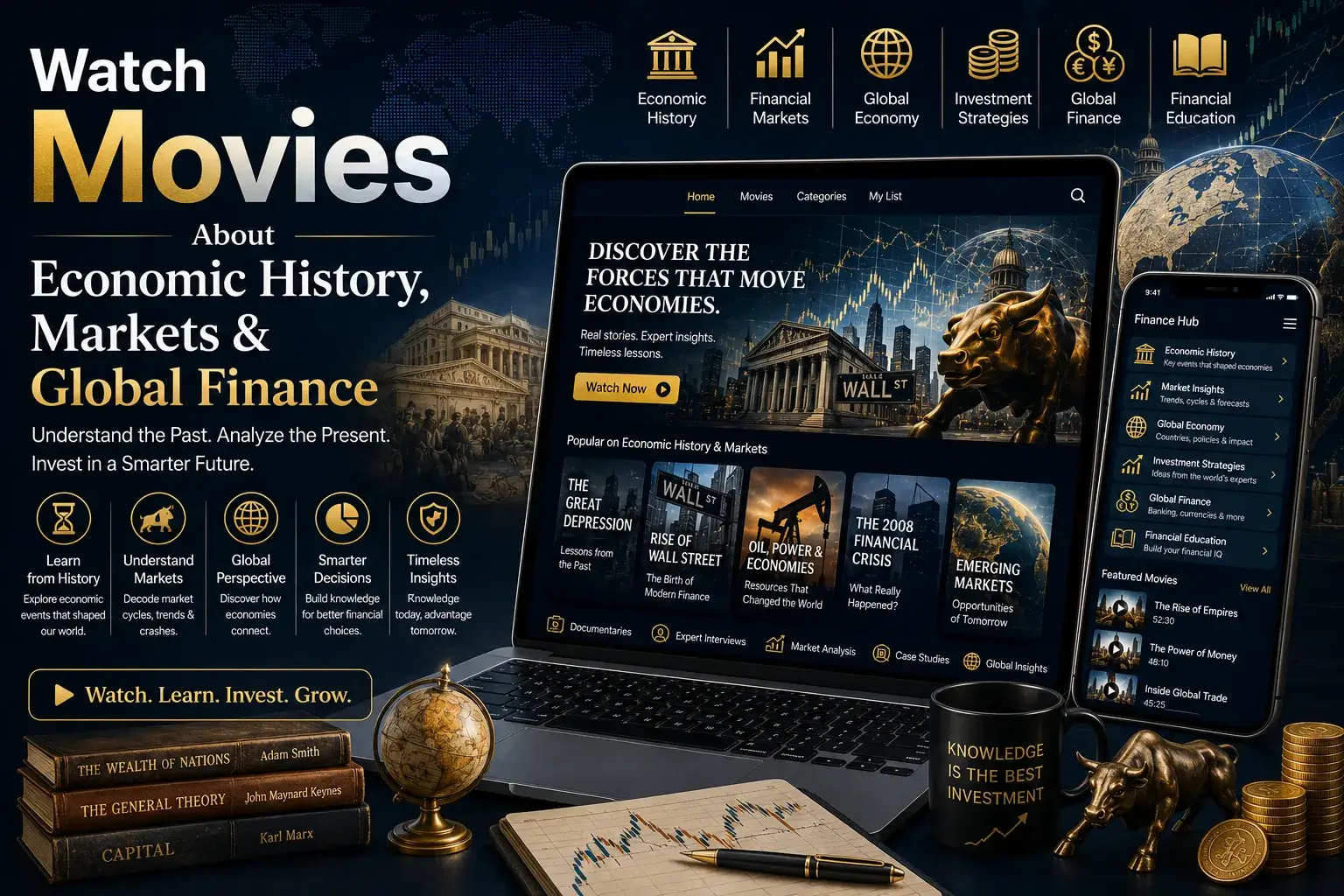
Watch Movies About Economic History, Markets & Global Finance
Economic history is the story of how money, markets, businesses, banks, governments and technology have shaped the modern world. From early monetary systems and traditional banking to electronic markets, digital payments and financial technology, the global economy has continuously evolved.
This collection of economic documentaries, financial history movies and global finance videos explores the major ideas, institutions and technological developments behind modern financial systems. Discover educational content covering financial markets, banking history, economic cycles, monetary policy, central banking, business finance, capital markets, financial technology and global economic development.
Understanding economic history can provide valuable context for understanding today's financial markets. Market prices, interest rates, inflation, employment, corporate earnings and economic growth are connected to a much larger financial system that has developed over centuries.
What Is Economic History?
Economic history examines how economies, financial institutions, businesses, markets and economic policies have developed over time.
It combines ideas from economics, history, finance, business and political institutions to explain how societies produce, distribute and consume goods and services.
Economic documentaries can make these subjects easier to understand by connecting historical events with real-world economic consequences.
Why Economic History Matters
Financial markets do not exist in isolation. Modern economies have been influenced by industrialization, international trade, banking systems, technological innovation, government policy and changes in consumer behavior.
Studying economic history can help viewers understand why financial institutions operate the way they do and why certain economic policies became important.
The Evolution of Money
Money has evolved significantly over time.
Early economies relied on barter and commodity-based systems. Over time, societies developed standardized forms of money that could serve as a medium of exchange, store of value and unit of account.
Modern monetary systems are predominantly based on government-issued currencies and sophisticated banking infrastructures.
Monetary Systems
A monetary system defines how money is created, distributed and managed within an economy.
Modern monetary systems involve central banks, commercial banks, financial institutions, payment networks and regulatory frameworks.
Money and Banking
Banks play a central role in modern economies by accepting deposits, providing credit, facilitating payments and supporting financial activity.
The banking industry has evolved from physical branches and paper records into highly automated digital financial systems.
Banking History
Banking history provides insight into how financial institutions developed alongside commerce and economic growth.
As economies expanded, businesses and individuals needed increasingly sophisticated systems for saving, borrowing, payments and investment.
Commercial Banking
Commercial banks provide financial services to individuals and businesses.
Business banking can include deposits, lending, payment processing, cash management, treasury services and other financial products.
Investment Banking
Investment banking focuses on activities such as capital raising, securities offerings, mergers and acquisitions and corporate financial advisory.
Investment banks can play an important role in connecting businesses with capital markets.
Central Banking
Central banks are institutions responsible for important monetary and financial-system functions within their jurisdictions.
Depending on the country, central banks may influence interest rates, manage monetary policy, oversee aspects of the financial system and support financial stability.
Monetary Policy
Monetary policy involves actions taken by a central bank to influence financial conditions and economic activity.
Interest rates are one of the most important tools associated with monetary policy.
Changes in monetary policy can influence borrowing costs, savings, investment, currency markets, bond prices and equity valuations.
Interest Rates and the Economy
Interest rates affect the cost of borrowing money and the return available on certain savings and investments.
Higher borrowing costs can affect consumer spending, housing activity and business investment. Lower borrowing costs can encourage borrowing and investment, although the overall economic impact depends on many factors.
Inflation
Inflation refers to a sustained increase in the general level of prices over time.
Inflation can reduce purchasing power and influence monetary policy, consumer behavior, wages, corporate costs and investment markets.
Inflation and Financial Markets
Financial markets closely monitor inflation because changes in inflation expectations can influence interest rates and asset valuations.
Investors may evaluate inflation when considering equities, bonds, real estate and other assets.
Economic Cycles
Economic cycles describe recurring changes in economic activity.
Economies can move through periods of expansion, slowing growth, recession and recovery. The timing and severity of these phases can vary significantly.
| Economic Phase | Typical Characteristics |
|---|---|
| Expansion | Increasing economic activity and business investment |
| Peak | High level of economic activity before a slowdown |
| Contraction | Declining or slowing economic activity |
| Recession | Broad and sustained economic weakness |
| Recovery | Economic activity begins improving |
Business Cycles
Business cycles can affect corporate revenues, employment, consumer spending, investment and financial markets.
Businesses and investors often monitor economic indicators to understand where the economy may be within a broader cycle.
Economic Growth
Economic growth generally refers to an increase in the production of goods and services within an economy.
Productivity, investment, technology, labor markets, infrastructure and innovation can contribute to long-term economic growth.
GDP and Economic Measurement
Gross domestic product, or GDP, is one of the most widely used measures of economic activity.
Economic documentaries can introduce viewers to GDP, employment, inflation, consumer spending and other indicators used to evaluate economic conditions.
Employment and the Economy
Employment is closely connected to household income, consumer spending and economic activity.
Labor-market conditions are therefore important indicators for businesses, investors and policymakers.
Consumer Spending
Consumer spending represents a significant component of economic activity in many economies.
Changes in household income, employment, confidence, credit availability and prices can influence consumer behavior.
Business Investment
Businesses invest in equipment, technology, infrastructure, research and development and other productive assets.
Business investment can influence productivity and long-term economic growth.
Global Trade
Global trade connects producers and consumers across international borders.
International trade allows countries and businesses to specialize, access foreign markets and obtain goods and services from global suppliers.
Economic Globalization
Globalization has increased connections between economies through trade, investment, technology and financial markets.
Modern businesses can operate across multiple countries while investors can access international financial markets.
International Finance
International finance examines financial relationships between countries, businesses, investors and financial institutions.
Currency markets, international investment, cross-border banking and global capital flows are important parts of international finance.
Foreign Exchange Markets
The foreign exchange market facilitates the conversion of one currency into another.
Exchange rates can be influenced by interest rates, economic conditions, trade flows, monetary policy and market expectations.
Global Financial Markets
Global financial markets include equity markets, bond markets, currency markets, commodity markets and other financial markets.
These markets are interconnected, meaning economic developments in one region can influence financial conditions elsewhere.
Capital Markets
Capital markets connect organizations seeking long-term funding with investors seeking investment opportunities.
Equity and fixed-income markets are two major components of the capital-market ecosystem.
Equity Markets
Equity markets allow investors to buy and sell ownership interests in publicly traded companies.
Stock exchanges provide organized infrastructure for securities trading, while brokerages and financial technology platforms connect investors with those markets.
Bond Markets
Bond markets allow governments, corporations and other issuers to raise capital through debt securities.
Bond markets are also important for investors seeking fixed-income exposure.
Credit Markets
Credit markets facilitate lending and borrowing between financial institutions, businesses, governments and consumers.
Credit availability can have a significant effect on economic activity and business investment.
Financial Crises
Financial history includes periods of significant financial stress and economic disruption.
Financial crises can involve banking instability, excessive leverage, declining asset values, liquidity shortages and disruptions in credit markets.
Studying financial crises can help viewers understand the importance of risk management, liquidity and financial regulation.
Banking Crises
A banking crisis can occur when financial institutions experience severe losses, liquidity problems or widespread concerns about their ability to meet obligations.
Banking crises can spread through financial markets and the broader economy because banks are deeply connected to businesses, households and other financial institutions.
Financial Stability
Financial stability refers broadly to the ability of the financial system to continue functioning effectively despite economic and financial shocks.
Central banks, regulators and financial institutions monitor risks that could threaten financial stability.
Financial Regulation
Financial regulation establishes rules governing financial institutions and markets.
Regulation can address areas such as capital requirements, consumer protection, market integrity, disclosure, cybersecurity and financial stability.
Fiscal Policy
Fiscal policy concerns government decisions involving taxation and public spending.
Fiscal policy can influence economic activity, public finances, investment and household income.
Government Finance
Governments raise revenue primarily through taxation and other sources and use those resources to fund public programs and services.
Government borrowing creates public debt that can influence financial markets and economic policy.
Sovereign Debt
Sovereign debt represents borrowing by national governments.
Government bonds are a major component of global fixed-income markets and are widely monitored by financial institutions and investors.
Business Finance
Business finance examines how companies manage capital, investment, financing and cash flow.
Corporate finance decisions can include capital expenditure, working capital management, debt financing, equity financing and mergers and acquisitions.
Capital Allocation
Capital allocation refers to how businesses and investors decide where financial resources should be deployed.
Effective capital allocation can support productivity, innovation and long-term business growth.
Corporate Finance and Economic Growth
Companies require capital to build factories, develop software, hire employees, acquire businesses and invest in research and development.
Financial markets provide important channels through which businesses can access this capital.
Financial Institutions
Modern economies depend on a wide network of financial institutions.
| Institution | Primary Function |
|---|---|
| Central Banks | Monetary policy and financial-system functions |
| Commercial Banks | Deposits, lending and payment services |
| Investment Banks | Capital raising and corporate financial services |
| Asset Managers | Investment and portfolio management |
| Insurance Companies | Risk transfer and financial protection |
| Brokerages | Investment and securities trading services |
| Payment Providers | Payment processing and financial transactions |
| FinTech Companies | Technology-enabled financial services |
The Rise of Financial Technology
Financial technology, commonly known as FinTech, has changed how people and businesses interact with financial services.
Online banking, digital payments, mobile applications, automated investment platforms, financial analytics and cloud-based banking software have transformed the financial industry.
Digital Banking
Digital banking allows customers to access many financial services through websites and mobile applications.
Digital banking technology can support payments, account management, transfers, lending applications, financial planning and customer service.
Payment Technology
Payment technology enables individuals and businesses to send and receive money electronically.
Digital wallets, payment gateways, card networks, bank transfers and mobile payments have become important components of modern commerce.
Financial Automation
Automation is increasingly used in financial operations.
Organizations can automate reconciliation, accounting workflows, reporting, payment processing, compliance processes and other repetitive activities.
Cloud Banking
Cloud computing has become increasingly important to financial institutions.
Cloud infrastructure can support scalability, data processing, analytics and digital financial services while requiring strong security, governance and operational controls.
Artificial Intelligence in Finance
Artificial intelligence is increasingly being explored across financial services.
Potential applications include fraud detection, financial analytics, customer service, risk analysis, document processing, investment research and operational automation.
Financial Data Analytics
Financial analytics transforms financial and economic data into information that can support decision-making.
Financial institutions can analyze market data, customer behavior, portfolio exposure, credit information and economic indicators.
Market Analytics
Market analytics platforms can help investors and financial professionals analyze prices, volumes, volatility, correlations and other financial information.
Advanced analytics can process large datasets much faster than traditional manual analysis.
Electronic Financial Markets
Technology has fundamentally changed the infrastructure supporting modern financial markets.
Electronic trading, automated clearing, digital settlement, real-time market data and cloud-based financial applications have created a highly connected financial ecosystem.
Financial Infrastructure
Behind every digital financial transaction is a network of infrastructure.
Banks, payment networks, exchanges, clearing systems, custodians, data providers, cloud platforms and cybersecurity systems work together to support financial activity.
Financial Cybersecurity
As financial services become increasingly digital, cybersecurity becomes an essential part of financial infrastructure.
Financial institutions must protect customer information, payment systems, trading platforms and sensitive financial data from cyber threats.
Financial Risk Management
Financial risk management involves identifying, measuring and managing potential financial exposures.
Businesses and financial institutions may monitor market risk, credit risk, liquidity risk, operational risk and other exposures.
Liquidity
Liquidity refers to the ability to buy or sell assets or meet financial obligations without significant disruption.
Liquidity is particularly important during periods of market stress when investors and institutions may need to access cash quickly.
Credit Risk
Credit risk is the possibility that a borrower or counterparty will fail to meet financial obligations.
Banks and other financial institutions use credit analysis and risk-management systems to evaluate lending exposures.
Economic Forecasting
Economic forecasting attempts to estimate future economic conditions using historical data, economic models and current indicators.
Forecasts can cover GDP growth, inflation, employment, interest rates and other economic variables.
Forecasts are inherently uncertain because economic outcomes depend on many changing factors.
Economic Indicators
Economic indicators help businesses, investors and policymakers evaluate economic conditions.
| Indicator | What It Can Help Explain |
|---|---|
| GDP | Overall economic production and activity |
| Inflation | Changes in general price levels |
| Employment | Labor-market conditions |
| Interest Rates | Cost of borrowing and financial conditions |
| Consumer Spending | Household demand and economic activity |
| Business Investment | Corporate spending and expansion |
| Trade Data | International goods and services flows |
Economic Education
Economic education provides a framework for understanding the relationship between businesses, consumers, governments and financial institutions.
Learning economic fundamentals can also make financial news and market developments easier to interpret.
Financial Education
Financial education includes learning about money management, banking, investing, credit, financial markets, risk and long-term financial planning.
Economic documentaries can complement traditional educational resources by providing historical examples and real-world context.
Financial Literacy and Market Awareness
Financial literacy helps individuals understand financial products and economic concepts before making financial decisions.
Understanding the difference between saving, investing, borrowing and managing risk is an important foundation for personal financial decision-making.
Economic History and Investment Markets
Investment markets are strongly influenced by economic conditions.
Corporate earnings, interest rates, inflation, economic growth and investor expectations can all affect asset prices.
Studying financial history helps investors understand that markets can experience periods of expansion, volatility and significant declines.
Economic History and Business Strategy
Businesses can also benefit from understanding economic cycles.
Companies may adjust hiring, inventory, capital expenditure, financing and expansion plans based on economic conditions.
Economic History and Technology
Technological innovation has repeatedly changed economic activity.
Industrial machinery, telecommunications, computers, the internet, cloud computing and artificial intelligence have each influenced productivity and business models.
The Digital Transformation of Finance
Modern finance is undergoing a major digital transformation.
Traditional banking processes are being supplemented by mobile applications, cloud infrastructure, financial APIs, automated workflows, digital identity systems and data analytics.
Open Banking
Open banking uses regulated data-sharing frameworks and APIs to allow financial information and services to be integrated into approved applications and platforms, subject to applicable rules and customer permissions.
It can enable new financial products and more connected digital financial experiences.
Embedded Finance
Embedded finance refers broadly to financial services integrated into non-financial digital products and business workflows.
Payments, lending, insurance and other financial capabilities can increasingly become part of e-commerce, software and business platforms.
Financial Inclusion
Technology can also improve access to financial services.
Mobile banking, digital payments and online financial platforms can help expand access to financial products where traditional banking infrastructure may be limited.
The Evolution of Global Finance
The global financial system has moved from relatively localized banking and trading networks toward a highly interconnected digital ecosystem.
Today, capital can move across borders, financial information can be transmitted almost instantly and investors can access international markets through digital platforms.
Why Watch Economic Documentaries?
Economic documentaries can provide a broader perspective than daily financial news.
Instead of focusing only on current market prices, documentaries can explore the historical forces behind economic institutions, financial crises, technological innovation and global commerce.
They can help viewers connect concepts such as inflation, monetary policy, interest rates, banking, capital markets and financial technology.
Who Should Explore Economic History Movies?
This educational content can be useful for finance students, economics students, investors, entrepreneurs, business owners, technology professionals and anyone interested in how the global economy works.
It can also be useful for people exploring careers in banking, investment management, corporate finance, investment banking, financial technology, financial analytics, economic research and capital markets.
Key Economic History Topics
| Topic | Key Concepts |
|---|---|
| Money | Currency, monetary systems and purchasing power |
| Banking | Deposits, lending, payments and financial institutions |
| Central Banking | Monetary policy, interest rates and financial stability |
| Financial Markets | Equities, bonds, currencies and capital markets |
| Economic Cycles | Expansion, contraction, recession and recovery |
| Global Trade | International commerce and economic globalization |
| Financial Crises | Banking stress, liquidity and market risk |
| FinTech | Digital banking, payments, automation and financial software |
| Economic Policy | Monetary and fiscal policy |
| Financial Technology | AI, cloud computing, analytics and digital finance |
How to Learn Economics Through Movies
A structured approach can make economic documentaries more valuable.
Begin with the history of money and banking. Then explore central banking, monetary policy, inflation and economic cycles. After understanding those concepts, explore financial markets, investment banking, capital markets and financial crises.
Finally, investigate how technology is changing banking, payments, investment management and financial analytics.
Economic History and Modern Business
Many business decisions are influenced by broader economic conditions.
Companies monitor interest rates, consumer demand, inflation, employment, currency movements and industry trends when developing financial and operational strategies.
Economic History and Corporate Finance
Corporate finance is connected to the wider economy through borrowing costs, capital availability and investor expectations.
Businesses may raise capital through debt or equity markets depending on their financial objectives and market conditions.
Economic History and Wealth Management
Economic conditions can influence investment portfolios and long-term financial planning.
Wealth-management professionals consider factors such as asset allocation, risk tolerance, investment objectives and economic conditions when advising clients.
Economic History and Retirement Planning
Long-term retirement planning can involve investments, savings, inflation assumptions and market risk.
Understanding historical market cycles can help individuals appreciate why long-term financial planning requires realistic assumptions and risk management.
Economic History and Real Estate
Real estate markets are influenced by interest rates, employment, household income, supply, demand and credit conditions.
Mortgage markets and property finance are therefore closely connected to broader economic conditions.
Economic History and Insurance
Insurance companies operate within the broader financial system and help individuals and businesses manage certain risks.
Insurance markets are influenced by economic conditions, interest rates, investment returns, regulation and changing risk patterns.
Economic History and Business Technology
Technology has changed how companies manage accounting, payments, treasury, payroll, procurement and financial reporting.
Cloud-based financial software and automation have become important components of modern business operations.
The Future of Global Finance
The financial industry is likely to become increasingly digital, data-driven and automated.
Artificial intelligence, machine learning, cloud infrastructure, real-time payments, financial APIs and advanced analytics may continue to reshape financial services.
At the same time, financial institutions will need to focus on cybersecurity, privacy, regulatory compliance, operational resilience and responsible technology adoption.
AI and Financial Markets
Artificial intelligence can assist with financial data analysis, document processing, fraud detection, customer support, risk analysis and investment research.
AI systems can process large datasets quickly, but their outputs still require appropriate validation, governance and human oversight.
Cloud Computing and Finance
Cloud technology can provide financial organizations with scalable computing and data infrastructure.
Cloud adoption can support digital banking, analytics, financial applications and automated business processes while introducing additional requirements for security and operational resilience.
Digital Payments
Digital payments have become an important part of modern commerce.
Payment processors, banking networks, digital wallets and financial technology platforms allow individuals and businesses to conduct transactions electronically.
Financial Automation
Automation can reduce manual work across accounting, payments, reporting, reconciliation and compliance operations.
Financial automation is increasingly important for businesses seeking efficiency, scalability and better access to financial information.
Market Analytics and Decision Intelligence
Modern financial organizations increasingly use analytics to support decisions.
Decision intelligence can combine data, analytical models and business context to help organizations evaluate financial and economic scenarios.
Financial Technology Innovation
FinTech innovation continues to create new approaches to banking, payments, investing, lending, insurance and financial management.
The combination of software, cloud infrastructure, APIs, data analytics and artificial intelligence is creating a more interconnected financial ecosystem.
Questions to Explore While Watching
| Question | Why It Matters |
|---|---|
| How did modern banking develop? | Explains the foundations of today's financial institutions |
| How does monetary policy affect markets? | Connects central banking with financial conditions |
| Why do economic cycles occur? | Helps explain expansions, recessions and recoveries |
| How do financial crises spread? | Explains interconnected financial risks |
| How do interest rates affect businesses? | Connects monetary policy with corporate finance |
| How does global trade affect economies? | Explains international economic relationships |
| How has technology changed finance? | Explores FinTech, digital banking and financial automation |
| How do financial markets allocate capital? | Explains the connection between investors and businesses |
Economic History, Markets & Global Finance Education
The modern financial system is the result of centuries of economic development, technological innovation and institutional change.
Understanding economic history provides a foundation for understanding today's financial markets. Banking systems developed to support commerce and credit. Central banks emerged as important financial institutions. Capital markets created mechanisms for companies and governments to raise funding. Global trade connected economies. Technology transformed financial transactions and market infrastructure.
Today, financial services are being reshaped again by cloud computing, artificial intelligence, automation, digital payments, financial analytics and FinTech innovation.
Exploring economic documentaries can help viewers connect historical events with modern financial concepts. A documentary about banking history may explain the foundations of commercial banking. A financial history documentary may explore market cycles and financial crises. A global finance documentary may examine international capital flows and economic globalization. Technology-focused content can demonstrate how digital banking, electronic trading and financial software are changing the industry.
For students, investors and business professionals, these subjects provide useful context for understanding economic cycles, financial markets, monetary policy, business finance, global finance, financial technology and economic education.
The more clearly we understand the history of money, markets and financial institutions, the easier it becomes to understand the economic forces shaping modern businesses and financial markets.
Watch, learn and explore the economic history, financial systems and technology that continue to shape the global economy.
Educational notice: This content is provided for general educational and informational purposes and does not constitute investment, financial, tax or legal advice. Economic and financial markets involve uncertainty and risk. Viewers should conduct appropriate research and consult qualified professionals when making financial decisions.