If you are looking for a simple, safe and completely free way to enjoy movies and series on your cell phone, tablet or TV, Tubi – Free Movies and Series stands out as one of the best options available in 2026 . With an impressive collection, a clean interface, and support for Portuguese subtitles, the app offers access to thousands of titles free of charge. And best of all, it's available for direct download from the official stores:

Tubi: Free Movies & Live TV
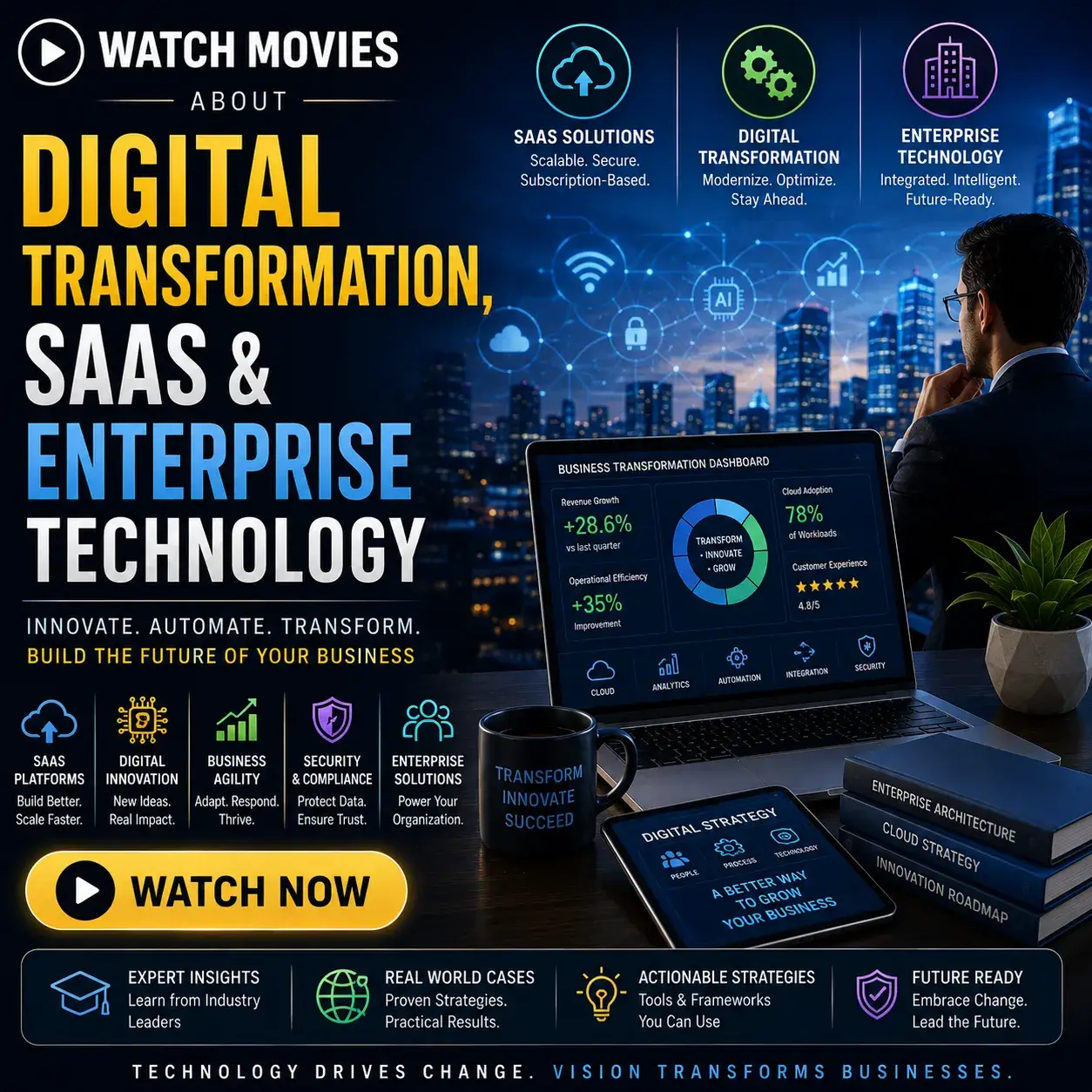
Watch Movies About Digital Transformation, SaaS & Enterprise Technology
Digital transformation is changing how modern organizations operate, compete and serve customers. From cloud computing and SaaS platforms to artificial intelligence, business intelligence, enterprise automation and connected business applications, technology has become a central component of modern business strategy.
This collection of digital transformation movies, SaaS documentaries and enterprise technology videos explores the technologies and business strategies behind modern organizations. Discover how companies modernize legacy systems, migrate workloads to the cloud, automate business processes, integrate enterprise applications and use data and AI to make better decisions.
Explore educational topics including enterprise software, cloud computing, SaaS, digital transformation, business automation, enterprise AI, business intelligence, workflow automation, data analytics, cybersecurity, cloud infrastructure and software innovation.
What Is Digital Transformation?
Digital transformation is the process of using digital technologies to fundamentally improve business processes, customer experiences, operating models and organizational capabilities.
It is much broader than simply moving software to the cloud. Successful transformation can involve changes to technology architecture, employee workflows, data management, customer interactions, security, organizational processes and business strategy.
A transformation program may involve modernizing legacy applications, implementing SaaS platforms, building data infrastructure, automating repetitive work and introducing artificial intelligence into business processes.
Why Digital Transformation Matters
Organizations operate in an environment where customers expect fast digital experiences, employees require modern tools and businesses need access to accurate information.
Technology can help organizations improve operational efficiency, increase visibility, reduce repetitive work and create new digital products and services.
Digital transformation can also help companies respond faster to changing market conditions by creating more flexible technology foundations.
Digital Transformation vs. IT Modernization
IT modernization generally focuses on improving technology infrastructure, applications and systems.
Digital transformation is broader. It connects technology modernization with business processes, customer experience, organizational strategy and operating models.
| Concept | Primary Focus |
|---|---|
| IT Modernization | Modernizing infrastructure and applications |
| Cloud Transformation | Moving and redesigning workloads for cloud environments |
| Process Automation | Reducing repetitive manual business activities |
| Data Transformation | Improving data collection, integration and analytics |
| Digital Transformation | Changing technology, processes and business capabilities together |
SaaS: Software as a Service
Software as a Service, commonly called SaaS, delivers software applications through cloud-based infrastructure.
Instead of installing and maintaining traditional software on individual machines or company-owned infrastructure, organizations can access SaaS applications through internet-connected systems.
SaaS has transformed enterprise software because businesses can adopt specialized applications without building and maintaining the underlying infrastructure themselves.
Enterprise SaaS
Enterprise SaaS refers to cloud software designed to support organizations with complex operational, security, integration and governance requirements.
Enterprise SaaS applications can support finance, human resources, sales, customer service, marketing, procurement, project management, analytics and other business functions.
Benefits of SaaS
| SaaS Capability | Potential Business Benefit |
|---|---|
| Cloud Delivery | Reduces the need to maintain traditional application infrastructure |
| Scalability | Allows organizations to expand software usage as requirements change |
| Automatic Updates | Provides access to continuously updated software capabilities |
| Integrations | Connects business applications through APIs and integration platforms |
| Accessibility | Supports authorized access across distributed teams |
| Subscription Model | Allows organizations to align software spending with ongoing usage |
SaaS Management
As companies adopt more SaaS applications, managing the software portfolio becomes increasingly important.
SaaS management can include monitoring application usage, user access, contracts, licenses, security requirements, integrations and costs.
Enterprise organizations may use SaaS management platforms to understand which applications are being used and whether access remains appropriate.
SaaS Security
Cloud applications contain valuable business information, making security a critical component of SaaS adoption.
Organizations should consider identity management, authentication, authorization, encryption, data protection, vendor risk and security monitoring when adopting cloud software.
Cloud Computing
Cloud computing provides computing resources such as servers, storage, databases, networking and applications through cloud infrastructure.
Cloud technology has become an important foundation for modern enterprise software and digital transformation.
Enterprise Cloud
Enterprise cloud environments support business workloads that may require high availability, security, scalability, governance and integration.
Organizations can use cloud services for applications, data platforms, analytics, artificial intelligence and infrastructure.
Hybrid Cloud
Hybrid cloud combines cloud environments with on-premises infrastructure or private cloud resources.
Hybrid architectures can be useful when organizations need to maintain certain workloads in existing environments while adopting cloud services for newer applications.
Multi-Cloud
Multi-cloud strategies involve using services from multiple cloud providers.
Organizations may choose multi-cloud architectures for workload requirements, geographic availability, business continuity, specialized services or strategic considerations.
Cloud Migration
Cloud migration involves moving applications, data and workloads from existing environments into cloud infrastructure.
A successful migration requires more than moving servers. Organizations need to evaluate application dependencies, security, data architecture, performance, costs and operational processes.
Application Modernization
Many organizations operate applications that were created years or decades ago.
Application modernization can involve refactoring, replatforming, rebuilding or replacing legacy applications to improve scalability, maintainability and integration.
Legacy System Modernization
Legacy systems can contain important business logic and data, making replacement difficult.
Modernization programs often require careful planning to preserve critical capabilities while introducing modern APIs, cloud infrastructure and digital workflows.
APIs and Enterprise Integration
Application programming interfaces, or APIs, allow software applications to communicate and exchange information.
APIs are essential to modern enterprise architecture because organizations rarely operate with a single software platform.
CRM, ERP, payment systems, marketing platforms, analytics systems and customer applications often need to exchange information.
Enterprise Software
Enterprise software supports business processes across departments and organizational functions.
Examples include ERP, CRM, human resources, finance, supply chain, procurement, analytics and collaboration platforms.
ERP Software
Enterprise resource planning, or ERP, systems integrate important business functions into a centralized platform.
ERP systems can manage finance, procurement, inventory, manufacturing, supply chain, human resources and other operational processes.
Cloud ERP
Cloud ERP provides enterprise resource planning capabilities through cloud infrastructure.
Cloud ERP can support centralized data, remote access, integration and scalable business operations.
CRM Software
Customer relationship management, or CRM, software helps businesses manage customer interactions, sales opportunities, marketing activities and customer service.
CRM platforms can become an important part of digital transformation because customer data and engagement increasingly depend on digital channels.
Cloud CRM
Cloud CRM platforms provide customer-management capabilities through cloud-based infrastructure.
They can integrate with marketing automation, communication platforms, analytics, customer service and enterprise systems.
Business Automation
Business automation uses software and technology to reduce repetitive manual processes.
Automation can be applied to finance, human resources, sales, customer service, procurement, operations and supply chain workflows.
Workflow Automation
Workflow automation uses predefined rules and digital processes to route tasks, data and approvals between people and systems.
For example, an employee expense report may automatically move from submission to approval, accounting and reimbursement.
Business Process Automation
Business process automation focuses on improving end-to-end business workflows rather than automating a single isolated task.
This approach can identify bottlenecks and redesign processes around digital systems.
Intelligent Automation
Intelligent automation combines workflow automation with technologies such as artificial intelligence, machine learning and document processing.
It can support workflows that involve unstructured information or require pattern recognition.
Robotic Process Automation
Robotic process automation, or RPA, uses software robots to perform repetitive digital tasks.
RPA can be useful for structured processes such as data entry, system transfers, report generation and repetitive administrative operations.
AI and Digital Transformation
Artificial intelligence is becoming a major component of enterprise transformation.
Organizations are exploring AI for customer service, software development, data analysis, document processing, forecasting, cybersecurity, marketing, finance and operational automation.
Generative AI
Generative AI can generate text, code, summaries, images and other forms of content based on user instructions and available models.
Enterprise adoption requires careful consideration of data security, privacy, intellectual property, model accuracy and governance.
Enterprise AI
Enterprise AI refers to artificial intelligence systems deployed to support organizational processes and business objectives.
Enterprise AI can include machine learning platforms, generative AI applications, predictive analytics and AI-powered business software.
AI Agents and Agentic AI
AI agents are designed to perform sequences of tasks using AI models, tools and defined objectives.
Agentic AI may eventually assist with complex enterprise workflows such as research, customer support, software operations, data analysis and process coordination.
Because AI agents can potentially take actions across business systems, organizations need strong permissions, monitoring, audit trails and governance.
Business Intelligence
Business intelligence, or BI, helps organizations transform business data into reports, dashboards and insights.
BI systems can combine data from finance, sales, operations, customer service and other enterprise applications.
Enterprise Analytics
Enterprise analytics allows organizations to analyze large amounts of operational and financial information.
Analytics can support performance management, forecasting, customer analysis, supply chain planning and strategic decision-making.
Predictive Analytics
Predictive analytics uses historical and current data to estimate potential future outcomes.
Businesses can apply predictive models to demand forecasting, customer behavior, risk management, maintenance and other use cases.
Decision Intelligence
Decision intelligence combines data, analytics, AI and business processes to support complex decisions.
The objective is to move beyond static reporting toward systems that can help organizations understand possible outcomes and evaluate different scenarios.
Enterprise Data Platforms
Modern organizations generate enormous quantities of data from applications, customers, devices and business operations.
Enterprise data platforms help organizations collect, store, govern and analyze this information.
Data Integration
Data integration connects information from different sources.
Integration can involve APIs, data pipelines, event systems, integration platforms and other technologies.
Cloud Data Warehouses
Cloud data warehouses provide scalable environments for storing and analyzing structured business information.
They can support enterprise reporting, business intelligence, analytics and machine-learning workloads.
Data Lakehouses
Data lakehouse architectures combine characteristics associated with data lakes and data warehouses.
They are designed to support different types of analytics and data workloads within modern cloud data environments.
Data Governance
Data governance defines policies and responsibilities for managing organizational data.
Governance can address data quality, ownership, access, privacy, security, retention and compliance.
Cybersecurity in Digital Transformation
Technology transformation expands an organization's digital footprint.
Cloud applications, APIs, remote access, connected devices and AI systems create new security considerations.
Cybersecurity therefore needs to be integrated into transformation programs rather than treated as an afterthought.
Cloud Security
Cloud security includes technologies and practices designed to protect cloud applications, infrastructure and data.
Identity management, encryption, configuration management, vulnerability management and continuous monitoring are important components of cloud security.
Zero Trust Security
Zero trust is a security approach based on continuously evaluating identity, device, access and context rather than automatically trusting users or systems.
It can be especially relevant for organizations operating distributed cloud environments and remote workforces.
Identity and Access Management
Identity and access management, or IAM, controls who can access applications and data.
Enterprise IAM can support authentication, authorization, role management, privileged access and lifecycle management.
Digital Workplace
The modern digital workplace combines cloud applications, communication platforms, collaboration tools and automated workflows.
Employees can work across locations while accessing business applications and data through controlled digital environments.
Customer Experience Technology
Digital transformation increasingly focuses on customer experience.
Organizations use CRM systems, mobile applications, personalization, analytics, digital payments and automation to improve interactions across customer journeys.
Omnichannel Technology
Omnichannel technology connects customer interactions across multiple channels.
A customer might interact through a website, mobile application, physical location, call center or social platform while the business maintains a connected customer profile.
Digital Payments
Digital payments are an important part of modern business technology.
Payment platforms can integrate with e-commerce systems, accounting software, CRM platforms and financial management applications.
Marketing Technology
Marketing technology, or MarTech, supports digital customer acquisition, campaign management, analytics and personalization.
Modern marketing platforms can integrate with CRM and business intelligence systems to create a more connected view of customers.
Sales Automation
Sales automation can help teams manage leads, opportunities, communications and follow-up activities.
CRM platforms can automate routine sales workflows while giving managers visibility into pipeline performance.
Enterprise Technology Architecture
Enterprise architecture provides a structured approach to understanding how business processes, applications, data and technology infrastructure work together.
A strong architecture can help organizations avoid disconnected technology investments and create a more coherent transformation strategy.
Technology Modernization Strategy
A successful modernization strategy typically begins with understanding the existing technology landscape.
Organizations can assess legacy applications, technical debt, business dependencies, security requirements, data architecture and future capabilities before selecting modernization priorities.
Digital Transformation Roadmap
| Stage | Typical Focus |
|---|---|
| Assessment | Evaluate existing systems, processes and business requirements |
| Strategy | Define transformation objectives and priorities |
| Architecture | Design the target technology and data environment |
| Modernization | Upgrade applications, infrastructure and workflows |
| Automation | Digitize and automate high-value business processes |
| Analytics | Build data and business intelligence capabilities |
| AI Adoption | Introduce appropriate AI and intelligent automation use cases |
| Optimization | Continuously measure and improve technology performance |
Challenges of Digital Transformation
Digital transformation is not without challenges.
Organizations may encounter legacy technology, fragmented data, employee resistance, cybersecurity risks, integration complexity, insufficient skills, unclear business objectives and unexpected implementation costs.
Transformation programs are more effective when technology investments are connected to measurable business outcomes.
Legacy Technology and Technical Debt
Technical debt can accumulate when systems are built quickly or maintained for long periods without modernization.
High technical debt can increase maintenance costs and make it more difficult to introduce new capabilities.
Change Management
Technology transformation affects employees as well as systems.
Change management helps organizations prepare employees for new workflows, applications and responsibilities.
Training, communication and leadership support can improve adoption of new technology.
Technology Governance
Technology governance provides structures for making decisions about technology investments, architecture, security and risk.
Governance becomes particularly important when organizations operate large portfolios of cloud applications and AI systems.
AI Governance
AI governance addresses issues such as model security, privacy, accuracy, transparency, human oversight and responsible deployment.
Organizations should establish appropriate policies before deploying AI in sensitive or high-impact business processes.
SaaS Integration
Organizations often use dozens or hundreds of SaaS applications.
Integration platforms and APIs help connect these applications so that customer, financial, operational and employee data can move between systems.
SaaS Operations
SaaS operations involve managing the availability, security, performance and usage of cloud applications.
Enterprise teams may monitor software adoption, access permissions, integrations, vendor relationships and costs.
DevOps
DevOps combines software development and IT operations practices to improve the speed and reliability of software delivery.
Automation, continuous integration, continuous delivery and monitoring are common components of modern DevOps environments.
DevSecOps
DevSecOps incorporates security into software development and operational processes.
Security testing, vulnerability scanning, identity controls and secure development practices can be integrated into application delivery pipelines.
Observability
Modern digital businesses need visibility into application and infrastructure performance.
Observability helps technology teams understand system behavior using telemetry such as logs, metrics and traces.
Application Performance Monitoring
Application performance monitoring can help identify slow transactions, errors, availability issues and other application problems.
This visibility becomes increasingly important as organizations rely on cloud applications and distributed architectures.
Digital Transformation and Business Value
Technology investments should ultimately create measurable business value.
Potential outcomes include improved productivity, faster customer service, reduced operational costs, stronger security, improved decision-making and new revenue opportunities.
How Digital Transformation Changes Business Departments
| Department | Transformation Examples |
|---|---|
| Finance | Cloud accounting, automation, analytics and financial planning |
| Sales | CRM, sales automation and pipeline analytics |
| Marketing | Marketing automation, customer analytics and personalization |
| Human Resources | Cloud HR systems and employee experience platforms |
| Operations | Workflow automation and operational analytics |
| Supply Chain | Digital planning, inventory systems and logistics analytics |
| IT | Cloud infrastructure, DevOps and observability |
| Customer Service | Digital channels, CRM and AI-assisted support |
The Intelligent Enterprise
The concept of an intelligent enterprise combines connected applications, integrated data, automation and artificial intelligence.
Instead of treating each department as a separate system, organizations can create connected digital workflows across finance, sales, operations, customer service and technology.
Connected Enterprise
A connected enterprise allows information to move between systems and departments.
For example, a customer order may trigger inventory updates, payment processing, fulfillment, accounting entries and customer notifications through an integrated digital workflow.
Business Process Optimization
Digital transformation creates an opportunity to redesign processes rather than simply digitize inefficient procedures.
Organizations can analyze process performance, remove unnecessary steps and automate repetitive activities.
Technology and Operational Efficiency
Automation and integrated software can reduce repetitive administrative work and help employees focus on higher-value activities.
Operational efficiency should be measured using relevant business metrics rather than automation volume alone.
Technology Strategy
Technology strategy connects business objectives with technology investments.
A strong strategy considers architecture, data, cloud infrastructure, cybersecurity, applications, people, governance and financial resources.
The Role of the CIO
The Chief Information Officer, or CIO, increasingly participates in strategic business decisions rather than focusing exclusively on IT infrastructure.
CIO organizations may lead cloud adoption, cybersecurity, enterprise applications, data platforms, automation and digital transformation initiatives.
The Role of the CTO
The Chief Technology Officer, or CTO, often focuses on technology strategy, engineering, product development and technical innovation.
In technology-driven companies, the CTO can play a major role in developing scalable software platforms and digital products.
Technology Leadership
Successful transformation requires leadership that understands both technology and business objectives.
Technology leaders must balance innovation with security, reliability, cost management, compliance and long-term architecture.
Digital Transformation Education
Documentaries and educational videos can provide an accessible way to explore complex technology concepts.
Viewers can learn how cloud infrastructure, SaaS, enterprise software, AI and automation influence modern businesses.
Who Should Watch Enterprise Technology Documentaries?
This content can be useful for CIOs, CTOs, IT managers, software professionals, business leaders, entrepreneurs, consultants, technology students, analysts and professionals involved in digital transformation.
It can also be useful for anyone who wants to understand how enterprise technology is changing modern organizations.
Key Enterprise Technology Topics
| Technology | Business Role |
|---|---|
| SaaS | Cloud-delivered business applications |
| Cloud Computing | Scalable infrastructure and digital services |
| ERP | Integrated enterprise business processes |
| CRM | Customer and sales management |
| Business Intelligence | Reporting and data-driven decisions |
| AI | Intelligent analysis and automation |
| APIs | Application and data integration |
| Cybersecurity | Protection of systems and business data |
| Workflow Automation | Digital execution of business processes |
| Data Platforms | Centralized analytics and information management |
Questions to Explore While Watching
While exploring digital transformation documentaries, consider questions such as:
- How are enterprises replacing legacy systems?
- Why are businesses adopting SaaS applications?
- How does cloud computing change enterprise architecture?
- Which business processes are suitable for automation?
- How can companies integrate data across applications?
- How is AI changing enterprise software?
- What security risks accompany cloud adoption?
- How can business intelligence improve decision-making?
- How should organizations manage SaaS portfolios?
- What skills will technology professionals need in the future?
The Future of Enterprise Technology
The future of enterprise technology will likely involve increasingly connected cloud applications, intelligent automation, AI-powered workflows, advanced analytics and more flexible digital infrastructure.
Enterprise applications are becoming more intelligent and interconnected. Instead of simply storing information, modern systems can analyze data, recommend actions and automate parts of business processes.
AI-Powered Enterprise Software
AI capabilities are increasingly being embedded directly into business applications.
Enterprise software may use AI to summarize information, detect anomalies, forecast demand, assist employees, automate documentation and provide natural-language interfaces to business data.
Agentic Enterprise Workflows
AI agents could eventually coordinate multiple applications and execute multi-step workflows.
For example, an enterprise agent could potentially retrieve information, analyze business data, prepare a draft report and route it for human approval.
Such systems require careful governance because automated actions can affect financial, operational and customer outcomes.
Cloud-Native Business Technology
Cloud-native architecture focuses on building applications specifically for scalable cloud environments.
Containers, microservices, APIs, managed services and automated deployment pipelines are commonly associated with cloud-native development.
Software Innovation
Software innovation is changing the competitive landscape across industries.
Companies can use software to create digital products, automate internal operations, improve customer experience and develop entirely new business models.
Digital Transformation and Competitive Advantage
Technology can become a competitive advantage when organizations use it to deliver better experiences, operate more efficiently and respond faster to market changes.
However, purchasing technology alone does not guarantee transformation. Business processes, people, data and strategy must evolve alongside the technology.
Digital Transformation Strategy
A strong transformation strategy connects technology initiatives to measurable business outcomes.
Organizations can prioritize projects based on customer value, operational impact, financial return, security requirements and strategic importance.
Building a Modern Enterprise Technology Stack
A modern enterprise technology stack may include cloud infrastructure, SaaS applications, ERP, CRM, data platforms, analytics, cybersecurity, integration tools and AI services.
The exact architecture depends on the organization's industry, size, regulatory environment and business objectives.
Enterprise Technology and Security
Security must remain a fundamental part of digital transformation.
Organizations should protect identities, applications, data, APIs and infrastructure throughout the technology lifecycle.
Technology Risk Management
Technology risk management involves identifying and managing risks associated with technology systems and digital operations.
Risks can include cybersecurity incidents, service outages, data loss, software vulnerabilities, vendor dependencies and regulatory requirements.
Vendor and SaaS Risk
Cloud and SaaS adoption creates dependencies on external technology providers.
Organizations should evaluate vendor security, availability, data handling, contractual obligations and business continuity requirements.
Digital Transformation Metrics
Transformation programs should be measured using business and technology metrics.
| Metric Category | Example Measurements |
|---|---|
| Operational Efficiency | Processing time, automation rate and productivity |
| Customer Experience | Conversion, retention and service performance |
| Technology | Availability, performance and deployment frequency |
| Financial | Technology costs, savings and business impact |
| Security | Incident rates, vulnerabilities and control performance |
| Adoption | User engagement and application utilization |
Why Watch Digital Transformation Movies?
Digital transformation documentaries can make complex enterprise technology easier to understand.
Instead of viewing cloud computing, SaaS, AI, data analytics and automation as isolated technologies, viewers can explore how these capabilities work together to change businesses.
Technology documentaries can also provide context around major changes in software delivery, enterprise architecture, cybersecurity, data management and artificial intelligence.
Digital Transformation, SaaS & Enterprise Technology Education
Digital transformation is ultimately about more than technology. It is about using technology to create better ways of working, serving customers, managing information and making decisions.
SaaS has changed how businesses access enterprise applications. Cloud computing has changed infrastructure. APIs have changed application integration. Business intelligence has changed how organizations use data. Automation has changed repetitive workflows. Artificial intelligence is now creating another major shift in how software can assist employees and execute business processes.
Understanding these technologies can help business leaders and technology professionals evaluate the opportunities and risks associated with modernization.
Whether you are interested in cloud computing, enterprise SaaS, ERP, CRM, business intelligence, AI, automation, cybersecurity, data analytics or software innovation, digital transformation documentaries offer a valuable way to explore the technology behind modern business.
Watch, learn and explore the technologies transforming enterprises and shaping the future of business.
Educational notice: This content is provided for general informational and educational purposes. Technology selection, cybersecurity, cloud architecture, AI deployment and business transformation decisions should be evaluated according to an organization's specific requirements, risk profile and applicable professional guidance.