If you are looking for a simple, safe and completely free way to enjoy movies and series on your cell phone, tablet or TV, Tubi – Free Movies and Series stands out as one of the best options available in 2026 . With an impressive collection, a clean interface, and support for Portuguese subtitles, the app offers access to thousands of titles free of charge. And best of all, it's available for direct download from the official stores:

Tubi: Free Movies & Live TV
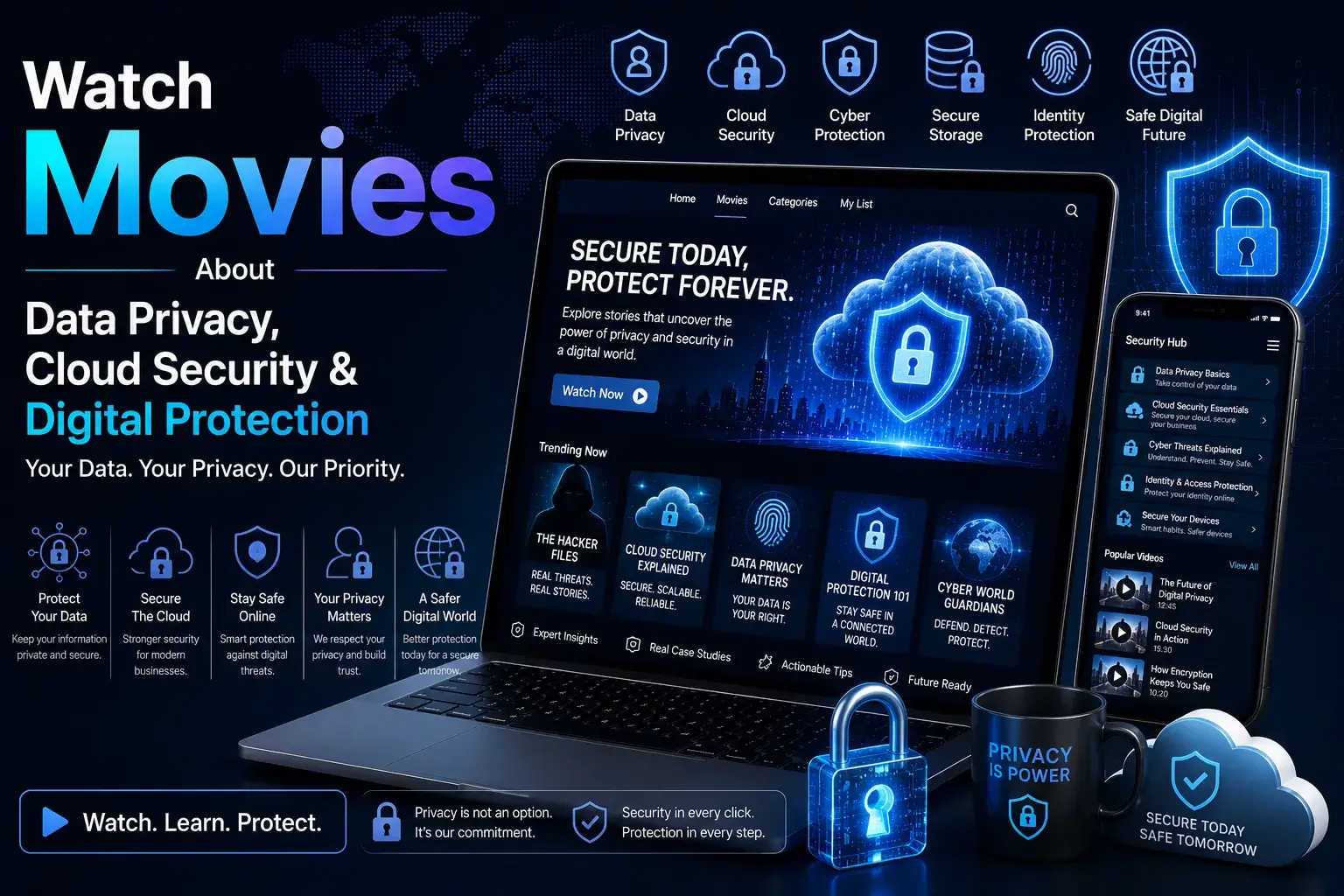
Watch Movies About Data Privacy, Cloud Security & Digital Protection
Data has become one of the most valuable assets in the modern digital economy. Businesses, financial institutions, healthcare organizations, governments and technology companies continuously collect, process and store information through cloud platforms, enterprise applications, mobile devices, databases and connected systems. Protecting that information requires a combination of cybersecurity, privacy technology, identity management, cloud security and strong data governance.
This collection of data privacy movies, cybersecurity documentaries and cloud security documentaries explores the technologies and concepts behind modern digital protection. Discover educational content covering information security, cloud cybersecurity, identity protection, data governance, privacy engineering, enterprise security, security compliance, digital risk and the technologies organizations use to protect sensitive information.
Modern cybersecurity is no longer limited to protecting a traditional office network. Organizations now operate across cloud infrastructure, SaaS applications, remote environments, APIs, mobile devices and distributed data platforms. As technology ecosystems become more interconnected, the need for comprehensive security and privacy strategies continues to grow.
What Is Data Privacy?
Data privacy focuses on how personal, confidential and sensitive information is collected, used, shared, retained and protected.
Privacy involves more than preventing unauthorized access. Organizations also need to understand what information they collect, why they collect it, who can access it, how long it is retained and whether it is shared with third parties.
Modern privacy programs often combine technology, governance, policies, risk management and regulatory compliance.
What Is Data Protection?
Data protection involves technical and organizational measures designed to protect information against unauthorized access, alteration, loss, disclosure or destruction.
Security controls can include encryption, access management, authentication, backup systems, monitoring, data classification and security policies.
Data Privacy vs. Data Security
Data privacy and data security are closely connected but represent different concepts.
Privacy focuses heavily on the appropriate handling and use of information, while security focuses on protecting information and systems from unauthorized access and other threats.
| Area | Primary Focus |
|---|---|
| Data Privacy | Appropriate collection, use and sharing of information |
| Data Security | Protection against unauthorized access and compromise |
| Data Governance | Policies, ownership, quality and lifecycle management |
| Cloud Security | Protecting cloud infrastructure, applications and data |
| Identity Security | Controlling users, devices and application access |
| Compliance | Meeting applicable legal, regulatory and contractual requirements |
Why Data Privacy Matters
Organizations may process customer identities, financial information, employee records, intellectual property, authentication credentials and other sensitive information.
A privacy failure can create financial, operational, legal and reputational consequences. Effective privacy management therefore forms an important component of enterprise risk management.
Digital Privacy
Digital privacy concerns the collection and use of information in online and connected environments.
Websites, applications, cloud services, mobile devices and connected systems can generate large amounts of data. Privacy practices help organizations establish appropriate rules around how that information is handled.
Privacy Technology
Privacy technology helps organizations discover, classify, manage and protect sensitive information.
Privacy platforms can support data inventories, consent management, data discovery, policy enforcement, retention management and privacy risk assessments.
Privacy by Design
Privacy by design means considering privacy requirements during the design and development of products, applications and business processes rather than treating privacy as an afterthought.
Technology teams can incorporate data minimization, access controls, encryption and appropriate retention practices into system architecture.
Privacy Engineering
Privacy engineering applies technical methods to privacy requirements.
Privacy engineers may work with developers, security teams, legal professionals and product teams to build systems that reduce unnecessary data exposure.
Data Governance
Data governance establishes policies and responsibilities for managing organizational data.
A mature data governance program can define data ownership, classification, access rules, quality requirements, retention policies and accountability.
Enterprise Data Governance
Large organizations may have thousands of applications and data repositories.
Enterprise data governance helps establish consistent approaches for managing information across departments, cloud environments and business systems.
Data Classification
Data classification categorizes information according to its sensitivity and business importance.
Organizations may distinguish between public information, internal business information, confidential data and highly sensitive information.
Classification can help security teams determine which controls should be applied to different categories of information.
Data Discovery
Data discovery identifies where sensitive information exists across databases, cloud storage, SaaS applications, endpoints and other systems.
Without knowing where sensitive information is stored, organizations may struggle to protect it effectively.
Sensitive Data Protection
Sensitive data can include financial information, authentication credentials, personal information, intellectual property and confidential business records.
Security teams can combine encryption, access controls, monitoring and data loss prevention to reduce the risk of unauthorized disclosure.
Data Loss Prevention
Data Loss Prevention, commonly known as DLP, helps organizations detect and prevent inappropriate movement or disclosure of sensitive information.
DLP technologies can monitor data across endpoints, networks, cloud applications and other environments.
Cloud Security
Cloud security protects cloud infrastructure, applications, identities, workloads and data.
Cloud environments introduce different security considerations because infrastructure can be distributed across multiple services, regions and providers.
Cloud Cybersecurity
Cloud cybersecurity combines identity management, network controls, workload protection, monitoring, encryption and configuration management.
Organizations need to understand the responsibilities shared between cloud service providers and customers.
Enterprise Cloud Security
Large organizations may operate across multiple cloud providers, private infrastructure and SaaS applications.
Enterprise cloud security aims to provide consistent visibility and security controls across these environments.
Cloud Infrastructure Security
Cloud infrastructure includes compute resources, storage, networks, databases and other services.
Security teams must protect infrastructure configurations, identities, workloads and communication channels.
Cloud Data Security
Cloud data security focuses on protecting information stored and processed in cloud environments.
Important controls can include encryption, access management, key management, data classification, monitoring and secure configuration.
Cloud Compliance
Organizations operating in regulated industries may need to demonstrate that cloud environments meet applicable security and compliance requirements.
Cloud compliance can involve policies, controls, audit evidence, configuration monitoring and vendor management.
Data Residency
Data residency refers to where data is physically or logically stored.
Businesses operating internationally may need to consider contractual, regulatory and organizational requirements related to data location.
SaaS Security
Software-as-a-Service applications are now widely used for productivity, finance, customer relationship management, collaboration and other business functions.
SaaS security focuses on protecting user accounts, application configurations, integrations and information stored within these services.
Identity and Access Management
Identity and Access Management, or IAM, controls who can access applications, systems and data.
IAM platforms can manage user identities, authentication, authorization and access policies.
Privileged Access Management
Privileged Access Management, or PAM, focuses on controlling high-level administrative access.
Privileged accounts can have significant authority, making appropriate monitoring and access restrictions particularly important.
Multi-Factor Authentication
Multi-factor authentication requires users to provide more than one authentication factor.
It can significantly strengthen account protection compared with relying solely on passwords.
Passwordless Authentication
Passwordless authentication uses mechanisms such as security keys, biometrics or other authentication technologies to reduce reliance on traditional passwords.
Organizations may adopt passwordless approaches to improve security and user experience.
Digital Identity Security
Digital identity systems determine how users and organizations establish and prove their identities online.
Identity security is increasingly important as businesses move applications and workflows into cloud environments.
Zero Trust Security
Zero Trust is a security approach based on continuously evaluating access rather than assuming that users or devices are trusted simply because they are inside a network perimeter.
Zero Trust strategies commonly emphasize identity, device security, least-privilege access and continuous monitoring.
Network Security
Network security protects communication infrastructure against unauthorized access, malicious activity and other threats.
Modern network security increasingly covers cloud networks, remote users, applications and distributed infrastructure.
Endpoint Security
Endpoint security protects devices such as laptops, desktops and mobile systems.
Endpoint protection can include malware detection, device management, behavioral monitoring and security policy enforcement.
Application Security
Application security addresses vulnerabilities and security risks within software applications.
Security can be incorporated into the development lifecycle through secure coding, testing, dependency management and continuous monitoring.
API Security
APIs connect applications and services and are fundamental to modern cloud and FinTech ecosystems.
API security involves authentication, authorization, validation, monitoring and protection against misuse.
Database Security
Databases often contain highly valuable business and customer information.
Database security can include encryption, access controls, monitoring, vulnerability management and secure configuration.
Encryption Technology
Encryption transforms information into a protected format that requires an appropriate key or mechanism for access.
Organizations can use encryption to protect data in transit and at rest.
Encryption Key Management
Effective encryption depends on appropriate management of cryptographic keys.
Organizations need controls around key generation, storage, rotation, access and lifecycle management.
Security Information and Event Management
SIEM platforms collect and analyze security events from multiple systems.
Security teams can use SIEM technology to identify suspicious patterns and support incident investigation.
Security Operations Centers
A Security Operations Center, or SOC, monitors an organization's security environment and responds to potential threats.
SOC teams may use SIEM, endpoint security, threat intelligence and security analytics platforms.
Security Analytics
Security analytics uses data and analytical techniques to identify suspicious behavior and potential security incidents.
Analytics can help security teams prioritize alerts and investigate unusual activity.
Cyber Threat Intelligence
Cyber threat intelligence provides information about potential threats, attacker behavior and emerging risks.
Organizations can use threat intelligence to improve monitoring, detection and risk management.
Threat Detection
Threat detection identifies potentially malicious activity across networks, endpoints, applications and cloud environments.
Modern detection systems may combine rules, behavioral analytics and machine learning.
Security Automation
Security automation can reduce repetitive manual work performed by security teams.
Automated workflows can assist with alert enrichment, investigation, access changes and incident response while maintaining appropriate human oversight.
Ransomware Protection
Ransomware is a category of malicious software that can prevent organizations from accessing systems or data.
Organizations can reduce risk through security awareness, strong identity controls, endpoint protection, network segmentation, vulnerability management and resilient backups.
Phishing Prevention
Phishing attempts to deceive users into revealing information or performing unauthorized actions.
Security awareness training, authentication controls, email security and user reporting mechanisms can help reduce phishing risk.
Malware Protection
Malware includes various forms of malicious software that can compromise devices or systems.
Endpoint security, application controls, vulnerability management and network monitoring can help organizations reduce malware exposure.
Vulnerability Management
Vulnerability management identifies, evaluates and prioritizes weaknesses in systems and applications.
Organizations can use vulnerability scanning and remediation processes to reduce their exposure to known security weaknesses.
Security Monitoring
Continuous security monitoring provides visibility into systems, applications, users and network activity.
Monitoring helps security teams identify anomalies and investigate potential incidents.
Incident Response
Incident response is the process organizations use to identify, contain, investigate and recover from security incidents.
A well-prepared incident response program can reduce operational disruption and improve recovery.
Cyber Risk Management
Cyber risk management evaluates how cybersecurity threats could affect business operations, financial performance, customers and reputation.
Organizations can prioritize security investments based on the likelihood and potential impact of different risks.
Third-Party Risk Management
Businesses often depend on vendors, cloud providers, SaaS platforms and technology partners.
Third-party risk management evaluates the security and operational risks introduced by external organizations.
Vendor Security
Vendor security programs can evaluate security controls, certifications, contractual requirements and incident management capabilities of technology providers.
This is particularly important when vendors process sensitive information or have privileged access to business systems.
Security Compliance
Security compliance involves implementing controls and processes required by applicable laws, regulations, contracts or industry standards.
Compliance does not replace security. Organizations should consider both regulatory requirements and broader risk management objectives.
Information Security
Information security protects information and information systems from unauthorized access, use, disclosure, disruption, modification or destruction.
It encompasses people, processes and technology.
Enterprise Security
Enterprise security combines security controls across infrastructure, applications, identities, data and business processes.
Large organizations need centralized visibility while accommodating different departments, geographies and technology environments.
Security Architecture
Security architecture defines how security controls are incorporated into an organization's technology environment.
Good architecture considers identity, networks, applications, data, endpoints, cloud infrastructure and monitoring.
Security Awareness
Employees are an important component of organizational security.
Security awareness programs can teach employees how to identify suspicious messages, protect credentials, handle sensitive information and report potential incidents.
Digital Risk
Digital risk includes risks created by technology, data, connectivity and digital business processes.
Organizations increasingly include cybersecurity, privacy, technology resilience and third-party risks within enterprise risk management.
Enterprise Risk Management
Enterprise risk management provides a broader framework for identifying and managing strategic, financial, operational, regulatory and technology risks.
Cybersecurity and data privacy can form important components of this overall risk framework.
Financial Data Security
Financial organizations handle highly sensitive information and high-value transactions.
Financial data security can involve encryption, access management, transaction monitoring, fraud detection and regulatory controls.
Healthcare Data Security
Healthcare organizations manage sensitive health and personal information.
Healthcare data security requires strong access controls, monitoring, encryption, privacy practices and appropriate governance.
Identity Protection
Identity protection helps prevent unauthorized use of personal or organizational identities.
Identity security can include multi-factor authentication, identity verification, access management and monitoring.
Consumer Data Protection
Businesses that collect customer information need processes for protecting and appropriately managing that information.
Privacy programs can help organizations understand data flows and establish appropriate retention, access and deletion practices.
Data Retention
Data retention determines how long information should be stored.
Keeping unnecessary information indefinitely can increase security, privacy and operational risks.
Data Minimization
Data minimization means collecting and retaining only information that is appropriate and necessary for defined business purposes.
Reducing unnecessary data can decrease the potential impact of a security incident.
Data Lifecycle Management
Data has a lifecycle that can include creation, collection, processing, storage, sharing, archival and deletion.
Security and privacy controls should be considered throughout that lifecycle.
Cloud Security and Shared Responsibility
Cloud security commonly involves a shared responsibility model.
Cloud providers secure certain aspects of the underlying infrastructure, while customers remain responsible for areas such as identities, configurations, applications and data depending on the service model.
Cloud Configuration Security
Incorrect cloud configurations can create unnecessary exposure.
Cloud security platforms can continuously monitor configurations and identify potentially risky settings.
Cloud Access Security
Cloud environments require carefully controlled access to applications, infrastructure and data.
Identity-centric security approaches can help organizations apply consistent access policies across cloud resources.
Secure Cloud Computing
Secure cloud computing combines infrastructure security, identity management, encryption, monitoring, vulnerability management and governance.
Security should be incorporated throughout cloud adoption and migration projects.
Cybersecurity Software
The modern cybersecurity market includes technologies for identity protection, endpoint security, network security, cloud security, data protection, vulnerability management and security analytics.
Organizations often deploy multiple security products that must work together as part of a broader security architecture.
How AI Is Changing Cybersecurity
Artificial intelligence and machine learning can help security teams analyze large volumes of events and identify patterns.
AI can support threat detection, security analytics, phishing analysis, vulnerability prioritization and security operations.
Organizations must also consider the risks associated with AI-generated attacks, data exposure and automated decision-making.
AI-Powered Security Analytics
AI-powered security analytics can analyze large volumes of security telemetry to identify unusual patterns.
These systems can assist analysts by prioritizing potentially important events.
Cybersecurity and Business Continuity
Security incidents can disrupt business operations.
Business continuity planning, disaster recovery, resilient infrastructure and reliable backups can help organizations recover from technology failures and cyber incidents.
Cybersecurity and Cyber Insurance
Cyber insurance is one component of broader cyber risk management.
Organizations considering cyber insurance may need to demonstrate security controls and provide information about their cybersecurity posture.
Why Watch Data Privacy Documentaries?
Data privacy documentaries can make abstract concepts more understandable.
They can illustrate how organizations collect data, how technology companies manage information, how cyber incidents affect businesses and why privacy has become an important component of digital transformation.
Who Should Watch Cybersecurity and Privacy Movies?
This content can be useful for technology professionals, cybersecurity students, privacy professionals, business owners, executives, compliance teams, software developers and anyone interested in digital security.
It can also provide useful introductory context for people exploring careers in cloud security, cybersecurity, data governance, privacy engineering, identity management, security operations and enterprise risk management.
Key Data Privacy and Cloud Security Topics
| Topic | Key Areas |
|---|---|
| Data Privacy | Privacy management, data usage, retention and information rights |
| Data Protection | Encryption, access controls and sensitive data security |
| Cloud Security | Cloud infrastructure, workloads, identities and configurations |
| Identity Security | IAM, MFA, privileged access and authentication |
| Data Governance | Data ownership, classification, quality and lifecycle management |
| Security Operations | SIEM, SOC, monitoring, detection and incident response |
| Cyber Risk | Risk assessment, third-party risk and enterprise security |
| Compliance | Security controls, privacy requirements and regulatory governance |
How to Learn Cybersecurity Through Movies
A useful way to explore cybersecurity documentaries is to start with basic information security concepts and then move toward specialized subjects.
Begin with data privacy and cybersecurity fundamentals. Next, explore identity security, cloud infrastructure and enterprise security. Finally, examine advanced areas such as Zero Trust, security analytics, data loss prevention, AI security and cyber risk management.
From Traditional Security to Cloud Security
Traditional enterprise security was often designed around physical offices and centralized data centers.
Modern organizations operate across cloud environments, remote endpoints, SaaS platforms and distributed applications. Security strategies have therefore evolved toward identity-centric and cloud-aware architectures.
From Passwords to Identity-Centric Security
Passwords alone are increasingly viewed as insufficient for protecting critical systems.
Modern identity programs can combine multi-factor authentication, conditional access, privileged access management and continuous monitoring.
From Perimeter Security to Zero Trust
Traditional network security frequently emphasized a boundary between internal and external systems.
Zero Trust approaches recognize that users, devices and applications should be evaluated based on identity, context and authorization rather than automatically trusted because of network location.
From Manual Monitoring to Security Automation
Security teams receive large volumes of alerts every day.
Automation and security analytics can help prioritize events, enrich alerts and streamline repetitive response workflows.
From Data Storage to Data Governance
Organizations increasingly recognize that simply storing information securely is not enough.
Businesses need to know what data they possess, where it resides, who can access it and how long it should be retained.
From Compliance to Continuous Risk Management
Compliance requirements provide important security and privacy obligations, but organizations also need broader risk management programs.
Continuous assessment can help security teams identify changing threats, technology risks and third-party dependencies.
The Future of Data Privacy
The future of privacy is likely to involve greater automation, stronger data governance and privacy-aware product design.
Organizations will increasingly need to understand data flows across cloud services, AI systems, SaaS platforms and third-party ecosystems.
The Future of Cloud Security
Cloud security will continue evolving as enterprises adopt multi-cloud architectures, AI workloads, serverless applications and increasingly distributed infrastructure.
Identity, data security, workload protection, application security and continuous monitoring will remain important areas of investment.
The Future of Digital Identity
Digital identity technology is becoming increasingly important as more services move online.
Future identity systems may combine stronger authentication, passwordless technologies, adaptive security and privacy-preserving approaches.
The Future of Enterprise Cybersecurity
Enterprise cybersecurity is moving toward integrated platforms that combine identity, endpoint, cloud, network and data security.
Security teams increasingly need centralized visibility while maintaining specialized controls for different technology environments.
The Future of Data Protection
Data protection will become increasingly important as organizations use analytics, AI and cloud platforms to process larger amounts of information.
Data classification, encryption, access control, privacy engineering and automated governance can help organizations protect sensitive information throughout its lifecycle.
Questions to Explore While Watching
| Question | Why It Matters |
|---|---|
| Where does sensitive data reside? | Helps organizations understand their data exposure |
| Who can access critical information? | Explains identity and access management |
| How is cloud infrastructure protected? | Introduces modern cloud security |
| How are cyber threats detected? | Explains monitoring and security analytics |
| How can organizations prevent data loss? | Introduces DLP, access controls and governance |
| How does privacy influence technology? | Connects privacy with product and system design |
| How should organizations manage cyber risk? | Connects security with enterprise risk management |
Data Privacy, Cloud Security & Digital Protection Education
Data privacy and cybersecurity are fundamental components of the modern digital economy. Organizations depend on cloud infrastructure, SaaS applications, digital identities, APIs and connected systems to operate, making information security and privacy increasingly important.
From cloud security and identity protection to data governance, encryption, Zero Trust, security analytics and enterprise risk management, modern digital protection requires multiple layers of technology and governance.
Cybersecurity documentaries can help viewers understand the risks behind the technologies they use every day. Data privacy movies can provide context around how personal and business information is collected and managed. Cloud security documentaries can demonstrate why organizations need strong controls across distributed infrastructure.
Explore educational content covering data privacy, cybersecurity, cloud security, information security, identity protection, privacy technology, data governance, enterprise security, security compliance and digital risk management.
Whether you are a cybersecurity professional, technology student, business leader, software developer, privacy specialist or simply interested in digital protection, these topics provide a useful foundation for understanding the systems protecting modern information.
Watch, learn and explore the technologies shaping the future of privacy, cybersecurity and digital protection.
Educational notice: This content is provided for general educational and informational purposes and does not constitute cybersecurity, legal, privacy, compliance or professional security advice. Security requirements, privacy obligations and regulatory frameworks vary by jurisdiction, industry and organization. Organizations should conduct appropriate risk assessments and consult qualified professionals for specific security and privacy requirements.