If you are looking for a simple, safe and completely free way to enjoy movies and series on your cell phone, tablet or TV, Tubi – Free Movies and Series stands out as one of the best options available in 2026 . With an impressive collection, a clean interface, and support for Portuguese subtitles, the app offers access to thousands of titles free of charge. And best of all, it's available for direct download from the official stores:

Tubi: Free Movies & Live TV
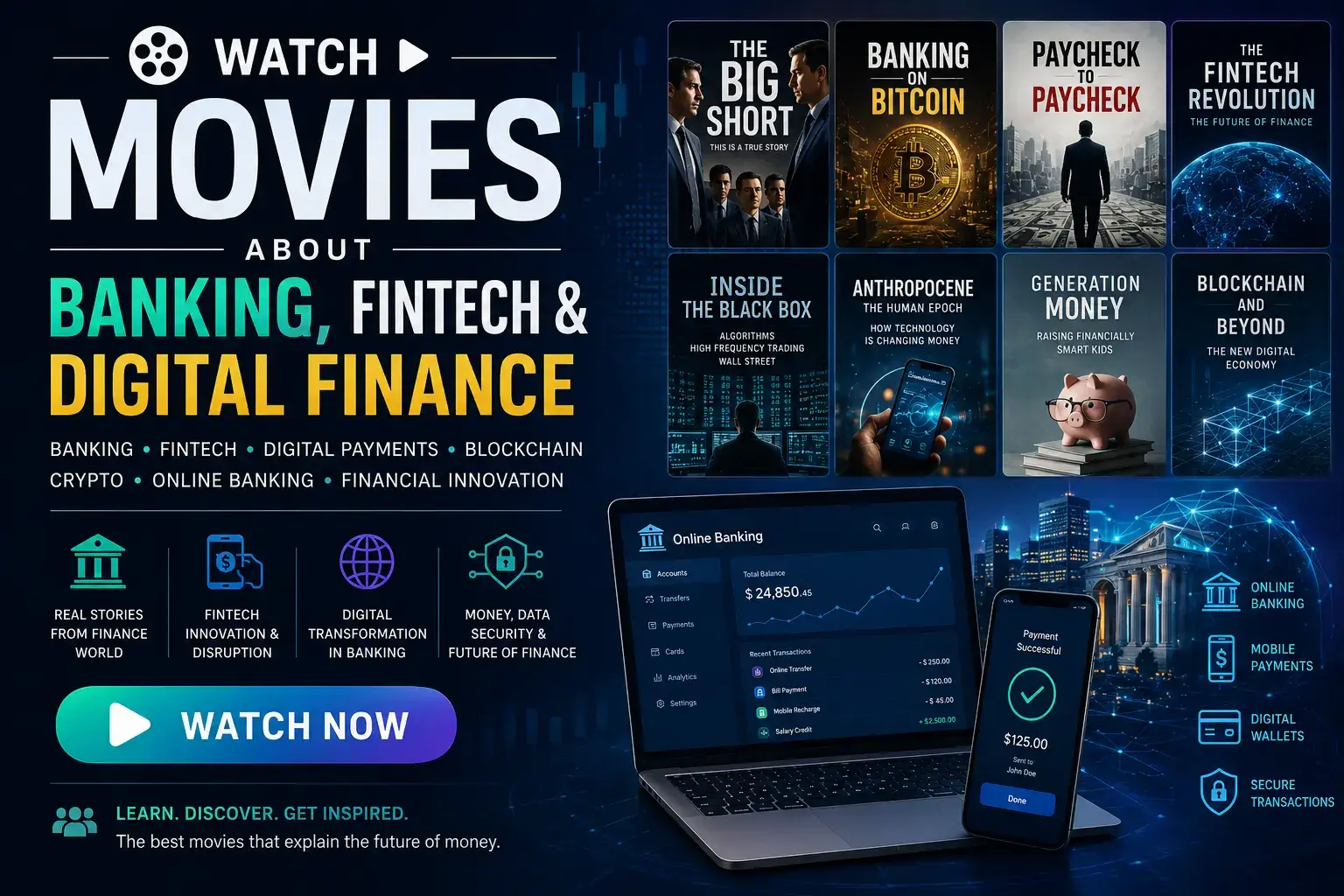
Watch Movies About Banking, FinTech & Digital Finance
Banking has changed dramatically from the traditional branch, paper statement and physical checkbook model. Today, financial services are increasingly powered by software, cloud infrastructure, artificial intelligence, real-time payments, digital identity systems, automated compliance tools and connected financial platforms. For anyone interested in money, technology, business or the future of financial services, banking and fintech movies offer an engaging way to understand how this transformation is happening.
Our collection of banking movies, fintech documentaries and digital finance videos explores the technologies, companies, business models and financial systems shaping modern economies. These topics go far beyond traditional banking. They include mobile banking, online payments, digital wallets, payment processing, open banking, financial cybersecurity, banking automation, artificial intelligence in finance, wealth management technology, insurance technology and the rapidly developing world of embedded financial services.
Whether you are a finance professional, technology enthusiast, entrepreneur, investor, student or simply curious about how modern financial systems work, movies about banking and financial technology can provide useful context around some of the biggest changes taking place across global markets.
Why Watch Movies About Banking and FinTech?
Financial technology is one of the most important intersections between technology and the global economy. Every time a customer opens a bank account through an application, pays with a digital wallet, receives an instant payment, applies for a financial product online or checks an investment portfolio from a smartphone, software is working behind the scenes.
Movies and documentaries can make these complicated subjects easier to understand by connecting technology with real-world businesses and human experiences. Instead of looking at banking software as a collection of technical systems, viewers can see how financial technology affects consumers, businesses, financial institutions and entire industries.
A good fintech documentary can introduce concepts such as payment processing, digital banking platforms, financial data, cybersecurity, fraud prevention and automated decision-making without requiring viewers to have an advanced financial or technical background.
These movies can also provide a broader understanding of the competitive environment surrounding banks and technology companies. Traditional financial institutions are investing heavily in digital transformation while fintech companies are developing new approaches to payments, lending, investing, insurance, accounting and financial management.
Digital Banking: From Branches to Software Platforms
Digital banking is one of the clearest examples of how technology has changed financial services. Customers increasingly expect to open accounts, transfer money, manage cards, review transactions and access financial products without visiting a physical branch.
Modern digital banking depends on a large technology ecosystem. A banking application may look simple on a smartphone, but behind the interface are authentication systems, databases, application programming interfaces, transaction processing platforms, fraud detection systems, compliance infrastructure, notification services and security controls.
Movies about digital banking can help viewers understand this transformation from a customer perspective. The focus is not simply on a banking application. It is on how financial institutions redesign their products and operating models around digital experiences.
Modern banking software also increasingly supports automation. Routine processes such as customer onboarding, transaction monitoring, document verification, notifications, reporting and certain forms of risk assessment can be handled by software systems. This allows financial institutions to improve operational efficiency while maintaining controls around sensitive financial activities.
FinTech Innovation and the New Financial Ecosystem
The term fintech combines finance and technology, but the industry encompasses a very broad range of services. Fintech companies can operate in payments, lending, banking, wealth management, accounting, insurance, identity verification, fraud prevention, financial analytics and business finance.
Fintech innovation is particularly interesting because new financial products are often created by combining technologies that already exist. Cloud computing, mobile applications, APIs, artificial intelligence, machine learning, data analytics and digital identity technologies can be combined to create entirely new customer experiences.
For example, a modern financial platform may connect a customer account with budgeting tools, automated notifications, investment information and payment services. A business finance platform may combine invoicing, accounting, payment collection, expense management and financial reporting in a single interface.
These developments are changing the relationship between financial institutions and technology providers. Banks increasingly operate as technology-driven organizations, while fintech companies are becoming important providers of specialized financial infrastructure.
Artificial Intelligence in Banking and Financial Services
Artificial intelligence has become one of the most important technology topics in financial services. AI can be applied to customer service, fraud detection, financial analytics, document processing, risk management, cybersecurity, personalization and operational automation.
AI-powered financial systems can process large amounts of information much faster than traditional manual workflows. This can help organizations identify unusual transaction patterns, prioritize potential fraud alerts, automate repetitive support tasks and provide more personalized digital experiences.
Generative AI is also creating new possibilities for financial institutions. Employees can use AI-based assistants to summarize documents, analyze information, generate reports, search internal knowledge and support customer service workflows. At the same time, financial organizations must carefully consider privacy, security, accuracy, governance and regulatory requirements when implementing AI.
Movies and documentaries exploring artificial intelligence in finance can therefore provide a useful introduction to both the opportunities and challenges of automated financial decision-making.
Payment Technology and the Evolution of Digital Payments
Payments are at the center of the modern fintech ecosystem. Consumers now have access to cards, mobile wallets, bank transfers, instant payment networks, online checkout systems and other digital payment methods.
Behind every digital transaction is a complex payment infrastructure. Payment gateways, payment processors, merchant systems, banks, card networks, fraud prevention platforms and identity verification services may all participate in the transaction lifecycle.
Payment technology is also becoming increasingly important for online businesses. Companies need secure checkout experiences, reliable payment processing, automated reconciliation, fraud monitoring and support for multiple payment methods.
Movies about digital payments can help explain why seemingly simple transactions require sophisticated financial technology infrastructure. They can also demonstrate how payment innovation changes consumer expectations and creates new opportunities for businesses.
Digital Wallets and Mobile Financial Services
Smartphones have transformed the way people interact with financial services. A digital wallet can store payment credentials, support transactions and integrate with other digital services. Mobile banking applications can provide many of the functions that previously required a branch visit.
This shift has created an enormous market for secure mobile financial technology. Authentication, encryption, tokenization, device security and fraud detection are critical components of mobile financial services.
The convenience of mobile banking also creates new responsibilities for consumers. Protecting account credentials, using strong authentication and recognizing fraudulent messages are increasingly important aspects of digital financial literacy.
Financial technology documentaries can make these security considerations easier to understand by showing how digital transactions operate and where risks can emerge.
Open Banking and Financial APIs
Open banking is another major development in modern financial technology. It involves the controlled sharing and integration of financial information through secure technology interfaces, commonly known as APIs.
APIs allow different software systems to communicate with one another. In financial services, this can enable applications to connect with banking infrastructure and deliver services that were traditionally separated across different platforms.
Open banking can support budgeting applications, financial dashboards, account aggregation, payment services and other digital experiences. It also creates important conversations around consent, data privacy, authentication, cybersecurity and consumer control.
Movies exploring open banking and financial APIs can help viewers understand why financial data has become such an important part of the modern digital economy.
Banking Cybersecurity and Financial Data Protection
As financial services become more digital, cybersecurity has become a fundamental part of banking infrastructure. Banks and fintech companies manage highly sensitive information, including account information, payment data, identity information and transaction histories.
Financial cybersecurity involves multiple layers of protection. These can include encryption, identity verification, multi-factor authentication, fraud monitoring, access controls, secure software development, network security and continuous threat monitoring.
Cybersecurity documentaries can demonstrate how financial institutions defend against increasingly sophisticated attacks. They can also show why cybersecurity is not simply an IT department responsibility. Employees, customers, software developers, security teams and executives all play a role in protecting financial systems.
Fraud prevention is another major area of financial security. Automated systems can analyze transaction behavior and identify patterns that may indicate unauthorized activity. Machine learning can help security teams prioritize suspicious activity, although human oversight remains important when financial decisions have significant consequences.
Cloud Computing and Modern Banking Infrastructure
Cloud technology has become an important component of digital transformation across financial services. Cloud platforms can provide scalable computing resources, storage, analytics capabilities and development infrastructure.
For financial institutions, moving workloads to cloud environments can support faster software development and more flexible infrastructure. However, financial organizations must also address security, regulatory compliance, resilience, data governance and operational risk.
The evolution from legacy banking infrastructure toward modern cloud-based architectures is an important story in the development of fintech. It demonstrates how financial institutions are attempting to combine the reliability required by banking with the speed and flexibility expected from modern software companies.
Core Banking Systems and Banking Software
Behind the modern banking experience are core banking systems that manage essential financial operations. These systems can support accounts, balances, transactions, products, interest calculations and other fundamental banking functions.
Traditional core banking infrastructure was often built around long-established technologies and highly controlled operating environments. Modernization efforts increasingly focus on APIs, cloud infrastructure, modular architectures and real-time services.
Banking software is therefore becoming an important technology category in its own right. Financial institutions need systems that can support large transaction volumes while remaining secure, reliable and compliant.
Movies about banking technology can provide an accessible way to explore the difference between the visible customer experience and the complex infrastructure operating underneath it.
Financial Automation and the Future of Operations
Automation is changing how financial organizations handle repetitive processes. Tasks such as invoice processing, reconciliation, document classification, reporting, customer onboarding and compliance workflows can increasingly be supported by automation platforms.
Financial automation can reduce manual work, improve processing speed and help organizations standardize repetitive operations. Intelligent automation can combine traditional workflow systems with artificial intelligence and data analytics.
For businesses, this can create opportunities to reduce operational complexity while giving employees more time to focus on higher-value activities such as customer relationships, strategy and financial analysis.
RegTech and Compliance Technology
Financial services operate in a highly regulated environment. Organizations must monitor transactions, verify customers, maintain records, protect financial data and meet regulatory obligations.
RegTech, or regulatory technology, focuses on using software and data-driven systems to make compliance processes more efficient. Identity verification, transaction monitoring, automated reporting and risk management are examples of areas where technology can support compliance teams.
The growth of RegTech demonstrates that financial technology is not only about creating faster payments or attractive mobile applications. A large part of the fintech ecosystem exists behind the scenes to make financial services safer, more transparent and more manageable.
WealthTech and Digital Investing
Technology has also transformed investing and wealth management. Digital investment platforms can provide portfolio information, market data, financial education, automated investing tools and analytical capabilities through online interfaces.
WealthTech companies are exploring ways to make investment services more accessible and data-driven. Automated portfolio tools and algorithmic financial systems have introduced new approaches to investment management, although investors still need to understand risk, fees, diversification and market volatility.
Movies about digital investing can help viewers understand how technology is influencing the relationship between investors and financial institutions.
Embedded Finance and Financial Services Everywhere
Embedded finance describes the integration of financial services into non-financial digital experiences. Instead of visiting a traditional financial institution, a customer may encounter payment, lending, insurance or financial management functionality directly inside another application or platform.
This model is particularly important for digital businesses and software platforms. A business management platform might offer payment collection. An online marketplace might provide integrated financial services to sellers. A software platform could incorporate expense management or business financing into its existing workflow.
Embedded finance shows how the boundaries between technology companies and financial institutions are becoming less distinct. Financial services are increasingly becoming features integrated into broader digital products.
Cybercrime, Fraud and the Financial Security Arms Race
As financial technology becomes more sophisticated, cybercriminals also develop new techniques. Phishing, account takeover, social engineering, malware and payment fraud can create significant challenges for consumers and organizations.
Modern fraud prevention therefore requires continuous monitoring and adaptation. Financial institutions can combine transaction analytics, behavioral signals, device information, identity verification and automated risk scoring to identify potentially suspicious activity.
Consumers also have an important role. They should be cautious with unexpected payment requests, suspicious links, unsolicited financial offers and requests for authentication codes or passwords.
Banking security documentaries can make these risks more understandable by showing how financial fraud happens and how organizations attempt to prevent it.
Financial Inclusion and Digital Access
One of the most important potential benefits of financial technology is increased access to financial services. Digital accounts, mobile payments and online financial platforms can reduce some barriers associated with traditional financial infrastructure.
However, digital financial inclusion also requires reliable connectivity, affordable technology, user education, strong consumer protections and secure identity systems. Technology alone cannot solve every financial access problem.
Understanding both the opportunities and limitations of digital finance is essential when evaluating the future of banking.
How Businesses Are Using Modern Financial Technology
Financial technology is not limited to banks. Businesses across industries increasingly depend on digital financial infrastructure for payments, payroll, accounting, invoicing, expense management and financial reporting.
Modern business software can connect financial information across departments and automate workflows that previously required spreadsheets or manual data entry. This creates demand for enterprise financial platforms, accounting software, payment APIs, treasury technology and financial analytics.
For business leaders, understanding fintech can therefore be valuable even when their company is not a financial institution. Financial technology increasingly affects how companies sell products, collect payments, manage cash flow and interact with customers.
The Role of Data in Modern Finance
Data is one of the most valuable resources in digital financial services. Transaction data, customer interactions, risk indicators and financial records can provide insights into consumer behavior and business performance.
Financial organizations use data analytics to monitor operations, identify patterns, understand customers and support risk management. However, financial data must be handled responsibly because it can contain highly sensitive information.
Data governance, privacy, security and consent are therefore becoming increasingly important as financial institutions expand their use of analytics and artificial intelligence.
The Future of Banking Technology
The next phase of financial technology is likely to combine several trends rather than depend on a single breakthrough. Artificial intelligence, cloud computing, real-time payments, digital identity, open APIs, cybersecurity automation and advanced analytics are increasingly interconnected.
Future banking platforms may become more personalized, automated and integrated into everyday digital experiences. Customers may interact with financial services through intelligent assistants, automated workflows and embedded financial tools rather than traditional banking interfaces alone.
At the same time, trust will remain essential. Financial institutions must maintain reliability, transparency, privacy and security while adopting new technology.
The future of finance will therefore not simply be about building faster software. It will be about creating financial systems that combine technology with strong security, responsible data practices and useful customer experiences.
What You Can Learn From Banking and FinTech Movies
A carefully selected collection of banking documentaries and fintech movies can introduce viewers to many areas of modern finance and technology. You can explore how traditional banks evolved into digital platforms, how payment technology changed commerce, how fintech startups challenge established institutions and how artificial intelligence is influencing financial operations.
You can also learn about the risks associated with financial technology. Cybersecurity, fraud, privacy, financial misinformation and technology failures are important subjects for anyone using digital financial services.
For students, these movies can provide additional context alongside formal finance, economics, business and computer science education. For professionals, they can offer a broader perspective on the technologies changing the financial services industry.
Topics to Explore While Watching
When watching banking movies or fintech documentaries, consider the technology and business models behind the story. Look for examples of digital banking, payment processing, financial automation, cybersecurity, artificial intelligence, open banking, cloud computing, banking software and data analytics.
Ask how a financial product is delivered, what infrastructure supports it, what risks exist and how technology changes the customer experience. These questions can turn entertainment into a valuable learning opportunity.
- Digital Banking: Explore how banks deliver financial services through web and mobile applications.
- FinTech: Learn how technology companies are creating new financial products and infrastructure.
- Payment Technology: Understand payment gateways, digital wallets, card payments and digital transaction systems.
- Artificial Intelligence: Explore AI applications in fraud detection, customer service, analytics and financial operations.
- Cybersecurity: Learn about protecting accounts, payment systems and sensitive financial information.
- Open Banking: Understand APIs, data connectivity and permission-based financial services.
- Banking Software: Discover the infrastructure supporting accounts, transactions and digital financial products.
- Financial Automation: Explore how software can streamline repetitive finance and accounting processes.
- RegTech: Learn how technology supports compliance, monitoring and financial risk management.
- WealthTech: Explore digital investment platforms and technology-enabled wealth management.
Banking, FinTech and Digital Finance for the Modern Viewer
The financial industry is no longer defined only by bank branches, cash and traditional financial paperwork. Software is now deeply embedded in nearly every part of the financial ecosystem. From mobile banking and digital payments to AI-powered fraud detection and cloud-based banking infrastructure, technology has become fundamental to how money moves and how financial services are delivered.
This transformation creates an enormous range of stories worth exploring. Banking documentaries can examine the history of financial institutions. Fintech movies can explore startups and technological disruption. Cybersecurity documentaries can examine the risks surrounding digital financial systems. Technology-focused financial videos can explain artificial intelligence, payment infrastructure, data analytics and banking software.
For viewers interested in business, finance and technology, these subjects provide a useful way to understand the forces shaping the modern economy.
Start Exploring Banking and Financial Technology
Our banking and fintech movie collection is designed for viewers who want to explore the intersection of finance, technology, business, cybersecurity and digital innovation. From the evolution of online banking to the rise of artificial intelligence in finance, there is an enormous amount to discover.
Explore documentaries and videos covering digital banking, fintech innovation, payment technology, financial cybersecurity, banking software, digital wallets, open banking, financial automation, AI in financial services and the future of digital finance.
Whether you are researching the future of banking, learning about financial technology, studying business innovation or simply looking for informative movies about money and technology, these topics provide a valuable starting point for understanding how financial services are evolving.
Watch, explore and learn how technology is transforming banking, payments and the global financial ecosystem.
Watch Movies About Personal Finance, Money & Financial Education
Money influences almost every part of modern life, from housing and education to retirement, healthcare, entrepreneurship and everyday spending. Yet many people learn about personal finance only through experience. Movies, documentaries and educational videos can provide another way to explore how money works, how financial decisions affect long-term outcomes and why financial literacy has become such an important life skill.
Our collection of personal finance movies, money documentaries and financial education videos explores the subjects that matter most when managing personal wealth. Topics include budgeting, saving, investing, credit, debt management, retirement planning, financial wellness, wealth management, banking, financial technology and long-term financial planning.
Whether you are beginning your financial education journey, improving your household budget, researching investing concepts or simply interested in the economics of everyday life, financial movies can make complex topics easier to understand. They can also provide historical context around markets, banking systems, economic cycles and the changing relationship between consumers and financial institutions.
Why Watch Personal Finance and Money Movies?
Personal finance is more than calculating monthly expenses. It involves understanding income, cash flow, savings, credit, debt, investing, insurance, taxes, retirement and financial risk. These subjects are interconnected, and a decision in one area can influence several others.
Financial documentaries can bring these concepts to life through real-world examples. Instead of reading a definition of compound growth, viewers may see how long-term investing affects wealth accumulation. Instead of simply learning what credit means, a documentary can demonstrate how borrowing decisions influence households and businesses.
Movies can also provide historical perspective. Financial crises, inflationary periods, housing markets, banking developments and investment bubbles have shaped modern financial systems. Understanding these events can help viewers recognize why financial planning and risk management matter.
Financial Literacy: The Foundation of Better Money Decisions
Financial literacy means having the knowledge and confidence to make informed financial decisions. It includes understanding basic concepts such as income, expenses, saving, borrowing, interest, investment risk and financial planning.
Strong financial literacy does not require becoming a professional investor or economist. It starts with understanding personal cash flow and recognizing the difference between short-term spending and long-term financial goals.
Financial education videos can introduce viewers to terminology commonly used by banks, lenders, investment firms and financial institutions. Learning these concepts can make financial products easier to evaluate and can help consumers ask better questions before making important decisions.
Important financial literacy topics include budgeting, emergency savings, credit management, debt repayment, insurance, investing, retirement planning and tax-aware financial decisions.
Budgeting and Cash Flow Management
Budgeting is one of the most practical areas of personal finance. A budget provides a framework for understanding how money enters and leaves a household.
A useful budget can categorize spending into areas such as housing, utilities, transportation, food, insurance, debt payments, subscriptions, entertainment and savings. The objective is not necessarily to eliminate spending. Instead, budgeting helps people understand where their money goes and whether spending aligns with their priorities.
Cash flow management is particularly important because income and expenses do not always occur at the same time. A person may have a strong annual income but still experience financial stress if large expenses arrive before expected income.
Personal finance documentaries can provide examples of how households manage changing expenses, unexpected costs and long-term financial goals.
Saving Money and Building an Emergency Fund
Savings provide financial flexibility. An emergency fund can help a household manage unexpected expenses without immediately relying on high-cost borrowing.
Emergency savings may be used for situations such as unexpected repairs, temporary income disruption, urgent travel or other unplanned expenses. The appropriate amount depends on individual circumstances, income stability and essential monthly costs.
Financial education content can also explain the difference between short-term savings and long-term investing. Money needed for near-term expenses generally has different requirements from money intended for long-term wealth building.
Developing a consistent saving habit can be more important than attempting to predict short-term market movements. Automated transfers and structured savings plans can help make saving part of a regular financial routine.
Compound Growth and Long-Term Wealth Building
Compound growth is one of the most important concepts in long-term finance. When returns are reinvested, future growth can build on previous growth over time.
The impact of compounding becomes increasingly significant over long periods. This is one reason financial education often emphasizes starting appropriate long-term saving and investing habits early rather than waiting for a perfect market environment.
Movies about investing and personal wealth can demonstrate how time, consistency and reinvestment can influence long-term financial outcomes.
However, compound growth does not eliminate investment risk. Returns are not guaranteed, and different financial assets have different levels of volatility, liquidity and risk.
Investing Education for Beginners
Investing is another major subject explored by financial documentaries. Investing involves putting money into assets with the expectation of achieving future financial returns, while accepting a degree of risk.
Common investment categories include stocks, bonds, mutual funds, exchange-traded funds, real estate and other financial assets. Each has different characteristics relating to risk, potential return, liquidity, fees and time horizon.
Educational investing content can help viewers understand concepts such as diversification, asset allocation, volatility, risk tolerance, investment horizon and portfolio construction.
Rather than focusing only on short-term market predictions, quality financial education emphasizes understanding the relationship between risk and potential return.
Portfolio Management and Asset Allocation
Portfolio management involves determining how investments are selected, monitored and organized. Asset allocation refers to how a portfolio is distributed across different asset categories.
The appropriate allocation depends on factors such as financial goals, investment horizon, risk tolerance and liquidity requirements. A long-term retirement portfolio may have different characteristics from money being saved for a near-term purchase.
Diversification is another important concept. Holding a range of investments can help reduce dependence on the performance of a single asset, sector or company. Diversification does not guarantee profits or eliminate losses, but it can be an important part of risk management.
Understanding Credit and Credit Scores
Credit is a central part of modern personal finance. Consumers may use credit cards, mortgages, personal loans, auto financing and other forms of borrowing to manage large purchases or cash-flow requirements.
Credit education helps consumers understand interest rates, repayment schedules, credit utilization, fees, loan terms and the potential consequences of missed payments.
Credit scores can also influence access to certain financial products and the terms offered by lenders. Different countries use different credit reporting systems and scoring models, but the general principle is similar: lenders use financial information to evaluate credit risk.
Movies and financial education videos can help viewers understand why responsible borrowing and timely repayment are important components of financial wellness.
Debt Management and Responsible Borrowing
Debt can be useful when managed responsibly, but expensive or poorly structured debt can create long-term financial pressure. Understanding the cost of borrowing is therefore an essential financial skill.
Interest rates, fees, repayment periods and compounding can significantly affect the total cost of a loan. A loan with a lower monthly payment may still cost more over its full term if the repayment period is substantially longer.
Financial education content can help viewers compare different borrowing structures and understand concepts such as annual percentage rates, fixed and variable rates, secured and unsecured loans and refinancing.
Debt management strategies should always consider individual circumstances. There is no universal solution for every household, and important financial decisions may benefit from qualified professional advice.
Mortgage and Home Financing Education
For many households, housing represents one of the largest financial decisions they will make. Understanding mortgage financing can therefore be an important part of financial literacy.
Home financing involves more than the advertised interest rate. Buyers may need to consider down payments, loan terms, closing costs, insurance, taxes, maintenance, property expenses and the overall affordability of the purchase.
Financial documentaries can help explain how housing markets interact with interest rates, household income, lending standards and broader economic conditions.
Retirement Planning and Long-Term Financial Security
Retirement planning is a long-term financial process. It involves estimating future expenses, considering potential income sources and determining how much needs to be saved or invested over time.
Retirement systems differ across countries, so the specific accounts, tax rules and government benefits available to an individual depend on their location.
Nevertheless, several general principles are widely relevant. Starting early can provide more time for savings to grow. Diversification can help manage investment risk. Understanding fees and taxes can improve long-term planning. Periodically reviewing financial goals can help account for changing income, expenses and life circumstances.
Retirement documentaries can also explore how demographics, longevity, inflation and changing employment patterns are influencing retirement planning.
Financial Planning and Goal-Based Money Management
Financial planning connects individual money decisions with long-term goals. Instead of managing each financial product separately, a comprehensive plan considers income, spending, savings, investments, insurance, taxes, debt and future objectives.
Goals may include building an emergency fund, purchasing a home, funding education, starting a business, preparing for retirement or creating long-term family wealth.
A goal-based approach can make financial decisions easier to evaluate. Every major financial decision can be considered in relation to its effect on short-term stability and long-term objectives.
Wealth Management and Personal Wealth
Wealth management involves coordinating financial resources with long-term goals. It can include investment management, financial planning, tax considerations, estate planning, insurance and retirement strategies.
For higher-net-worth households, financial decisions can become increasingly complex. Investment diversification, tax-efficient structures, business ownership, estate considerations and risk management may require professional assistance.
Financial documentaries about wealth management can provide insight into how wealthy individuals and families approach capital preservation, investment diversification and long-term planning.
Insurance and Financial Risk Management
Financial planning is not only about growing wealth. Protecting financial resources against major risks is equally important.
Insurance can transfer certain financial risks from an individual or business to an insurance provider in exchange for premiums. Common forms include health, life, property, auto, disability and business insurance, depending on individual circumstances and local markets.
Understanding deductibles, coverage limits, exclusions, premiums and policy terms is important before purchasing insurance. The appropriate level of coverage depends on personal circumstances, assets, income and potential risks.
Movies about financial planning can help viewers recognize why risk management should be considered alongside saving and investing.
Taxes and Personal Financial Planning
Taxes can have a significant impact on household finances and investment outcomes. Tax systems vary considerably by country, state or province and individual circumstances.
Financial education can introduce viewers to concepts such as taxable income, capital gains, deductions, tax-advantaged accounts and tax-efficient investment strategies. However, tax rules can be complex and change over time, so specific tax decisions should be based on current local regulations and qualified professional guidance.
Understanding the relationship between taxes and financial planning can help individuals ask better questions when working with accountants, financial planners or other professionals.
Financial Technology and Personal Finance
Technology has changed how consumers manage money. Mobile banking applications, budgeting software, digital wallets, automated savings tools and investment platforms have made financial information more accessible.
Fintech applications can provide real-time transaction information, spending analytics, automated alerts and digital financial services. These tools can make money management more convenient, but users should also consider privacy, security, fees and data-sharing policies.
Financial technology is increasingly becoming part of everyday personal finance, connecting banking, payments, investing and financial planning through digital platforms.
Digital Banking and Everyday Money Management
Online and mobile banking allow consumers to monitor accounts, transfer funds, pay bills and manage financial products without visiting a physical branch.
Digital banking can also support better financial awareness by providing real-time notifications and transaction histories. Regularly reviewing account activity can help consumers identify unexpected charges and recognize spending patterns.
Security remains essential. Strong authentication, secure passwords, device protection and caution around suspicious messages are important practices for anyone using digital financial services.
Behavioral Finance and the Psychology of Money
Financial decisions are influenced by psychology as much as mathematics. People can make decisions based on emotions, social pressure, fear, optimism, habits and past experiences.
Behavioral finance examines how psychological factors influence financial decision-making. Concepts such as loss aversion, overconfidence, herd behavior and present bias can help explain why people sometimes make decisions that conflict with their long-term financial objectives.
Money movies and documentaries can make these behavioral patterns easier to recognize. Understanding personal financial behavior can be an important step toward building better habits.
Inflation and Purchasing Power
Inflation is another fundamental financial concept. When prices rise over time, the purchasing power of a fixed amount of money can decline.
Inflation affects household budgets, savings decisions, borrowing costs and investment planning. A financial plan that ignores changing purchasing power may underestimate future expenses.
Financial documentaries covering economic history can help viewers understand how inflation affects consumers, businesses, interest rates and financial markets.
Interest Rates and the Cost of Money
Interest rates influence borrowing and saving decisions across the economy. Mortgage rates, consumer loans, business financing and savings products can all be affected by changes in interest-rate environments.
Central banks use monetary policy to influence economic conditions, and their decisions can affect financial markets and consumer borrowing costs.
Understanding interest rates is therefore valuable for both personal finance and broader economic literacy.
Economic Cycles and Financial Markets
Financial markets move through periods of growth, volatility and decline. Economic conditions can influence employment, consumer spending, corporate profits, interest rates and asset prices.
Movies about financial markets can provide historical examples of market booms, financial crises and periods of economic uncertainty. These stories can help viewers understand why investing requires a long-term perspective and appropriate risk management.
Historical performance does not guarantee future results, and financial markets can behave unpredictably. Educational content should therefore be used to develop knowledge rather than as a substitute for personalized investment advice.
Emergency Planning and Financial Resilience
Financial resilience means having the capacity to handle unexpected changes. This can include maintaining appropriate emergency savings, managing debt carefully, protecting income and reviewing insurance coverage.
Financial resilience became an especially visible topic during periods of economic uncertainty when households experienced changes in employment, expenses and investment values.
Personal finance movies can demonstrate why preparing for uncertainty is an important part of financial planning.
Financial Independence and Long-Term Goals
Financial independence generally refers to having sufficient financial resources to support desired living expenses without relying entirely on active employment income. The path toward financial independence varies considerably between individuals.
Key factors can include savings rates, income growth, investment returns, expenses, debt levels, taxes and time horizon.
Financial education content can help viewers understand the mathematics behind long-term wealth building while also emphasizing realistic expectations and risk management.
Money Management for Families
Household financial planning becomes more complex when multiple people share financial responsibilities. Families may need to coordinate housing costs, education expenses, insurance, childcare, transportation, savings and retirement goals.
Open communication can be an important part of household money management. Clear financial goals and regular budget reviews can help families understand priorities and make decisions together.
Financial education movies can provide relatable examples of how different households approach spending, saving and long-term planning.
Financial Education for Young Adults
Young adults often make important financial decisions before receiving formal financial education. Opening bank accounts, applying for credit, renting or purchasing housing, starting employment and beginning retirement savings can all have long-term implications.
Learning basic money management early can help build strong financial habits. Important topics include budgeting, credit, emergency savings, insurance, investing and retirement accounts.
Personal finance videos can make these subjects more accessible to students and young professionals who are beginning to manage their own finances.
How to Get More Value From Financial Documentaries
Watching a financial documentary can be more useful when viewers actively evaluate the ideas presented. Consider separating facts from opinions and historical information from predictions.
When a documentary discusses an investment or financial strategy, consider questions such as: What is the risk? What assumptions are being made? What are the fees? What is the time horizon? Could the outcome change under different economic conditions?
This approach turns financial entertainment into a learning experience while reducing the risk of accepting a dramatic claim without examining the underlying evidence.
Important Personal Finance Topics to Explore
- Budgeting: Learn how income and expenses can be organized into a practical spending plan.
- Saving: Explore emergency funds, short-term savings and long-term financial goals.
- Investing: Understand stocks, bonds, funds, diversification, risk and long-term portfolio planning.
- Credit: Learn about credit scores, borrowing costs, utilization and responsible repayment.
- Debt Management: Explore interest rates, loan terms, repayment strategies and refinancing concepts.
- Retirement Planning: Understand long-term savings, investment horizons and retirement income planning.
- Wealth Management: Explore portfolio management, financial planning, risk management and wealth preservation.
- Financial Technology: Discover how mobile banking, fintech applications and digital payments are changing personal finance.
- Insurance: Learn how financial risk can be managed through appropriate insurance coverage.
- Tax Planning: Understand why taxes can influence saving, investing and retirement decisions.
- Financial Wellness: Explore the relationship between financial stability, financial habits and long-term confidence.
- Behavioral Finance: Understand how emotions and cognitive biases can influence financial decisions.
The Future of Personal Finance
The future of personal finance will increasingly be shaped by technology. Artificial intelligence, automated financial planning, real-time banking, personalized financial analytics and digital investment platforms are changing how consumers interact with money.
AI-powered tools may help consumers categorize spending, identify recurring expenses, summarize financial information and provide educational insights. However, automated recommendations must be evaluated carefully because financial decisions involve personal circumstances, risk tolerance and long-term objectives.
Open banking and financial APIs may also make it easier for consumers to view information from multiple financial institutions in one place. This could create more personalized financial dashboards and automated financial management experiences.
Security and privacy will remain critical as more financial information becomes digitally connected. The future of personal finance will therefore depend not only on convenience but also on responsible technology, strong security and consumer trust.
Why Financial Education Matters in a Digital Economy
The modern consumer encounters financial products through websites, mobile applications, social media, online marketplaces and digital advertising. Financial services are becoming easier to access, but this also makes financial literacy increasingly important.
Consumers need to understand fees, interest rates, contractual terms, investment risk, privacy policies and security practices before using financial products.
Financial education can provide the foundation for asking the right questions. It can help people compare financial products, understand risk and recognize when professional advice may be appropriate.
Explore Movies About Money, Finance and Wealth
Personal finance movies and financial documentaries cover a remarkable range of subjects. Some focus on household money management, while others explore investing, banking, economic crises, wealth creation, financial technology or the psychology of money.
Together, these stories provide a broader perspective on how individuals and institutions interact with money. They can help viewers understand why financial decisions matter and how financial systems influence everyday life.
From budgeting and saving to investing and retirement planning, every stage of financial life presents opportunities to learn. The more familiar viewers become with financial concepts, the easier it becomes to evaluate financial information critically.
Start Your Financial Education Journey
Explore our collection of personal finance movies, money documentaries and financial education videos covering budgeting, saving, investing, credit, debt management, retirement planning, wealth management, banking, financial technology and financial wellness.
Whether you are learning the fundamentals of money management, researching investing concepts, exploring the psychology of wealth or following the evolution of digital finance, these videos can provide an engaging starting point.
Use financial documentaries as an opportunity to learn, compare perspectives and develop a stronger understanding of the financial world. Always verify important financial, investment, tax or credit information using current authoritative sources before making significant financial decisions.
Watch, learn and explore the ideas shaping personal finance, financial education and the future of money.
Watch Movies About Cybersecurity, Cybercrime & Data Protection
Technology has transformed the way people communicate, work, shop, bank and manage information. Businesses now depend on cloud platforms, connected devices, software applications, digital identity systems and online services to operate every day. With this digital transformation comes an equally important responsibility: protecting systems, data and people from cyber threats.
Our collection of cybersecurity movies, cybercrime documentaries and technology videos explores the rapidly changing world of digital security. These stories cover cybersecurity technology, ransomware, data protection, privacy, identity security, cloud security, network protection, enterprise cybersecurity, security awareness and the evolving risks facing connected organizations.
Cybersecurity documentaries can provide a fascinating introduction to the technology behind modern security. They can also reveal how cyber incidents affect businesses, governments, financial institutions and individuals. From large-scale data breaches to ransomware incidents and identity theft, cybersecurity has become a major business and technology concern across virtually every industry.
Why Watch Cybersecurity and Cybercrime Movies?
Cybersecurity can be difficult to understand because much of it operates invisibly. A secure login, encrypted connection, endpoint protection system or security monitoring platform may work continuously without the user ever seeing it.
Movies and documentaries make these concepts easier to visualize by connecting technology with real-world events. A cybersecurity documentary can explain why organizations invest in security software, why data protection matters and how companies respond when digital systems are disrupted.
For technology professionals, these movies can provide broader industry context. For business leaders, they can demonstrate why cyber risk belongs in enterprise risk management. For students, they can introduce important information security concepts. For everyday users, they can provide practical awareness about privacy, identity protection and digital security.
The Growing Importance of Cybersecurity
Modern businesses depend on digital infrastructure for almost every critical function. Customer information, payment systems, employee records, intellectual property, applications and operational data may all be stored or processed digitally.
This dependence makes cybersecurity a strategic business priority rather than simply an IT concern. A significant security incident can affect operations, reputation, customer trust, regulatory obligations and financial performance.
Organizations therefore increasingly approach cybersecurity as an enterprise-wide risk management discipline. Security teams work with executives, legal departments, compliance professionals, developers, human resources teams and employees to reduce exposure and improve resilience.
Cybercrime and the Digital Threat Landscape
Cybercrime encompasses a wide range of illegal activity involving computers, networks, digital accounts and information systems. Threats can include fraud, identity theft, malicious software, unauthorized access, extortion and data theft.
Cybercrime documentaries often focus on the people, organizations and technologies involved in major incidents. These stories can demonstrate how criminals exploit weaknesses in technology as well as weaknesses in human behavior.
Understanding the threat landscape helps organizations prioritize security investments. Not every threat presents the same level of risk, and security teams must consider the sensitivity of their data, the importance of their systems and the potential business impact of different incidents.
Ransomware and Business Resilience
Ransomware has become one of the most visible cybersecurity threats. In a ransomware incident, malicious software can disrupt access to systems or data and criminals may attempt to demand payment in exchange for restoring access or avoiding the release of stolen information.
Ransomware documentaries can demonstrate why organizations need layered security and strong business continuity planning. Preventing every incident is difficult, so resilience also depends on preparation, monitoring, backup strategies, access controls and tested recovery procedures.
Organizations should maintain appropriate backups, protect privileged accounts, monitor unusual activity and regularly review their incident response plans. Recovery planning can be just as important as prevention.
Data Protection and Information Security
Data has become one of the most valuable resources in the digital economy. Businesses store customer information, employee records, financial data, intellectual property and operational information across applications and infrastructure.
Data protection focuses on ensuring that information is appropriately collected, stored, accessed, transmitted and disposed of. Security controls can help protect data against unauthorized access, accidental exposure and malicious activity.
Important data protection concepts include access control, encryption, authentication, data classification, secure storage, monitoring and retention policies.
Cybersecurity documentaries can help viewers understand why protecting information requires more than installing security software. Effective data protection combines technology, policies, processes and employee awareness.
Cloud Security in the Modern Enterprise
Cloud computing has transformed enterprise technology. Organizations can use cloud platforms for applications, databases, storage, analytics, collaboration and business operations.
Cloud adoption also changes the cybersecurity model. Security teams must understand identities, permissions, configurations, applications, data flows and third-party services across cloud environments.
Cloud security therefore involves multiple layers of protection. Identity and access management, encryption, security monitoring, configuration management, vulnerability management and data protection can all contribute to a secure cloud environment.
Movies about cloud security can provide valuable context around the challenges organizations face when moving critical workloads from traditional infrastructure to modern cloud platforms.
Identity and Access Management
Identity is at the center of modern cybersecurity. Employees, customers, applications and devices may all require controlled access to digital resources.
Identity and access management, commonly known as IAM, focuses on ensuring that the right users and systems receive appropriate access to the right resources.
Strong authentication, multi-factor authentication, role-based access controls and regular permission reviews can reduce the risk associated with compromised credentials and excessive privileges.
As organizations adopt cloud applications and remote work environments, identity security has become increasingly important. A strong security program must understand not only where data is stored but also who can access it and under what conditions.
Zero Trust Security
Zero trust is a security approach based on the principle that access should not automatically be trusted simply because a user or device is inside a traditional network boundary.
Modern organizations can have employees, applications and devices connecting from many locations. This makes traditional perimeter-focused security models less suitable for some environments.
Zero trust strategies can emphasize identity verification, least-privilege access, continuous evaluation and segmentation. The goal is to limit unnecessary access and reduce the potential impact of compromised accounts or devices.
Cybersecurity documentaries discussing enterprise transformation can help viewers understand why zero trust has become an important topic in modern security architecture.
Network Security and Digital Infrastructure
Networks connect users, applications, devices and data. Protecting these connections is an important component of information security.
Network security can include firewalls, secure access technologies, segmentation, traffic monitoring, intrusion detection and other protective controls. Organizations also need visibility into their infrastructure so security teams can identify unusual behavior.
The rise of cloud services and distributed applications has made network architecture more complex. Security teams increasingly need to protect hybrid environments that combine cloud infrastructure, corporate systems, remote users and third-party services.
Endpoint Security and Device Protection
Every laptop, workstation, smartphone and connected device can represent an important part of an organization's security environment. Endpoint security focuses on protecting these devices from malware, unauthorized activity and other threats.
Modern endpoint security platforms can provide monitoring, threat detection, policy enforcement and centralized visibility across large numbers of devices.
Security awareness also matters. Employees can encounter suspicious messages, fraudulent websites or unexpected files during everyday work. Technology can reduce risk, but users remain an important part of the security ecosystem.
Security Operations Centers and Continuous Monitoring
Large organizations may operate security operations centers, commonly called SOCs, to monitor security events and investigate potential threats.
A SOC can bring together security analysts, monitoring systems, threat intelligence, incident response processes and security analytics. The objective is to identify suspicious activity and coordinate an appropriate response.
Security monitoring is increasingly supported by automation and analytics. Large organizations can generate enormous amounts of security data, making prioritization essential.
Cybersecurity documentaries can provide an interesting look into the people and technologies responsible for monitoring digital environments around the clock.
Threat Intelligence and Cyber Risk
Threat intelligence involves collecting and analyzing information about cybersecurity threats and the techniques used by malicious actors. Security teams can use intelligence to understand potential risks and improve defensive strategies.
Cyber risk management goes beyond identifying technical vulnerabilities. Organizations must consider the business consequences of security incidents, including operational disruption, financial losses, regulatory exposure and reputational damage.
Enterprise cybersecurity programs increasingly connect technical security metrics with broader business risk. This allows executives to make better-informed decisions about security investments and resilience.
Application Security and Secure Software Development
Software applications are central to modern businesses, which makes application security an important part of the cybersecurity lifecycle.
Application security focuses on identifying and reducing security weaknesses throughout software development and operation. Security can be integrated into requirements, architecture, development, testing, deployment and ongoing monitoring.
Secure software development practices can help organizations reduce vulnerabilities before applications reach production. Code review, dependency management, security testing and access control are examples of areas that can contribute to stronger application security.
As businesses increasingly rely on APIs and cloud-native applications, developers and security teams must work together to protect digital services.
API Security and Connected Applications
APIs allow different software systems to communicate. They are essential to modern applications, financial services, e-commerce platforms, healthcare systems and enterprise software.
Because APIs can provide access to sensitive data and business functionality, API security is an important part of application security. Organizations need appropriate authentication, authorization, monitoring and data protection controls around API-based services.
As more businesses adopt interconnected software ecosystems, securing application-to-application communication becomes increasingly important.
Privacy in the Digital Economy
Privacy has become a major issue as organizations collect more information about customers and users. Websites, mobile applications, online services and connected devices can generate significant amounts of data.
Privacy involves questions about what information is collected, why it is collected, how it is used, how long it is retained and who can access it.
Data privacy and cybersecurity overlap but are not identical. Cybersecurity focuses heavily on protecting systems and information, while privacy also considers appropriate data use and individual rights.
Privacy-focused documentaries can help viewers understand why responsible data management is becoming increasingly important for technology companies and financial institutions.
Identity Theft and Personal Security
Identity theft can occur when criminals obtain and misuse personal information. Compromised credentials, fraudulent communications and data exposure can all create risks for individuals.
Consumers can improve their digital security by using strong unique passwords, enabling multi-factor authentication, keeping software updated and being cautious with unexpected requests for sensitive information.
Regularly reviewing financial accounts and important online services can also help identify suspicious activity earlier.
Cybersecurity movies that explore identity theft can demonstrate how seemingly small security mistakes can have broader consequences.
Security Awareness and the Human Factor
Technology is only one part of cybersecurity. Human behavior can have a major influence on an organization's security posture.
Employees may encounter phishing messages, fraudulent requests, social engineering attempts or accidental data-sharing situations. Security awareness programs can help employees recognize suspicious activity and understand how to report potential incidents.
A strong security culture should encourage employees to report mistakes and suspicious events rather than hide them. Early reporting can help security teams respond before an issue becomes a major incident.
Phishing, Social Engineering and Digital Fraud
Social engineering focuses on manipulating people rather than directly defeating technical security controls. Fraudulent messages can attempt to create urgency, fear or curiosity in order to encourage an unsafe action.
Security awareness training commonly teaches users to verify unexpected requests, inspect communications carefully and avoid sharing authentication information.
Organizations can also implement technical controls that reduce exposure to suspicious messages and unusual account activity.
Cybercrime documentaries can demonstrate the psychological side of digital fraud and explain why awareness remains an essential cybersecurity control.
Incident Response and Cybersecurity Recovery
No organization can assume that security incidents will never happen. Incident response planning prepares teams to detect, contain, investigate and recover from cybersecurity events.
An incident response program can define responsibilities, communication procedures, escalation processes and recovery priorities.
After an incident, organizations may also conduct a post-incident review to identify lessons and improve security controls. This continuous improvement process is an important part of mature cybersecurity programs.
Business Continuity and Disaster Recovery
Cybersecurity and business continuity are closely connected. A security incident can disrupt applications, communication systems, customer services and operational processes.
Business continuity planning considers how essential services can continue during disruptions. Disaster recovery focuses on restoring technology and data following an incident or outage.
Organizations should regularly test recovery plans because documentation alone does not guarantee effective recovery. Testing can reveal dependencies, communication gaps and recovery challenges before a real incident occurs.
Security Compliance and Governance
Businesses in many industries must meet regulatory, contractual and internal security requirements. Governance, risk and compliance programs help organizations establish policies, monitor risk and demonstrate appropriate controls.
Compliance is not identical to cybersecurity. Meeting a compliance requirement does not automatically eliminate every security risk. Strong cybersecurity programs combine compliance with continuous risk assessment and technical protection.
Security governance also establishes accountability. Senior leadership needs visibility into major cybersecurity risks and the resources required to manage them.
Enterprise Cybersecurity and Business Risk
Large organizations often operate complex technology environments containing thousands of users, applications, devices and third-party connections.
Enterprise cybersecurity requires coordination across many teams. Security architecture, identity management, endpoint protection, network security, application security, cloud security, data protection and incident response all need to work together.
Cyber risk should also be connected to business priorities. A security control is valuable when it reduces meaningful risk to important business assets and processes.
Cybersecurity in Financial Services
Financial institutions are particularly dependent on cybersecurity because they manage sensitive financial information and high-value transactions.
Banks, payment providers, investment firms and fintech companies use layered security controls to protect accounts, payment systems and customer information.
Financial cybersecurity can include identity verification, transaction monitoring, fraud detection, encryption, access controls and continuous security monitoring.
Documentaries about financial cybercrime can demonstrate why digital security is closely connected to financial stability and consumer trust.
Cybersecurity in Healthcare and Critical Industries
Cybersecurity is important across industries where digital systems support critical services. Healthcare organizations, energy companies, transportation providers, telecommunications businesses and public-sector organizations can face significant consequences when technology is disrupted.
Protecting critical infrastructure requires resilience as well as prevention. Organizations need appropriate access controls, monitoring, incident response and recovery capabilities.
Cybersecurity documentaries can provide broader context by showing how digital security affects society beyond traditional technology companies.
Artificial Intelligence and the Future of Cybersecurity
Artificial intelligence is becoming increasingly relevant to both cybersecurity defense and the broader threat landscape. Security teams can use analytics and machine learning to identify unusual patterns across large datasets.
AI can support security operations by helping analysts prioritize alerts, summarize information and identify relationships between security events.
At the same time, organizations must carefully evaluate the risks associated with AI-generated content, automated decision-making and rapidly evolving threats. Security teams need governance and human oversight when deploying AI-based security systems.
Automation in Security Operations
Modern security environments can generate enormous volumes of alerts and telemetry. Automation can help security teams handle repetitive tasks and focus human expertise on higher-priority investigations.
Security automation may assist with alert enrichment, ticket creation, reporting and predefined response workflows. The appropriate level of automation depends on the organization's risk tolerance and operational requirements.
Automation should complement experienced security professionals rather than eliminate the need for human judgment.
Security Software and Modern Protection Platforms
The cybersecurity industry includes a wide range of security software and technology platforms. Organizations may deploy endpoint protection, identity security, cloud security, vulnerability management, security information and event management, email security and data protection technologies.
Because security environments differ significantly, organizations typically evaluate technology based on their specific infrastructure, risk profile, compliance requirements and operational capabilities.
Cybersecurity movies can provide an accessible introduction to the broader security technology ecosystem and explain why organizations use multiple layers of protection rather than relying on a single security product.
Vulnerability Management and Security Testing
Software and infrastructure can contain weaknesses that attackers may attempt to exploit. Vulnerability management involves identifying, prioritizing and addressing security weaknesses.
Organizations may use automated scanning, security assessments and controlled testing to understand their exposure. Prioritization is important because not every vulnerability presents the same level of business risk.
Effective vulnerability management considers the importance of the affected system, potential impact, exposure and available mitigations.
Third-Party and Supply Chain Security
Businesses increasingly depend on external software providers, cloud platforms, contractors and technology vendors. This creates additional cybersecurity considerations.
A company can maintain strong internal controls while still being exposed to risks originating from a third-party provider. Vendor security assessments, contractual requirements, access controls and ongoing monitoring can help organizations manage these dependencies.
Supply chain security has therefore become an important topic in enterprise cybersecurity and technology risk management.
Cybersecurity Careers and Professional Skills
The growing importance of digital security has created demand for cybersecurity professionals across many disciplines.
Security careers can include security engineering, cloud security, security analysis, incident response, governance and compliance, application security, identity management, risk management and security architecture.
Successful security professionals often combine technical knowledge with communication, analytical thinking and business awareness. Cybersecurity is not limited to coding or technical troubleshooting. Many roles require understanding organizational risk and explaining security decisions to non-technical stakeholders.
Cybersecurity Education for Students
Students interested in cybersecurity can use documentaries and technology movies as a starting point for exploring the field. Topics such as networking, operating systems, cloud computing, programming, identity management and information security provide useful foundations.
Educational content should be combined with structured learning and safe, authorized practice environments. Cybersecurity skills should always be applied responsibly and only to systems where the learner has explicit permission to test.
How Businesses Can Build a Stronger Security Culture
A strong cybersecurity culture begins with leadership. Employees need clear policies, appropriate training and straightforward procedures for reporting suspicious activity.
Organizations can also establish security principles such as least privilege, strong authentication, regular software updates, secure development practices, data classification and continuous monitoring.
Security should be integrated into business processes rather than treated as an afterthought. When security becomes part of product development, employee onboarding, vendor management and strategic planning, organizations can reduce risk more effectively.
Cybersecurity and Digital Transformation
Digital transformation creates new opportunities for businesses but also changes their security requirements. Cloud adoption, remote work, mobile applications, APIs, automation and artificial intelligence all introduce new technology dependencies.
Organizations should therefore consider security during technology planning rather than waiting until systems are already deployed.
A secure digital transformation strategy balances innovation with risk management, privacy, resilience and regulatory responsibilities.
Important Cybersecurity Topics to Explore
- Cybersecurity: Explore the technologies, policies and processes used to protect digital systems.
- Cybercrime: Learn about the broader impact of digital crime on individuals and organizations.
- Ransomware: Understand business disruption, resilience and recovery considerations.
- Data Protection: Explore methods for protecting sensitive information.
- Cloud Security: Learn about securing modern cloud infrastructure and applications.
- Network Security: Understand how organizations protect connected systems and communication.
- Identity Security: Explore authentication, authorization, IAM and access management.
- Zero Trust: Learn why modern security architectures increasingly emphasize continuous verification.
- Endpoint Security: Understand how organizations protect employee and business devices.
- Privacy: Explore responsible data collection, storage, processing and sharing.
- Security Operations: Discover how SOC teams monitor and investigate security events.
- Threat Intelligence: Learn how organizations analyze emerging cybersecurity risks.
- Application Security: Explore security throughout the software development lifecycle.
- Incident Response: Understand how organizations prepare for and recover from security incidents.
- Business Continuity: Explore strategies for maintaining essential operations during disruptions.
- Security Governance: Learn how organizations connect cybersecurity with business risk and compliance.
The Future of Data Protection
As organizations collect and process increasing amounts of information, data protection will remain a major technology and business priority.
Future security systems are likely to combine identity-based controls, artificial intelligence, automated monitoring, cloud security, privacy technologies and increasingly sophisticated data governance.
Organizations will also need to balance data-driven innovation with responsible privacy practices. Customers increasingly expect companies to protect their information and communicate clearly about how it is used.
The Future of Enterprise Cybersecurity
Enterprise security is evolving from traditional perimeter protection toward distributed, identity-focused and data-centric security architectures.
Cloud applications, remote employees, mobile devices and third-party services mean that organizations cannot rely exclusively on a single network boundary.
Modern cybersecurity programs increasingly focus on continuous visibility, strong identity controls, least-privilege access, security automation, resilience and rapid incident response.
The organizations that manage these areas effectively can create stronger foundations for digital transformation while reducing unnecessary cyber risk.
Why Cybersecurity Awareness Matters for Everyone
Cybersecurity is no longer exclusively a concern for technology professionals. Almost everyone uses online accounts, digital payments, cloud applications, smartphones or connected devices.
Basic security awareness can therefore make a meaningful difference. Users should understand the importance of strong authentication, software updates, privacy settings and careful handling of unexpected communications.
Businesses should similarly ensure that employees understand how their everyday decisions can affect organizational security.
Explore Cybersecurity and Cybercrime Documentaries
Cybersecurity movies and documentaries provide a fascinating way to explore the technology, people and business decisions behind digital security.
From ransomware and major data breaches to cloud security, privacy, identity protection and enterprise risk management, cybersecurity stories demonstrate how deeply technology is connected to modern society.
These documentaries can also help viewers understand why cybersecurity is a continuous process rather than a one-time technology purchase. Threats evolve, systems change and organizations must continually adapt their defenses.
Start Exploring Digital Security
Explore our collection of cybersecurity documentaries, cybercrime movies and technology videos covering data protection, ransomware, cloud security, network security, identity protection, zero trust, security operations, privacy, enterprise cybersecurity and the future of information security.
Whether you are a technology professional, business leader, student, entrepreneur or everyday internet user, cybersecurity education can help you better understand the digital world around you.
Use these movies and documentaries as an educational starting point. For security decisions affecting a real organization, always rely on current authoritative guidance, qualified security professionals and appropriate risk assessments.
Watch, learn and explore the technologies protecting the world's increasingly connected digital economy.
Watch Movies About Artificial Intelligence, AI & Future Technology
Artificial intelligence has moved from a futuristic concept into one of the most important technology developments shaping modern business and society. AI is increasingly being used to analyze information, generate content, automate workflows, assist professionals, power software applications, improve customer experiences and support complex decision-making.
Our collection of AI movies, artificial intelligence documentaries and future technology videos explores the technologies behind this transformation. Discover content covering generative AI, machine learning, large language models, AI agents, robotics, enterprise AI, automation, computer vision, AI infrastructure, cybersecurity and the rapidly evolving digital economy.
Artificial intelligence is not a single technology. It represents a broad ecosystem of algorithms, models, data, computing infrastructure, software platforms and applications. From AI assistants that help employees complete everyday tasks to autonomous systems capable of operating across multiple steps, the possibilities continue to expand.
Watching documentaries and movies about artificial intelligence can be an engaging way to understand these developments. Instead of looking at AI only through technical terminology, viewers can explore the business, economic, social and technological forces driving the industry.
Why Watch Movies About Artificial Intelligence?
Artificial intelligence can be difficult to understand because much of its complexity exists behind the user interface. A person may ask an AI assistant a question and receive an answer within seconds, but behind that experience are models, data processing, computing infrastructure, software systems and sophisticated engineering.
AI documentaries can make these concepts more accessible. They can explore the history of machine intelligence, the development of neural networks, advances in computing and the emergence of generative AI.
Technology documentaries can also show how artificial intelligence is being adopted across industries. Financial services, healthcare, manufacturing, retail, transportation, cybersecurity, marketing and enterprise software are all exploring ways to use AI.
For students, these movies can provide useful context around computer science and emerging technology. For business professionals, they can highlight opportunities for automation and productivity. For technology enthusiasts, they offer an engaging look at what may come next.
The Evolution of Artificial Intelligence
The history of artificial intelligence spans decades. Early researchers explored whether computers could perform tasks associated with human reasoning, problem-solving and language understanding.
Progress was influenced by advances in computing power, algorithms and access to data. Machine learning became increasingly important because systems could learn patterns from examples instead of relying entirely on manually programmed rules.
Later advances in neural networks and deep learning enabled major improvements in areas such as image recognition, speech processing and language technologies.
The development of large-scale AI models accelerated the industry's transformation. Modern systems can process and generate text, images, audio, video and other forms of information, creating a new generation of AI-powered applications.
Machine Learning and Intelligent Systems
Machine learning is a core component of modern artificial intelligence. Instead of programming every possible response, machine learning systems can identify patterns in data and use those patterns to make predictions or generate outputs.
Machine learning can be applied to many different problems. Businesses may use predictive models for demand forecasting, fraud detection, customer analytics, recommendation systems, risk analysis and operational planning.
The quality of a machine learning system depends on many factors, including data quality, model architecture, evaluation methods, computing resources and how the system is deployed.
AI documentaries can provide useful context around the evolution of machine learning and why it has become central to modern software development.
Deep Learning and Neural Networks
Deep learning uses multi-layer neural networks to process complex patterns. These systems have contributed to major advances in computer vision, speech recognition and natural language processing.
Large neural networks require significant computing resources during training and deployment. This has created demand for specialized AI hardware, high-performance computing infrastructure and large-scale cloud platforms.
The development of increasingly capable models has also changed the economics of software. Organizations can now build applications on top of advanced AI models rather than developing every capability from scratch.
Generative AI and the New AI Era
Generative AI represents one of the most significant recent developments in artificial intelligence. Instead of only classifying or predicting information, generative systems can create new text, images, audio, code and other content.
Large language models can generate natural-language responses, summarize documents, assist with writing, analyze information and support software development. Multimodal AI systems can work across multiple types of information, allowing applications to combine text, images, audio and other inputs.
Generative AI has created new opportunities for productivity software, customer service, marketing, education, software engineering, research and enterprise automation.
It has also introduced important questions about accuracy, intellectual property, privacy, security, bias and responsible deployment.
Large Language Models and AI Assistants
Large language models, commonly known as LLMs, are a major foundation of modern generative AI applications. These models are trained on large amounts of data and can process and generate human-like language.
AI assistants built using language models can help users research information, summarize documents, generate drafts, analyze data, write code and interact with software.
Enterprise AI assistants can be connected to organizational knowledge and business systems, potentially allowing employees to search internal information and automate repetitive workflows.
However, AI-generated responses should be evaluated appropriately. AI systems can produce incorrect or incomplete information, which means human review remains important for high-impact decisions.
AI Agents and Agentic AI
One of the most important emerging directions in artificial intelligence is the development of AI agents and agentic systems.
Traditional AI assistants generally respond to individual requests. Agentic AI aims to go further by allowing systems to plan multiple steps, use tools, interact with software and work toward defined objectives with less continuous human intervention.
An AI agent might receive a high-level objective, break it into tasks, gather information, interact with approved tools and evaluate intermediate results.
This creates significant opportunities for enterprise automation. AI agents may eventually support workflows involving customer service, software development, research, business operations, document processing and data analysis.
At the same time, agentic systems introduce new governance requirements. Organizations need appropriate permissions, monitoring, security controls and human oversight when AI systems can take actions rather than simply generate information.
Enterprise AI and Business Transformation
Enterprise AI is increasingly focused on practical business applications rather than experimentation alone. Companies are exploring AI to improve productivity, reduce repetitive work, analyze large datasets and create better customer experiences.
Enterprise AI applications can include intelligent document processing, customer support, sales assistance, financial analysis, supply chain optimization, software development and cybersecurity.
The value of enterprise AI depends on more than model quality. Organizations also need reliable data, secure infrastructure, integration with existing systems, governance processes and employees who understand how to work with AI.
This means successful AI adoption is often a business transformation project rather than simply a software installation.
AI Automation and Intelligent Workflows
Automation has traditionally been used to execute predefined workflows. Artificial intelligence can add another layer by allowing systems to interpret information, classify documents, summarize content and make predictions.
Intelligent automation can combine workflow software, machine learning and generative AI. For example, an organization might automatically receive a document, classify its contents, extract relevant information, route it to the appropriate team and generate a summary.
AI automation can potentially reduce repetitive administrative work and allow employees to focus on tasks requiring judgment, creativity and relationship management.
Robotics and Physical AI
Artificial intelligence is not limited to software. Robotics combines AI with sensors, mechanical systems and physical control to enable machines to interact with the real world.
Industrial robots have been used for decades in manufacturing, but advances in computer vision, machine learning and hardware are creating new possibilities for more flexible robotic systems.
Robots can be used in manufacturing, logistics, warehouses, healthcare research, agriculture and other environments where automation can improve efficiency or safety.
Future technology documentaries can provide a fascinating look at how software intelligence is increasingly connected with physical machines.
Humanoid Robots and Autonomous Machines
Humanoid robotics is receiving significant attention as developers explore machines designed to operate in environments built for humans.
Advances in AI perception, motion planning, sensors, batteries and robotics hardware may enable robots to perform increasingly sophisticated tasks.
However, building capable physical AI systems is considerably more challenging than creating software. Robots must understand physical environments, respond to unexpected situations and operate safely around people.
The development of humanoid robots illustrates how artificial intelligence, mechanical engineering and advanced computing are converging.
Computer Vision and Visual Intelligence
Computer vision allows machines to analyze visual information. Modern computer vision systems can identify objects, interpret images, analyze video and extract information from visual environments.
Computer vision has applications across manufacturing, healthcare, transportation, retail, security, agriculture and robotics.
In manufacturing, visual AI can assist with quality inspection. In transportation, computer vision can support autonomous systems. In retail, it can help analyze inventory and customer environments.
These applications demonstrate how AI can transform raw information into useful business intelligence.
Natural Language Processing
Natural language processing focuses on enabling computers to understand and work with human language.
Modern language models have dramatically expanded what NLP systems can accomplish. Applications can summarize documents, translate languages, classify text, answer questions and generate natural-language content.
Businesses can use NLP to analyze customer feedback, process large document collections, automate support interactions and extract information from unstructured data.
As language interfaces become more capable, interacting with software through natural language may become increasingly common.
AI in Financial Services
Financial services are among the industries with significant potential for AI adoption. Banks, payment companies, investment firms and fintech organizations can use AI for fraud detection, customer service, document processing, risk analytics and operational automation.
AI can process large quantities of financial information and identify patterns that may be difficult to detect manually. However, financial applications require strong governance because incorrect decisions can have serious consequences.
AI in finance therefore involves both technological innovation and careful risk management.
AI in Healthcare and Life Sciences
Healthcare is another area where artificial intelligence is being explored extensively. AI systems can assist with medical imaging research, administrative workflows, drug discovery, data analysis and clinical decision support.
Healthcare AI requires particularly careful validation because patient safety, privacy and regulatory requirements are critical.
Technology documentaries about AI in healthcare can demonstrate both the potential benefits of intelligent systems and the importance of responsible implementation.
AI in Cybersecurity
Cybersecurity teams increasingly use artificial intelligence and machine learning to analyze large amounts of security data, identify unusual behavior and prioritize alerts.
AI can support security operations by helping analysts investigate events and recognize patterns across complex environments.
At the same time, security professionals must consider how AI can be misused. The technology landscape is evolving rapidly, making security governance and continuous monitoring increasingly important.
AI in Marketing and Customer Experience
Businesses are also using AI to personalize customer experiences, analyze consumer behavior, automate content workflows and support sales teams.
AI can help marketers analyze large datasets and identify patterns across customer interactions. Generative AI can also assist with content production, research and campaign workflows.
Responsible AI adoption requires attention to accuracy, transparency, privacy and brand standards. Human oversight remains important when AI-generated material reaches customers.
AI in Software Development
Software engineering is undergoing significant change as AI coding assistants become increasingly capable of generating code, explaining existing systems, writing tests and helping developers troubleshoot problems.
AI-assisted development can improve productivity, particularly for repetitive tasks and initial implementation. Developers still need to review generated code for correctness, security, maintainability and performance.
The future of software development may involve humans directing increasingly capable AI systems while focusing more heavily on architecture, product requirements, system design and quality assurance.
AI Infrastructure and Cloud Computing
Advanced AI requires substantial computing infrastructure. Training and operating large models can require specialized processors, high-speed networking, large-scale storage and sophisticated data center architecture.
Cloud computing providers have become important to the AI ecosystem by offering scalable computing resources and managed AI services.
The growth of AI is also driving investment in data centers, specialized processors, networking technology, energy infrastructure and cooling systems.
This infrastructure layer is an essential part of the AI economy and represents one of the largest intersections between artificial intelligence and enterprise technology.
AI Chips and Specialized Computing
General-purpose processors are not the only hardware used for AI workloads. Specialized accelerators can be designed to efficiently process the mathematical operations required by machine learning models.
Demand for AI computing has created a major ecosystem involving processors, memory, networking, servers and data center infrastructure.
Future AI systems will depend not only on better algorithms but also on advances in computing efficiency, energy management and hardware architecture.
AI Data Centers and Energy Requirements
AI workloads can require significant computing resources, especially when training and serving large models at scale.
This has increased attention on data center efficiency, power availability, cooling technology and sustainable computing.
As AI adoption expands, technology companies and infrastructure providers are exploring more efficient hardware and data center designs to support growing computational requirements.
AI and the Future of Work
Artificial intelligence is changing how many professionals approach knowledge work. Tasks that previously required manual research, document processing or repetitive analysis can increasingly be assisted by AI systems.
This does not necessarily mean that every job will disappear. Instead, the composition of many jobs may change as workers collaborate with AI tools.
Employees who understand how to evaluate AI outputs, formulate effective instructions, verify information and integrate AI into workflows may gain new productivity advantages.
The future workplace is likely to involve a combination of human expertise and increasingly capable AI systems.
AI Productivity and Business Efficiency
One of the strongest business cases for AI is productivity. AI can assist employees with tasks such as summarizing meetings, drafting documents, searching information, analyzing spreadsheets and preparing reports.
Organizations can also use AI to automate back-office workflows, classify documents, route customer requests and support internal knowledge management.
The greatest value often comes when AI is integrated into existing business processes rather than used as a standalone novelty.
AI Governance and Responsible Artificial Intelligence
As AI becomes more powerful, organizations need frameworks for responsible deployment. AI governance addresses questions about security, privacy, transparency, accountability, risk management and appropriate human oversight.
Businesses may need to establish policies governing which data can be used with AI systems, how outputs are reviewed and which applications require additional controls.
Responsible AI is particularly important in high-impact areas such as finance, healthcare, employment and public services.
AI Security and Privacy
AI systems can process sensitive information, which creates important security and privacy considerations.
Organizations need to understand what information is sent to AI services, where it is processed, who can access it and how long it may be retained.
Enterprise AI deployments may therefore require access controls, data classification, monitoring and security policies.
Privacy-aware AI design can help organizations capture the benefits of artificial intelligence without unnecessarily exposing sensitive information.
AI Accuracy and Hallucinations
Generative AI systems can sometimes produce information that appears convincing but is inaccurate. These errors are commonly referred to as hallucinations.
This is one reason human review remains important. AI-generated information should be verified when accuracy matters, particularly in professional, financial, legal, medical or technical contexts.
Improving AI reliability is an active area of research and engineering. Techniques such as retrieval systems, tool use, evaluation frameworks and structured workflows can help improve the reliability of AI applications.
AI Agents and Enterprise Automation
AI agents may become an important bridge between generative AI and enterprise automation. Instead of simply generating text, an agent can potentially interact with approved business systems and complete sequences of tasks.
For example, an enterprise agent could receive a customer request, retrieve relevant information, prepare a response, update an internal system and escalate the case when human intervention is required.
These systems require strong controls. Organizations need to define permissions, monitor actions and establish boundaries around what an AI agent is allowed to do.
AI and Robotics in Manufacturing
Manufacturing is one of the industries where AI and automation can work together particularly effectively.
AI-powered visual inspection can identify product defects. Predictive maintenance systems can analyze equipment data. Robots can perform repetitive physical operations, while optimization algorithms can improve production planning.
The combination of industrial automation, machine learning and real-time analytics is creating increasingly intelligent manufacturing environments.
Autonomous Vehicles and Intelligent Transportation
Autonomous transportation combines computer vision, sensors, machine learning, mapping, decision-making and control systems.
Self-driving technology remains a complex engineering challenge because vehicles must operate safely in unpredictable environments.
AI documentaries exploring autonomous systems can provide insight into the technology required to enable machines to understand roads, traffic, obstacles and human behavior.
AI and Scientific Discovery
Artificial intelligence is also being used to accelerate scientific research. AI systems can analyze large datasets, identify patterns, generate hypotheses and support simulations.
In fields such as materials science, biology and drug discovery, machine learning can help researchers explore possibilities that would be difficult to evaluate manually at the same scale.
The combination of AI and scientific computing could become an important driver of future technological breakthroughs.
AI Education and Learning
Artificial intelligence is changing education by providing personalized learning tools, automated feedback and interactive assistants.
AI systems can help explain concepts, generate practice questions, summarize material and support research. Educators must also consider accuracy, academic integrity and appropriate use.
Learning how AI works is becoming increasingly valuable regardless of career path because AI is becoming part of many professional environments.
AI Innovation and Startup Opportunities
The rapid development of AI has created opportunities for entrepreneurs to build specialized applications around specific business problems.
Rather than creating general-purpose AI models, many startups focus on vertical applications such as healthcare, finance, legal technology, cybersecurity, marketing, customer service and enterprise operations.
The availability of AI APIs and cloud infrastructure has lowered some barriers to building intelligent software, although successful AI products still require strong domain knowledge, reliable data and effective user experiences.
AI Software and Enterprise Platforms
The AI software market includes model platforms, developer tools, enterprise assistants, analytics systems, automation platforms and specialized applications.
Organizations increasingly evaluate AI software based on factors such as performance, integration capabilities, security, privacy, cost and reliability.
Enterprise AI adoption is therefore becoming a technology procurement and strategic planning decision rather than simply an experimental project.
Emerging Technology Beyond AI
Artificial intelligence is a major driver of technological change, but it is part of a larger ecosystem of emerging technologies.
Robotics, quantum computing, advanced semiconductor technology, augmented reality, virtual reality, biotechnology, autonomous systems, edge computing and advanced connectivity are also shaping the future.
These technologies may increasingly converge. AI can provide intelligence to robots, edge devices can process information locally, and advanced computing can accelerate complex simulations.
The future may therefore be defined by the combination of technologies rather than by any single invention.
The Future of Human and Machine Collaboration
One of the most important questions surrounding AI is how humans and machines will work together.
AI systems are particularly effective at processing large quantities of information and performing repetitive computational tasks. Humans contribute context, judgment, creativity, empathy, accountability and domain expertise.
The most productive future may involve systems where AI handles appropriate computational and repetitive tasks while people remain responsible for goals, oversight and important decisions.
How to Learn From AI Movies and Documentaries
AI documentaries can be valuable educational resources, but viewers should distinguish between established capabilities, experimental research and speculative predictions.
When watching a technology documentary, consider what problem a technology solves, what data it requires, how it is evaluated and what limitations it has.
It is also useful to consider the economic side of AI. Who develops the technology? Who provides the computing infrastructure? How does the business model work? What costs are involved? What risks need to be managed?
These questions provide a more complete understanding of artificial intelligence beyond the excitement surrounding new product launches.
Important AI and Future Technology Topics to Explore
- Generative AI: Explore systems that generate text, images, audio, video and software.
- Machine Learning: Learn how algorithms identify patterns and make predictions from data.
- Large Language Models: Understand the technology behind modern language-based AI applications.
- AI Agents: Explore systems designed to plan, use tools and complete multi-step objectives.
- Enterprise AI: Discover how businesses integrate AI into operations and software platforms.
- AI Automation: Learn how intelligent systems can automate repetitive business workflows.
- Robotics: Explore the convergence of AI, sensors, software and physical machines.
- Computer Vision: Understand how machines interpret images and video.
- AI Infrastructure: Explore cloud computing, specialized processors, networking and data centers.
- AI Cybersecurity: Learn how AI can support threat detection, monitoring and security operations.
- Responsible AI: Explore governance, transparency, privacy, safety and human oversight.
- AI in Finance: Discover applications in fraud detection, analytics, customer service and financial automation.
- AI in Healthcare: Explore medical research, data analysis and administrative automation.
- AI in Manufacturing: Learn about intelligent inspection, predictive maintenance and robotics.
- Autonomous Systems: Explore self-driving technology, drones and intelligent machines.
- Future Technology: Discover how AI intersects with robotics, advanced computing and emerging technologies.
The Economic Impact of Artificial Intelligence
AI is increasingly influencing how businesses think about productivity, investment and technology strategy. Companies are evaluating AI infrastructure, software platforms and automation opportunities as part of broader digital transformation initiatives.
The economic impact of AI may extend beyond software companies. Increased demand for computing infrastructure can affect data centers, semiconductor manufacturing, networking equipment and energy systems.
At the business level, AI may change how organizations allocate employee time and how digital services are designed.
The Future of Enterprise Automation
Enterprise automation is likely to evolve from simple rule-based workflows toward more intelligent systems capable of interpreting unstructured information and coordinating multiple tasks.
AI agents, workflow engines, business applications and data platforms may increasingly work together.
This could create software systems where employees define objectives while AI handles parts of the execution process under controlled permissions.
The organizations that benefit most will likely be those that combine AI capabilities with strong data infrastructure, clear processes, security controls and effective human oversight.
The Future of Artificial Intelligence
The future of AI is difficult to predict precisely because the technology is developing rapidly. New model architectures, hardware improvements, data techniques and application designs continue to expand what AI systems can accomplish.
AI may become increasingly embedded in everyday software rather than appearing as a separate application. Search, productivity software, enterprise platforms, customer service systems, creative tools and business applications may increasingly include intelligent capabilities.
AI agents may also become more capable of completing multi-step workflows. Robotics could bring AI further into the physical world. Specialized hardware may make intelligent systems more efficient.
At the same time, responsible development will remain essential. Security, privacy, reliability, governance and human accountability will determine how successfully AI can be deployed at scale.
Why AI Education Matters
Artificial intelligence is becoming a general-purpose technology that can affect many industries and professions. Understanding its basic concepts is therefore useful even for people who do not work directly in technology.
AI education can help people understand what these systems can do, where they have limitations and how they should be used responsibly.
Professionals can benefit from learning how AI may affect their workflows. Business leaders can evaluate potential applications more effectively. Students can develop foundational knowledge for future careers.
Explore AI Movies and Technology Documentaries
AI movies and artificial intelligence documentaries provide an engaging way to explore one of the most important technological transformations of the modern era.
From the history of machine learning to generative AI, autonomous systems, robotics, enterprise automation and AI agents, these stories reveal how computing is evolving from tools that follow explicit instructions toward systems capable of interpreting information and producing sophisticated outputs.
They also provide an opportunity to explore the challenges accompanying this transformation. AI raises important questions about employment, privacy, cybersecurity, intellectual property, governance, safety and the relationship between humans and machines.
Start Exploring Artificial Intelligence and Future Technology
Explore our collection of AI movies, artificial intelligence documentaries and future technology videos covering generative AI, machine learning, AI agents, enterprise AI, robotics, automation, AI software, intelligent systems and emerging technology.
Whether you are a technology professional, entrepreneur, investor, student, business leader or simply curious about the future, these documentaries can provide an accessible introduction to the technologies changing the digital economy.
Use AI movies and documentaries as a starting point for deeper learning. For important business, financial, legal, medical or technical decisions, verify information using current authoritative sources and qualified professionals.
Watch, learn and explore how artificial intelligence is transforming software, business, robotics and the future of technology.
Watch Movies About Insurance, Risk Management & Financial Protection
Insurance is one of the most important mechanisms used to manage financial risk. Individuals, families and businesses face uncertainty every day, from property damage and accidents to cyber incidents, business interruptions, natural catastrophes and unexpected financial losses. Insurance provides a structured way to transfer certain risks while helping people and organizations build greater financial resilience.
Our collection of insurance movies, insurance documentaries and financial protection videos explores the technology, business models and risk-management strategies behind the modern insurance industry. Topics include InsurTech, underwriting, claims management, insurance software, cyber insurance, enterprise risk management, insurance analytics, artificial intelligence, predictive modeling and the future of digital insurance.
Insurance may appear simple from the customer's perspective. A policy is purchased, a premium is paid and coverage is available if a qualifying event occurs. Behind that simple relationship, however, is a highly sophisticated ecosystem involving actuarial science, data analytics, risk assessment, underwriting, claims operations, regulatory compliance, technology platforms and financial markets.
Insurance documentaries can make this complex industry easier to understand by showing how insurers evaluate risk, price policies, process claims and respond to major events. They can also reveal how technology is transforming traditional insurance operations.
Why Watch Movies About Insurance and Risk Management?
Insurance affects almost every major financial decision. Homeowners may need property coverage, businesses may purchase liability insurance, organizations may protect against cyber risk, and individuals may consider life, health or disability coverage.
Understanding insurance can therefore be an important part of financial education. Movies and documentaries provide an engaging way to learn how insurance markets operate and why risk management matters.
For business professionals, insurance documentaries can provide insight into commercial risk and enterprise resilience. For technology professionals, they can demonstrate how InsurTech is transforming underwriting and claims. For consumers, they can provide useful context around premiums, coverage, deductibles and policy terms.
How Insurance Works
Insurance is fundamentally a system for managing uncertainty. Many policyholders contribute premiums to an insurer, and the insurer uses those resources to pay covered claims and operate the business.
The insurer's ability to manage risk depends on analyzing large pools of information. Historical claims, customer characteristics, geographic factors, economic conditions and other variables can influence how risks are evaluated.
Insurers must also maintain sufficient financial resources to meet their obligations. This makes insurance both a risk-management business and a major component of the broader financial system.
Risk Management and Financial Protection
Risk management involves identifying potential threats, estimating their impact and deciding how they should be handled.
Individuals can manage risk through savings, diversification, insurance and careful financial planning. Businesses may combine insurance with cybersecurity controls, business continuity plans, operational safeguards and financial reserves.
Insurance is only one part of risk management. It generally works best as part of a broader strategy designed around the specific risks facing an individual or organization.
Insurance Education for Consumers
Insurance policies can contain specialized terminology that makes them difficult to evaluate. Consumers may encounter terms such as premium, deductible, limit, exclusion, endorsement, coverage period and claim.
Financial education content can help viewers understand these concepts before purchasing or renewing insurance.
The appropriate coverage depends on individual circumstances, financial resources, risk exposure and local regulations. Insurance products also differ significantly between countries and providers.
Consumers should carefully review policy documents and seek qualified professional advice when necessary.
InsurTech and Digital Transformation
InsurTech refers broadly to the use of technology to improve insurance products, processes and customer experiences.
Digital insurance platforms can automate customer onboarding, policy administration, underwriting workflows, claims processing and customer communications.
Cloud computing, artificial intelligence, machine learning, APIs and data analytics are becoming increasingly important components of modern insurance technology.
InsurTech is not simply about creating mobile applications. It can transform the underlying infrastructure used by insurers and brokers.
Insurance Software and Policy Administration
Insurance companies rely on specialized software to manage policies, customers, premiums, claims and other operational processes.
Policy administration systems can help insurers manage the lifecycle of an insurance product from quotation and underwriting through renewal or cancellation.
Modern insurance software increasingly uses APIs and cloud infrastructure to connect policy systems with analytics platforms, payment services, customer portals and external data sources.
This interconnected architecture can make insurance operations more flexible while creating additional cybersecurity and data-management requirements.
Digital Insurance Platforms
Customers increasingly expect insurance services to provide digital experiences similar to those offered by modern banking and e-commerce platforms.
Digital insurance platforms can allow customers to obtain quotes, review policies, submit documents, make payments and track claims online.
For insurers, digital channels can improve accessibility and operational efficiency. However, insurance remains a highly regulated industry, meaning digital transformation must be implemented with appropriate security, privacy and compliance controls.
Underwriting and Risk Assessment
Underwriting is one of the most important functions in insurance. Underwriters evaluate risk and determine whether coverage can be offered under specific terms.
Traditional underwriting relied heavily on historical information, applications and professional judgment. Modern underwriting increasingly incorporates data analytics, automation and predictive models.
Automated underwriting systems can analyze predefined information and support faster decisions for certain insurance products. More complex or unusual risks may still require human expertise.
The combination of technology and human judgment can allow insurers to improve efficiency while maintaining appropriate oversight.
Artificial Intelligence in Insurance
Artificial intelligence is creating new opportunities across the insurance value chain. AI can support customer service, document processing, fraud detection, claims analysis, underwriting and risk analytics.
Machine learning models can identify patterns in historical data and help insurers estimate risk or prioritize cases.
Generative AI may also assist employees by summarizing documents, extracting information from policies and supporting customer service workflows.
Because insurance decisions can have significant financial consequences, AI applications require appropriate validation, monitoring, governance and human oversight.
Predictive Analytics and Insurance Data
Insurance companies operate on large amounts of data. Claims records, policy information, customer characteristics, geographic information and external risk indicators can all contribute to insurance analytics.
Predictive analytics can help insurers identify patterns and estimate potential outcomes. These capabilities may support underwriting, claims management, pricing analysis and fraud detection.
Data quality is critical. Poor-quality or incomplete data can produce unreliable models and potentially lead to poor decisions.
Claims Management and Digital Claims Processing
Claims are one of the most important interactions between an insurer and its customers. When a covered event occurs, customers expect the claims process to be clear, efficient and responsive.
Digital claims platforms can allow customers to submit information online, upload documents and track claim progress.
Automation can assist with document classification, information extraction and case routing. Computer vision can also support certain types of property or vehicle assessment where appropriate.
Technology can reduce administrative effort, but human review remains important for complex claims and situations requiring judgment.
Insurance Fraud Detection
Insurance fraud can increase costs for insurers and policyholders. Fraud detection systems use data analytics and other tools to identify potentially unusual claims or patterns.
Machine learning can help analyze large volumes of information and prioritize claims for additional review.
Fraud detection must be carefully designed because unusual behavior does not automatically mean fraudulent behavior. Human investigation and appropriate procedures remain important.
Cyber Insurance and Digital Risk
As businesses become increasingly dependent on digital systems, cyber risk has become an important area of commercial insurance.
Cyber insurance can provide coverage for certain risks associated with cyber incidents, depending on the policy and jurisdiction. Potential areas of exposure can include data breaches, business interruption, incident response costs and certain liability risks.
Cyber insurance is not a substitute for cybersecurity. Insurers and businesses increasingly consider security controls when evaluating cyber risk.
This creates an interesting connection between cybersecurity and financial protection. Organizations can combine security technology, risk management and insurance to build greater resilience.
Commercial and Business Insurance
Businesses face many different risks. Property damage, liability claims, cyber incidents, equipment failures, supply-chain disruptions and business interruptions can all create financial consequences.
Commercial insurance products are designed to address specific categories of business risk. The appropriate coverage depends on industry, location, company size, operations and other factors.
Business insurance documentaries can demonstrate how companies use risk transfer alongside operational controls and financial planning.
Enterprise Risk Management
Enterprise risk management, commonly known as ERM, takes a broad view of organizational risk. Instead of examining individual risks separately, ERM considers how financial, operational, strategic, cybersecurity and regulatory risks interact.
Large organizations may establish formal risk frameworks, governance structures and risk committees to monitor significant exposures.
Insurance can form one component of an enterprise risk strategy. Other approaches can include prevention, mitigation, diversification, contingency planning and financial reserves.
Property and Home Insurance
Property insurance helps protect certain physical assets against covered risks. Homeowners and businesses may purchase property coverage depending on their circumstances and local insurance markets.
Property risk can be influenced by location, construction, maintenance, environmental conditions and other factors.
Modern insurers increasingly use data and technology to evaluate property risk. Satellite imagery, geographic data, property information and analytics can contribute to more sophisticated risk assessment.
Climate Risk and Catastrophe Insurance
Natural catastrophes can create significant financial losses for households, businesses and insurers. Floods, wildfires, hurricanes, severe storms and other events can affect property values and insurance markets.
Climate risk has therefore become an increasingly important topic in insurance and enterprise risk management.
Insurers use catastrophe models and other analytical tools to estimate potential losses. These models can help insurers understand exposures across geographic areas and manage their portfolios.
Climate-related risk is complex, and insurance markets can vary significantly depending on local conditions and regulation.
Reinsurance and Global Risk Transfer
Reinsurance allows insurance companies to transfer portions of their risk to other insurance organizations. It is an important mechanism for managing large or concentrated exposures.
For example, a major catastrophe could generate claims across many policyholders at the same time. Reinsurance can help insurers manage these potential losses and maintain financial stability.
The global reinsurance market demonstrates how risk can be distributed across financial institutions and geographic regions.
Life Insurance and Financial Protection
Life insurance can play a role in financial planning by providing a financial benefit to beneficiaries after the insured person's death, subject to the policy terms.
Families may consider life insurance when they have financial responsibilities such as mortgages, dependents or long-term income replacement needs.
The appropriate amount and type of coverage depend on individual circumstances. Consumers should carefully evaluate policy terms, premiums, exclusions and financial objectives.
Health Insurance and Healthcare Financial Risk
Healthcare expenses can represent a significant financial risk for individuals and families. Health insurance systems differ considerably between countries, but insurance can help manage certain covered healthcare costs.
Understanding deductibles, premiums, networks, coverage limits and exclusions can help consumers make informed decisions within their local healthcare and insurance system.
Health insurance documentaries can also explore how technology is changing claims administration, healthcare data and insurance operations.
Auto Insurance and Connected Vehicles
Auto insurance is another major insurance category where technology is changing risk assessment.
Telematics and connected vehicle technologies can provide information about driving behavior, vehicle usage and other factors. Depending on the market and product, insurers may use such information as part of risk assessment.
Advanced driver-assistance systems and autonomous driving technologies may also influence the future of auto insurance by changing the nature of vehicle risk.
Insurance Analytics and Big Data
Insurance analytics has become increasingly sophisticated as insurers gain access to larger datasets and improved computing capabilities.
Analytics can support pricing analysis, underwriting, claims forecasting, customer segmentation, fraud detection and portfolio management.
Big data can provide valuable insights, but organizations must also consider privacy, data quality, governance and regulatory requirements.
Customer Experience and Digital Insurance
Customers increasingly expect simple digital interactions when purchasing financial services. Insurance companies are responding by investing in mobile applications, online portals, automated communications and digital claims experiences.
A strong digital customer experience can make policy management easier while reducing administrative friction.
However, insurance is often purchased for complex risks, so customers may still require access to knowledgeable professionals when making important coverage decisions.
Insurance APIs and Connected Financial Services
APIs allow insurance platforms to communicate with other software systems. This can enable integrations between insurers, brokers, financial platforms, business software and customer applications.
Connected insurance ecosystems can improve data exchange and automate parts of the insurance lifecycle.
API-based architecture also requires strong authentication, authorization, monitoring and data protection because insurance systems may process sensitive personal and financial information.
Cloud Computing in Insurance
Cloud computing is increasingly important to insurance technology. Cloud platforms can provide scalable infrastructure for applications, analytics, storage and AI workloads.
Insurers moving to cloud environments must carefully manage security, data governance, resilience and regulatory requirements.
Cloud modernization can also make it easier to launch new digital products and integrate modern technology with existing insurance systems.
Insurance Automation
Automation can reduce repetitive manual work across insurance operations. Automated workflows can support customer onboarding, document processing, policy administration, claims routing and reporting.
Intelligent automation can combine traditional workflow systems with machine learning and generative AI to process unstructured information.
The objective is not simply to replace manual work. Effective automation should improve speed, consistency and employee productivity while maintaining appropriate human oversight.
Insurance Cybersecurity
Insurance companies manage sensitive personal, financial and health-related information, making cybersecurity a critical business requirement.
Security controls can include identity management, encryption, endpoint protection, network security, access controls, security monitoring and incident response.
As insurance companies increasingly use cloud platforms and APIs, security architectures must evolve to protect distributed systems and third-party integrations.
Insurance Compliance and Regulation
Insurance is highly regulated in many markets. Regulatory requirements can address financial stability, consumer protection, privacy, reporting and product standards.
Technology can help insurers manage compliance workflows, maintain records and monitor operational processes.
RegTech solutions may support automated reporting, document management, identity verification and compliance monitoring.
Because insurance regulations vary by jurisdiction, businesses and consumers should rely on current local regulatory information for specific requirements.
Artificial Intelligence and Automated Underwriting
AI-powered underwriting is one of the most interesting areas of InsurTech. Automated systems can process large amounts of information and provide risk insights to underwriters.
For straightforward insurance products, automation may support faster decisions. For complex commercial risks, human expertise may remain essential.
AI systems should be evaluated carefully for accuracy, fairness, explainability and regulatory compliance before being used in high-impact decisions.
Generative AI in Insurance Operations
Generative AI is creating new possibilities for insurance employees. AI assistants can summarize policy documents, analyze claims information, draft communications and help employees search internal knowledge.
Generative AI can potentially reduce administrative workloads and improve employee productivity.
However, insurers must establish controls around confidential information, model accuracy, data privacy and human review.
Insurance Technology and the Future of Risk
The insurance industry is increasingly becoming data-driven. Connected devices, cloud platforms, AI systems and advanced analytics can provide insurers with new ways to understand risk.
This could lead to more dynamic products, faster claims processes and increasingly personalized customer experiences.
At the same time, technology raises important questions about privacy, data ownership, transparency and the responsible use of predictive models.
Financial Resilience and Insurance
Financial resilience means being better prepared for unexpected financial shocks. Insurance can form one component of this resilience by transferring certain risks that could otherwise create substantial losses.
Emergency savings, diversified assets, appropriate insurance and careful debt management can all contribute to a stronger financial position.
The right combination depends on individual or business circumstances, and financial protection should be reviewed periodically as circumstances change.
How Businesses Can Think About Risk
Businesses can begin risk management by identifying their most important assets, operations and dependencies.
Questions may include: What would happen if a critical facility were damaged? What if a major supplier failed? What if sensitive data were compromised? What if a cyber incident interrupted operations?
After identifying risks, businesses can evaluate prevention, mitigation, insurance, contingency planning and financial reserves.
This structured approach can help organizations become more resilient rather than reacting only after an incident occurs.
Insurance Careers and Professional Skills
The modern insurance industry requires professionals across many disciplines. Careers can include underwriting, actuarial science, claims management, risk analysis, insurance technology, cybersecurity, compliance, data analytics and customer service.
Technology is also creating demand for professionals who understand both insurance and software.
InsurTech companies need developers, data scientists, product managers, cybersecurity professionals and financial experts who can work together to create modern insurance solutions.
Insurance Education for Students
Students interested in finance, economics, business, technology or risk management can use insurance documentaries as an introduction to the industry.
Understanding probability, statistics, financial markets, data analysis and business operations can provide useful foundations for studying insurance.
Technology-focused learners can also explore cloud computing, AI, data analytics, software development and cybersecurity as they relate to insurance systems.
How to Get More Value From Insurance Documentaries
When watching an insurance documentary, consider the underlying risk-management concepts rather than focusing only on the story.
Ask how the insurer evaluates risk, how premiums are determined, how claims are handled and what happens when a major event affects many policyholders simultaneously.
Also consider the role of technology. Is data being used to improve underwriting? Is automation changing claims? Could AI improve customer service? What cybersecurity risks arise from digital transformation?
These questions can turn an insurance movie into an educational exploration of finance, technology and risk.
Important Insurance and Risk Management Topics to Explore
- Insurance: Learn the fundamentals of financial protection and risk transfer.
- InsurTech: Explore how technology is transforming insurance products and operations.
- Underwriting: Understand how insurers evaluate and price risk.
- Claims Management: Explore digital claims processing and customer service technology.
- Risk Management: Learn how individuals and organizations identify and manage uncertainty.
- Cyber Insurance: Explore financial protection related to cyber risk.
- Business Insurance: Understand commercial risk and insurance solutions.
- Insurance Analytics: Discover how data supports underwriting, claims and portfolio management.
- AI in Insurance: Explore machine learning, generative AI and automated workflows.
- Fraud Detection: Learn how insurers use analytics to identify suspicious patterns.
- Climate Risk: Explore catastrophe modeling and insurance challenges associated with environmental risks.
- Reinsurance: Understand how insurers distribute large or concentrated risks.
- Insurance Software: Explore policy administration, customer platforms and claims systems.
- Enterprise Risk: Learn how organizations connect insurance with broader risk management.
- Insurance Cybersecurity: Understand how insurers protect sensitive financial and personal information.
The Future of InsurTech
The next generation of insurance technology is likely to combine artificial intelligence, cloud computing, automation, connected devices and advanced analytics.
Digital platforms may make insurance purchasing and claims management faster and more convenient. AI may support underwriting and customer service. Predictive analytics may improve risk assessment, while automation may reduce administrative workloads.
Connected devices could also create new sources of risk information in areas such as transportation, property and commercial operations.
However, the future of insurance will depend on balancing innovation with consumer protection, privacy, security and regulatory requirements.
The Future of Insurance Claims
Claims management is likely to become increasingly digital. Customers may submit information through mobile applications, automated portals and connected systems.
AI and analytics may assist with document processing and claims triage. Computer vision may support certain property or vehicle assessment workflows.
Complex claims will continue to require experienced professionals because financial protection often involves nuanced circumstances that cannot be fully understood through automated systems alone.
The Future of Insurance Underwriting
Underwriting is likely to become increasingly data-driven. Insurers can combine traditional application information with advanced analytics and external risk data.
Automated systems may support routine decisions while experienced underwriters focus on complex commercial and specialty risks.
The responsible use of AI will be essential. Insurance companies must ensure that automated models are appropriately tested, monitored and governed.
Why Risk Management Matters in a Digital Economy
Digital transformation has created new opportunities but also new risks. Businesses depend on cloud infrastructure, software applications, digital payments, remote employees and third-party technology providers.
These dependencies can create operational, cybersecurity, financial and regulatory risks.
Enterprise risk management helps organizations understand these interconnected exposures and prepare for potential disruptions.
Explore Insurance Movies and Financial Protection Documentaries
Insurance movies and documentaries offer a unique perspective on the financial systems that help individuals and businesses manage uncertainty.
From underwriting and claims management to cyber insurance, climate risk and artificial intelligence, the modern insurance industry combines finance, technology, data science and risk management.
These stories can help viewers understand why insurance remains important in an increasingly complex economy and how technology is transforming the way risk is evaluated and managed.
Start Exploring Insurance and Risk Management
Explore our collection of insurance documentaries, InsurTech videos and financial protection movies covering insurance technology, underwriting, claims management, risk analytics, cyber insurance, business insurance, enterprise risk management and digital transformation.
Whether you are a finance professional, business owner, technology enthusiast, student or consumer interested in understanding insurance, these videos provide an engaging starting point for exploring the industry.
Use insurance documentaries as an educational resource and verify important policy, legal, financial and regulatory information using current authoritative sources and qualified professionals.
Watch, learn and explore how insurance, technology and risk management are shaping the future of financial protection.
Watch Movies About Cloud Computing, SaaS & Business Technology
Cloud computing has transformed the way businesses build software, store information, manage infrastructure and deliver digital services. What once required organizations to purchase and maintain large amounts of physical hardware can now be delivered through flexible computing platforms, cloud software and subscription-based technology services.
Our collection of cloud computing movies, cloud documentaries and business technology videos explores the technologies behind this transformation, including SaaS, enterprise cloud platforms, cloud infrastructure, cloud security, data centers, DevOps, cloud migration, automation, artificial intelligence infrastructure and digital transformation.
Cloud computing is much more than storing files online. Modern cloud environments can provide computing power, databases, networking, analytics, artificial intelligence, cybersecurity services, application platforms and development tools. These capabilities allow organizations to build and scale digital products without owning every layer of the underlying infrastructure.
For technology professionals, entrepreneurs, students, business leaders and anyone interested in the future of enterprise technology, cloud documentaries provide an engaging way to understand how modern digital businesses operate.
Why Watch Movies About Cloud Computing?
Many of the digital services people use every day depend on cloud infrastructure. Streaming platforms, online banking, e-commerce, enterprise applications, collaboration tools and mobile applications often rely on distributed computing environments.
Cloud computing documentaries can explain the infrastructure behind these services and show how the technology industry evolved from traditional data centers toward highly automated and scalable cloud platforms.
They can also provide valuable context around business technology decisions. Companies need to consider performance, security, availability, compliance, cost and scalability when designing cloud environments.
Understanding these concepts can help viewers appreciate why cloud computing has become one of the foundations of modern enterprise IT.
What Is Cloud Computing?
Cloud computing is a model for delivering computing resources through network-accessible infrastructure and services. Instead of purchasing dedicated hardware for every workload, organizations can obtain computing, storage, databases and other services as needed.
Cloud platforms can provide resources dynamically, allowing businesses to scale applications according to demand.
This flexibility has changed how organizations approach technology investments. Instead of treating infrastructure entirely as a fixed capital expense, companies can use consumption-based models for many workloads.
Cloud computing can also accelerate software development because developers can access managed infrastructure and services without building every component themselves.
The Evolution of Enterprise IT
Traditional enterprise IT often depended on physical servers located inside corporate data centers. Organizations had to purchase hardware, install networking equipment, maintain cooling systems and manage physical infrastructure.
As internet technologies developed, hosting providers began offering infrastructure remotely. Virtualization then allowed physical servers to support multiple virtual machines, increasing utilization and flexibility.
Cloud computing expanded these concepts by providing highly automated infrastructure and managed services at large scale.
This evolution created a new approach to enterprise technology where infrastructure can be provisioned programmatically and applications can be deployed globally.
Software as a Service
Software as a Service, or SaaS, is one of the most visible forms of cloud computing. SaaS applications are delivered over the internet rather than requiring customers to install and maintain traditional software packages.
Businesses use SaaS applications for customer relationship management, accounting, human resources, collaboration, project management, marketing, analytics, cybersecurity and many other functions.
SaaS has changed enterprise software procurement because customers can often subscribe to software rather than purchasing perpetual licenses.
SaaS providers are responsible for much of the underlying infrastructure, maintenance, updates and application availability.
SaaS Business Models
SaaS companies typically operate recurring-revenue business models. Customers may pay monthly or annually depending on the product and service agreement.
This model creates different economics from traditional software licensing. SaaS providers need to continuously maintain their applications, improve features, protect customer data and deliver reliable service.
For customers, SaaS can reduce the need to manage infrastructure while providing access to continuously updated software.
Cloud technology documentaries can provide useful insight into how SaaS changed the enterprise software industry.
Infrastructure as a Service
Infrastructure as a Service, commonly known as IaaS, provides fundamental computing resources such as virtual machines, storage and networking.
IaaS gives organizations greater control than many SaaS applications because companies can deploy their own operating systems, applications and configurations.
Organizations may use IaaS for websites, enterprise applications, development environments, databases and specialized workloads.
Cloud infrastructure can also be automatically scaled, allowing organizations to respond to changing demand.
Platform as a Service
Platform as a Service, or PaaS, provides a higher level of abstraction. Developers can build and deploy applications without managing every aspect of the underlying operating system and infrastructure.
PaaS offerings can provide application runtimes, databases, development tools, integration services and deployment capabilities.
This approach can accelerate software development because engineering teams can focus more heavily on application functionality.
Public Cloud, Private Cloud and Hybrid Cloud
Cloud environments can be designed in different ways depending on business requirements.
- Public cloud: Infrastructure and services are provided by external cloud providers and shared across customers through logically isolated environments.
- Private cloud: Cloud infrastructure is dedicated to a specific organization and may be operated internally or by a service provider.
- Hybrid cloud: Combines private infrastructure with public cloud services.
- Multi-cloud: Uses services from multiple cloud providers to meet specific technical, commercial or risk-management objectives.
There is no universal architecture that is best for every organization. Cloud strategy depends on security requirements, workloads, compliance obligations, technical capabilities and business objectives.
Cloud Infrastructure
Cloud infrastructure consists of many layers working together. Physical servers provide computing resources, storage systems maintain information, networking connects workloads and virtualization or container technologies provide flexible execution environments.
Above this infrastructure, cloud platforms can offer databases, analytics, machine learning, identity management, monitoring and application services.
The complexity of modern cloud infrastructure demonstrates why cloud engineering has become a specialized technology discipline.
Modern Data Centers
Cloud computing depends on large-scale data centers. These facilities contain servers, storage systems, networking equipment, power infrastructure and cooling systems.
Modern data centers are designed for high availability and operational efficiency. Multiple power systems, redundant networking and sophisticated monitoring can help maintain service continuity.
The rapid growth of artificial intelligence is also increasing demand for advanced data center infrastructure, high-performance computing and specialized processors.
Cloud Data Centers and AI Infrastructure
Artificial intelligence workloads can require significant computing resources. Training and operating advanced machine learning models can involve specialized accelerators, high-speed networking and large amounts of storage.
Cloud platforms increasingly provide AI infrastructure that allows organizations to access these capabilities without building every component themselves.
This intersection between cloud computing and artificial intelligence is becoming an important part of enterprise technology strategy.
Cloud Storage and Cloud Databases
Cloud platforms provide many approaches to storing and managing data. Object storage can be used for documents, media and large datasets, while managed relational and NoSQL databases can support application workloads.
Cloud databases can provide automated backups, replication, scaling and monitoring depending on the service.
Organizations still need to design appropriate data architectures because cloud services do not automatically solve data quality, governance or security challenges.
Cloud Networking
Networking is a fundamental component of cloud architecture. Applications may depend on virtual networks, load balancers, firewalls, DNS systems, private connections and content delivery networks.
Modern cloud networks can be configured through software, allowing organizations to automate infrastructure changes.
Cloud networking also introduces new security requirements because applications and users can operate from many locations.
Cloud Security
Cloud security is one of the most important considerations when organizations migrate workloads to cloud platforms.
Security responsibilities are shared between cloud providers and customers. Providers protect the underlying infrastructure, while customers remain responsible for appropriate configurations, identities, applications and data depending on the service.
Cloud security programs can include identity and access management, encryption, network controls, security monitoring, vulnerability management and incident response.
Zero Trust and Cloud Security
Traditional security architectures often assumed that users or systems inside a corporate network could be trusted more than external users. Modern distributed environments have challenged that assumption.
Zero Trust security focuses on continuously evaluating identity, device posture, access permissions and contextual risk rather than automatically trusting network location.
This approach can be particularly relevant to cloud environments where employees, applications and services may operate from many different locations.
Cloud Identity and Access Management
Identity is a central security control in cloud environments. Organizations need to determine who can access specific applications, databases, infrastructure and administrative functions.
Identity and access management systems can support authentication, authorization, role-based access controls and privileged access management.
Strong identity controls are essential because compromised credentials can provide attackers with access to valuable cloud resources.
Cloud Compliance and Governance
Organizations operating in regulated industries may need to meet specific requirements regarding data handling, privacy, security and operational controls.
Cloud governance provides policies and processes for managing infrastructure consistently. Governance can address identity, data classification, resource provisioning, security configurations, cost management and compliance.
Automated policy controls can help organizations detect configuration problems before they become significant risks.
Cloud Migration
Cloud migration involves moving applications, data and infrastructure from existing environments into cloud platforms.
Migration is not always as simple as copying servers to a new location. Organizations need to evaluate application dependencies, data architecture, security, performance, licensing and operational requirements.
Some applications can be moved with minimal changes, while others may benefit from modernization.
Cloud Migration Strategies
Organizations commonly evaluate different approaches when moving applications to the cloud.
- Rehost: Move an application with relatively limited architectural changes.
- Replatform: Make selected changes to use managed cloud services more effectively.
- Refactor: Redesign parts of an application to take advantage of cloud-native architecture.
- Retain: Keep workloads in existing environments when migration is not currently appropriate.
- Retire: Remove applications that no longer provide sufficient business value.
The appropriate strategy depends on business objectives, technical complexity and long-term technology plans.
Application Modernization
Cloud migration can also provide an opportunity to modernize legacy applications.
Application modernization may involve microservices, APIs, containers, managed databases, serverless technologies and automated deployment pipelines.
Modernization can improve scalability and development velocity, but it can also introduce additional complexity if architecture is not carefully planned.
Cloud Native Applications
Cloud-native applications are designed around principles that take advantage of cloud environments. These systems may use containers, microservices, APIs, automated deployment and infrastructure as code.
Cloud-native architecture can allow individual components to scale independently and enable development teams to release changes more frequently.
However, cloud-native systems can also create complex operational environments that require strong observability and engineering practices.
Containers and Kubernetes
Containers package applications and their dependencies into standardized units that can run consistently across environments.
Kubernetes has become an important platform for managing containerized workloads at scale. It can automate deployment, scaling, service discovery and workload management.
Container orchestration can provide powerful capabilities but also requires specialized knowledge. Organizations need to manage security, networking, storage, monitoring and cluster operations.
DevOps and Cloud Computing
DevOps combines software development and IT operations practices to improve the speed and reliability of software delivery.
Cloud computing supports DevOps by making infrastructure easier to provision and automate.
Development teams can create environments programmatically, run automated tests and deploy applications through continuous integration and continuous delivery pipelines.
This combination has changed how modern software organizations build and release applications.
DevSecOps and Cloud Security
Security is increasingly integrated into the software development lifecycle through DevSecOps practices.
Instead of waiting until the end of development to perform security checks, teams can incorporate vulnerability scanning, dependency analysis, secrets detection and infrastructure security into automated pipelines.
DevSecOps can help organizations identify security problems earlier and reduce the risk of vulnerable applications reaching production.
Infrastructure as Code
Infrastructure as Code, or IaC, allows organizations to define infrastructure configurations using code or declarative configuration files.
This approach can make cloud environments more repeatable and auditable. Infrastructure changes can be reviewed through version-control systems and automated deployment pipelines.
IaC is an important component of modern cloud engineering because it turns infrastructure management into a software-driven process.
Serverless Computing
Serverless computing allows developers to execute application logic without directly managing traditional servers.
Serverless platforms can automatically provision computing resources in response to events or requests.
This model can be particularly useful for event-driven applications, APIs, background processing and workloads with variable demand.
Although called serverless, physical servers still exist underneath the service. The term refers primarily to the abstraction of server management from the developer.
Cloud Automation
Automation is one of the major benefits of modern cloud platforms. Organizations can automate infrastructure provisioning, deployments, backups, security checks, scaling and monitoring.
Automation reduces repetitive manual work and can improve consistency.
However, poorly designed automation can also create large-scale failures. Production automation therefore requires testing, access controls, change management and monitoring.
Cloud Observability and Monitoring
Modern distributed applications can contain hundreds or thousands of individual services and components. Monitoring these systems requires visibility into metrics, logs and traces.
Observability tools help engineering teams understand application behavior and investigate performance problems.
Effective observability can reduce downtime and improve incident response by helping teams identify the source of failures more quickly.
Cloud Reliability and High Availability
Businesses increasingly depend on digital services being available around the clock. Cloud architectures can support high availability through redundancy, geographic distribution and automated recovery mechanisms.
However, cloud availability is not automatic. Applications must be designed appropriately and organizations need tested disaster recovery procedures.
Reliability engineering therefore remains an important part of cloud architecture.
Disaster Recovery and Business Continuity
Disaster recovery focuses on restoring technology systems after significant disruptions. Business continuity considers how the broader organization can continue operating during adverse events.
Cloud platforms can provide backup storage, replication and recovery capabilities.
Organizations should define recovery objectives, test recovery procedures and ensure that backups are protected against unauthorized access and accidental deletion.
Cloud Backup and Data Protection
Cloud backup services can provide scalable storage for copies of business data. Backups can support recovery from hardware failures, accidental deletion, ransomware and other incidents.
Backup strategies should consider retention, encryption, access control and recovery testing.
A backup that cannot be successfully restored when needed does not provide reliable protection, making regular recovery testing essential.
FinOps and Cloud Cost Management
Cloud computing changes the economics of IT infrastructure. Instead of paying only for owned hardware, organizations may pay according to resource consumption.
This flexibility can be beneficial, but poorly managed cloud environments can produce unexpected costs.
FinOps brings together finance, engineering and business teams to improve visibility and control over cloud spending.
Cloud cost management can involve resource tagging, budgets, usage monitoring, rightsizing and architectural optimization.
Cloud Economics and Business Strategy
Cloud adoption should be evaluated based on business value rather than technology trends alone.
Organizations may consider factors such as infrastructure costs, employee productivity, application performance, scalability, operational efficiency and speed of innovation.
A well-designed cloud strategy aligns technology investment with measurable business objectives.
Enterprise Software in the Cloud
Enterprise software has increasingly moved toward cloud-based delivery. Customer relationship management, enterprise resource planning, human resources, analytics and collaboration applications can all be delivered through cloud platforms.
Cloud enterprise software can simplify upgrades and provide centralized access across locations.
However, organizations must carefully evaluate data integration, security, vendor dependency and business continuity when selecting cloud software.
Cloud CRM and Business Applications
Cloud customer relationship management systems allow businesses to manage customer information, sales pipelines, service interactions and marketing activities through online platforms.
Integration between CRM, analytics, marketing automation and AI systems can create increasingly intelligent customer workflows.
Modern businesses may use cloud applications as interconnected systems rather than isolated software products.
Cloud ERP and Financial Operations
Cloud enterprise resource planning platforms can provide centralized systems for financial management, procurement, inventory, operations and other business processes.
Cloud ERP can improve accessibility and simplify software updates while supporting integration with other enterprise systems.
Financial data requires strong security and governance, making access controls and compliance particularly important.
Cloud Data Analytics
Cloud platforms can provide scalable environments for collecting, storing and analyzing large datasets.
Businesses can use cloud analytics for customer insights, financial reporting, forecasting, operational optimization and decision support.
Modern data architectures may combine data warehouses, data lakes, streaming systems and machine learning platforms.
Cloud AI and Machine Learning
Cloud platforms increasingly provide managed services for machine learning and artificial intelligence.
Businesses can use cloud AI infrastructure to train models, process data, deploy machine learning applications and integrate generative AI into enterprise workflows.
This allows organizations to experiment with advanced AI without necessarily building every component of the infrastructure themselves.
Edge Computing
Cloud computing is increasingly complemented by edge computing. Instead of sending every piece of data to a centralized cloud environment, some processing can occur closer to where data is generated.
Edge computing can be useful for applications requiring low latency, local processing or reduced network dependency.
Examples can include industrial systems, connected devices, telecommunications, autonomous systems and real-time analytics.
Internet of Things and Cloud Platforms
Internet of Things systems connect physical devices to software platforms. Sensors can generate large volumes of data that cloud systems can store and analyze.
Businesses can use IoT data for predictive maintenance, asset tracking, environmental monitoring and operational optimization.
Cloud computing provides scalable infrastructure for managing these connected ecosystems.
Cloud Cybersecurity and Threat Detection
Cloud environments are attractive targets for cybercriminals because they may contain valuable business information and critical applications.
Security teams increasingly use automated monitoring, identity controls, vulnerability management and threat detection to protect cloud infrastructure.
AI and machine learning can assist security teams by analyzing large volumes of events and identifying potentially unusual activity.
Cloud Security Misconfigurations
Cloud security incidents can sometimes result from configuration errors rather than weaknesses in the underlying cloud provider.
Examples can include excessive permissions, exposed storage, weak authentication or insecure network configurations.
Automated security tools and policy-as-code approaches can help organizations identify and prevent certain configuration problems.
Multi-Cloud and Hybrid Cloud Strategy
Some organizations use multiple cloud providers or combine cloud platforms with on-premises infrastructure.
Multi-cloud strategies can provide flexibility and may support specific technical or business requirements. However, they can also increase operational complexity.
Organizations should avoid adopting multiple platforms without a clear reason because each additional environment can increase costs, skills requirements and security management responsibilities.
Cloud Vendor Management
Cloud services create important relationships between organizations and technology providers. Businesses should evaluate service availability, security practices, data management, support, pricing and contractual requirements.
Vendor risk management becomes especially important when a cloud service supports critical business operations.
Organizations may also develop exit strategies and portability plans for important workloads where appropriate.
API Economy and Cloud Applications
APIs allow cloud applications to communicate with each other. Businesses can connect payment systems, CRM platforms, analytics services, communication tools and other applications.
This interconnected architecture supports automation and creates richer digital experiences.
API security is essential because poorly protected interfaces can expose sensitive information or business functionality.
Digital Transformation
Cloud computing is one of the foundational technologies behind digital transformation.
Digital transformation involves more than moving servers to the cloud. It can include redesigning business processes, modernizing applications, improving customer experiences and creating data-driven operating models.
Cloud technology provides infrastructure that can support these changes, but successful transformation also requires organizational and strategic change.
Cloud Computing and Remote Work
Cloud applications have made it easier for employees to access business systems from different locations.
Collaboration platforms, cloud storage, virtual desktops and SaaS applications can support distributed workforces.
Remote access also increases the importance of identity security, endpoint management and secure access controls.
Cloud Technology and Business Productivity
Cloud software can improve productivity by allowing employees to access applications and information without depending on a single physical office.
Collaboration tools can enable teams to work together on documents and projects from different locations.
Automation can further reduce repetitive tasks and allow employees to focus on higher-value activities.
Cloud Consulting and Managed Services
Cloud adoption can require specialized expertise. Cloud consultants and managed service providers can help organizations design architectures, migrate workloads, improve security and optimize costs.
Organizations should evaluate service providers based on technical expertise, security practices, experience, support capabilities and understanding of business requirements.
Cloud Careers and Technology Skills
Cloud computing has created demand for professionals with skills in cloud architecture, DevOps, cybersecurity, data engineering, networking, automation and software development.
Cloud engineers may work on infrastructure and deployment systems. Cloud architects design technology environments. Security professionals protect cloud workloads. Data engineers build systems for collecting and processing information.
Because cloud technology continues to evolve, continuous learning is an important part of cloud careers.
Cloud Education for Students
Students interested in technology can use cloud documentaries as an introduction to concepts such as virtualization, networking, distributed systems and software architecture.
Hands-on learning can complement documentaries. Building a small application, deploying a website, configuring a database or creating an automated deployment pipeline can make cloud concepts easier to understand.
Important Cloud Computing Topics to Explore
- Cloud Computing: Learn the fundamentals of on-demand computing infrastructure and services.
- SaaS: Explore subscription-based enterprise software delivered through the cloud.
- Cloud Infrastructure: Understand servers, networking, storage and virtualization.
- Cloud Security: Explore identity, encryption, monitoring and security architecture.
- Cloud Migration: Learn how businesses move workloads from traditional infrastructure.
- DevOps: Discover automated software development and deployment practices.
- DevSecOps: Explore how security integrates into modern development pipelines.
- Cloud Automation: Learn how infrastructure and operational processes can be automated.
- Data Centers: Understand the physical infrastructure behind cloud services.
- FinOps: Explore strategies for managing and optimizing cloud expenditure.
- Cloud AI: Discover how cloud platforms support artificial intelligence and machine learning.
- Cloud Databases: Explore scalable data storage and managed database services.
- Kubernetes: Learn about container orchestration and cloud-native applications.
- Serverless: Understand event-driven computing without direct server management.
- Digital Transformation: Explore how cloud technology changes business operations.
- Enterprise Software: Learn how CRM, ERP, analytics and other applications are delivered through the cloud.
The Future of Cloud Computing
The future of cloud computing will likely involve greater automation, more intelligent infrastructure and increasingly specialized computing services.
Artificial intelligence is already changing cloud infrastructure requirements, while serverless computing and managed services continue to abstract infrastructure complexity from developers.
Edge computing may complement centralized cloud platforms, particularly for applications requiring low latency.
Cloud security will also remain a major priority as organizations move increasingly critical workloads into distributed environments.
AI-Powered Cloud Operations
Artificial intelligence may increasingly assist cloud operations by analyzing infrastructure metrics, detecting anomalies, predicting capacity requirements and supporting incident investigation.
AI-powered operations can potentially reduce the time required to identify problems and optimize resources.
However, automated infrastructure changes should be implemented carefully. Systems controlling production environments need appropriate safeguards, approval mechanisms and monitoring.
Autonomous Cloud Infrastructure
A longer-term vision for cloud technology is increasingly autonomous infrastructure that can detect problems, optimize resources and adjust capacity with minimal human intervention.
Such systems would combine observability, automation, machine learning and policy controls.
Human engineers would still play an important role in architecture, governance and handling unusual or high-impact situations.
Cloud Computing and the Future of Business
Cloud technology is becoming an essential part of modern business infrastructure. Companies increasingly depend on SaaS applications, cloud databases, digital payment systems, analytics platforms and cloud-hosted customer experiences.
This means technology strategy and business strategy are becoming increasingly interconnected.
Organizations that understand their cloud architecture, security requirements, data strategy and technology economics can make better decisions about digital transformation.
How to Get More Value From Cloud Documentaries
When watching a cloud computing documentary, consider both the technical and business perspectives.
Ask how the technology works, what problem it solves and why businesses would adopt it. Consider the infrastructure required to deliver the service and the security controls needed to protect it.
Also consider the economics. How is the service priced? What costs scale with usage? What operational efficiencies can it create? What risks could arise from dependence on a particular provider?
These questions can turn a technology movie into a practical introduction to cloud strategy and enterprise IT.
Explore Cloud Computing Movies and Technology Documentaries
Cloud computing documentaries provide a fascinating look at the infrastructure powering the modern digital economy. From massive data centers and cloud platforms to SaaS applications and AI infrastructure, cloud technology connects many of the most important developments in modern business technology.
These movies can help viewers understand why businesses are migrating applications, adopting cloud software, modernizing legacy systems and investing in cybersecurity.
They also reveal how technologies such as DevOps, Kubernetes, serverless computing, automation, AI and edge computing are changing the way applications are built and operated.
Start Exploring Cloud and Business Technology
Explore our collection of cloud computing movies, SaaS documentaries and business technology videos covering cloud infrastructure, cloud security, data centers, DevOps, cloud migration, enterprise software, AI infrastructure, automation and digital transformation.
Whether you are a cloud engineer, software developer, business leader, entrepreneur, IT professional, student or technology enthusiast, these documentaries provide an engaging starting point for understanding the infrastructure behind today's digital businesses.
Use technology documentaries as an educational resource and verify important technical, security, financial or compliance information through current authoritative sources and qualified professionals.
Watch, learn and explore how cloud computing, SaaS and enterprise technology are building the infrastructure of the digital economy.