If you are looking for a simple, safe and completely free way to enjoy movies and series on your cell phone, tablet or TV, Tubi – Free Movies and Series stands out as one of the best options available in 2026 . With an impressive collection, a clean interface, and support for Portuguese subtitles, the app offers access to thousands of titles free of charge. And best of all, it's available for direct download from the official stores:

Tubi: Free Movies & Live TV
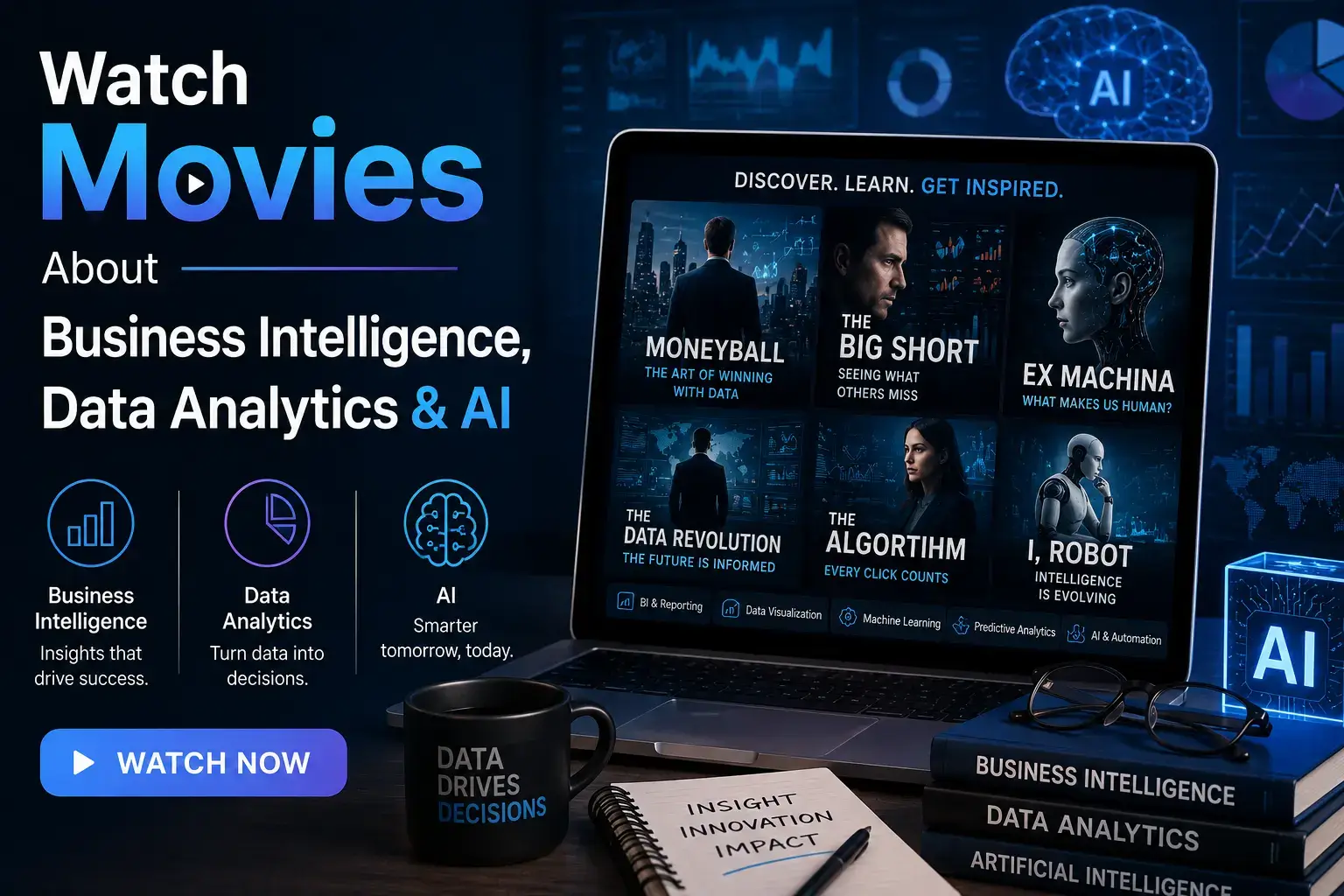
Watch Movies About Business Intelligence, Data Analytics & AI
Modern organizations generate enormous amounts of information every day. Sales transactions, customer interactions, financial records, website activity, supply chain events, employee data and operational systems all create valuable business information. Business intelligence, data analytics and artificial intelligence help organizations transform this information into insights that can support better decisions.
This collection of business intelligence movies, data analytics documentaries and AI technology videos explores the systems and ideas behind modern enterprise analytics. Discover educational content covering business intelligence software, predictive analytics, data visualization, enterprise reporting, machine learning, AI analytics, decision intelligence and modern data platforms.
From traditional management dashboards to AI-powered analytics and natural-language business intelligence, the evolution of data technology is changing how organizations understand customers, manage operations and plan for the future.
What Is Business Intelligence?
Business Intelligence (BI) refers to technologies and processes used to collect, organize, analyze and present business information.
BI platforms can transform information from enterprise applications into dashboards, reports, charts and other analytical outputs.
Business leaders can use BI to monitor revenue, expenses, sales performance, customer activity, inventory, operational efficiency and other key performance indicators.
The purpose of business intelligence is not simply to display data. The larger objective is to make relevant information easier to understand and use in business decisions.
What Is Data Analytics?
Data analytics is the process of examining information to identify patterns, trends, relationships and useful insights.
Analytics can range from simple descriptive reports to sophisticated predictive models and AI-powered decision systems.
Businesses use analytics across finance, marketing, sales, operations, supply chains, cybersecurity, human resources and customer experience.
Business Intelligence vs. Data Analytics
Business intelligence traditionally focuses heavily on understanding what has happened and what is happening within an organization.
Data analytics is a broader discipline that can include descriptive, diagnostic, predictive and prescriptive approaches.
Modern platforms increasingly combine BI, advanced analytics, machine learning and artificial intelligence.
The Four Major Types of Analytics
| Analytics Type | Main Question | Typical Business Application |
|---|---|---|
| Descriptive Analytics | What happened? | Reports, dashboards and historical performance |
| Diagnostic Analytics | Why did it happen? | Root-cause and performance analysis |
| Predictive Analytics | What may happen? | Forecasting and risk modeling |
| Prescriptive Analytics | What should we do? | Optimization and decision support |
Descriptive Analytics
Descriptive analytics summarizes historical information.
Examples include monthly revenue reports, quarterly sales dashboards, inventory summaries and customer activity reports.
Descriptive analytics provides organizations with a foundation for understanding business performance.
Diagnostic Analytics
Diagnostic analytics investigates why an outcome occurred.
For example, a company might notice that sales declined in a particular region. Diagnostic analysis can examine product categories, customer segments, pricing, marketing activity and other variables to identify potential causes.
Predictive Analytics
Predictive analytics uses historical data, statistical methods and machine learning to estimate potential future outcomes.
Businesses can use predictive models for demand forecasting, customer retention, financial planning, fraud detection and risk management.
Predictive analytics does not guarantee future outcomes. It provides estimates based on available information and model assumptions.
Prescriptive Analytics
Prescriptive analytics focuses on potential actions.
Optimization algorithms and analytical models can help organizations evaluate different scenarios and identify actions that may improve specific objectives.
This approach can be useful for resource allocation, inventory planning, pricing and logistics.
Business Intelligence Software
Business intelligence software provides tools for connecting data sources, creating reports, building dashboards and analyzing information.
Modern BI platforms can support both technical analysts and business users.
Self-service analytics capabilities allow employees to explore approved business data without requiring every report to be created by a central IT team.
Enterprise Analytics
Enterprise analytics applies analytical technologies across an organization.
Instead of limiting analytics to one department, organizations can use connected analytics across finance, sales, marketing, operations, supply chain, HR and customer service.
This can create a more complete understanding of organizational performance.
Data Visualization
Data visualization transforms information into charts, graphs, maps and interactive dashboards.
Effective visualization can make complex information easier to understand.
Common visualizations include line charts, bar charts, scatter plots, geographic maps, KPI cards and trend dashboards.
Executive Dashboards
Executive dashboards provide leaders with a concise view of important business metrics.
They may include revenue, profitability, customer growth, sales pipeline, operating expenses and other strategic KPIs.
Well-designed dashboards help decision-makers focus attention on the information most relevant to organizational objectives.
KPI Reporting
Key Performance Indicators (KPIs) are measurable values used to monitor business performance.
Examples include revenue growth, customer acquisition cost, customer retention, gross margin, inventory turnover and operating efficiency.
Analytics platforms can automatically update KPI dashboards as new data becomes available.
Enterprise Reporting
Enterprise reporting provides structured information to employees and management.
Financial reports, operational reports, compliance reports and management reports can be generated from centralized enterprise data.
Automated reporting can reduce manual spreadsheet preparation and improve reporting consistency.
Self-Service Analytics
Self-service analytics allows business users to explore approved datasets and create their own reports.
This can reduce dependence on specialized technical teams for every analytical request.
However, organizations still need data governance to ensure users work with accurate and appropriately controlled information.
Embedded Analytics
Embedded analytics integrates dashboards and analytical capabilities directly into business applications.
For example, a CRM system may display customer analytics while an ERP application can provide financial and operational dashboards.
This allows users to access insights within the context of their normal workflows.
AI-Powered Business Intelligence
Artificial intelligence is changing the way users interact with business intelligence platforms.
AI can assist with identifying patterns, generating summaries, explaining trends and helping users explore business information using natural language.
AI-powered BI can make analytics more accessible to users who may not have advanced data-query skills.
Natural Language Analytics
Natural language analytics allows users to ask questions about business data using ordinary language.
Instead of manually constructing complex queries, a user might ask which products generated the highest revenue during a specific period.
The system can interpret the request and present an analytical result.
Generative AI and Business Analytics
Generative AI can assist with analytical workflows by summarizing reports, explaining trends and helping users formulate questions.
Organizations need to validate AI-generated analytical outputs because inaccurate interpretations can lead to incorrect decisions.
Enterprise AI
Enterprise AI combines artificial intelligence with organizational data, applications and business workflows.
AI systems can support forecasting, customer analytics, document processing, risk management, cybersecurity and operational optimization.
Enterprise AI generally requires secure data infrastructure and appropriate governance.
AI Decision Support
AI decision-support systems can evaluate large datasets and provide recommendations or predictions.
These systems can help employees identify important information more quickly.
Human expertise remains important when decisions involve significant financial, legal, operational or customer consequences.
Decision Intelligence
Decision intelligence combines data, analytics, AI and business processes to improve organizational decision-making.
Rather than simply producing reports, decision intelligence focuses on connecting information to potential actions.
This can help organizations create more structured approaches to complex decisions.
Data Management
High-quality analytics depend on effective data management.
Organizations need processes for collecting, storing, organizing, securing and maintaining business information.
Data management can include databases, data warehouses, data lakes, integration platforms and governance systems.
Data Warehouses
A data warehouse is designed to store structured information for analytical workloads.
Organizations can consolidate information from ERP, CRM, financial and operational systems into a centralized analytical environment.
Data warehouses can support reporting, dashboards and analytical queries.
Data Lakes
A data lake can store large volumes of structured, semi-structured and unstructured information.
Data lakes can support machine learning, advanced analytics and large-scale data processing.
Organizations need appropriate governance and data management practices to maintain usability and security.
Data Lakehouses
A data lakehouse combines characteristics of data lakes and analytical data warehouses.
Modern enterprise data architectures increasingly seek to support multiple analytical workloads using integrated data platforms.
Cloud Analytics
Cloud computing has made it easier for organizations to scale data storage and analytical processing.
Cloud analytics platforms can provide scalable computing, managed databases, data warehouses and machine learning services.
Organizations can choose cloud architectures based on performance, security, compliance and cost requirements.
Data Integration
Enterprise information is often distributed across multiple applications.
Data integration connects these systems and moves information into analytical platforms.
Integration can involve APIs, ETL pipelines, ELT processes, streaming systems and managed integration platforms.
ETL and ELT
Extract, Transform and Load (ETL) processes extract information from source systems, transform it into a suitable format and load it into a destination platform.
Extract, Load and Transform (ELT) moves data into the target environment before performing transformations.
Both approaches are used in modern enterprise data architectures.
Real-Time Analytics
Real-time analytics processes information with very low delay.
Organizations can use real-time analytics for transaction monitoring, cybersecurity, fraud detection, operational monitoring and customer experiences.
Real-time data can help businesses respond more quickly to changing conditions.
Streaming Analytics
Streaming analytics processes continuously generated information such as application events, sensor readings and financial transactions.
It can help organizations identify events and anomalies as they occur rather than waiting for periodic reports.
Big Data Analytics
Big data analytics involves processing large and complex datasets that may exceed the capabilities of traditional analytical systems.
Cloud computing and distributed processing technologies have expanded the ability of organizations to analyze large datasets.
Data Science
Data science combines statistics, programming, machine learning and domain expertise to extract insights from information.
Data scientists can develop predictive models, experiment with algorithms and investigate complex datasets.
Data science often works alongside data engineering and business intelligence teams.
Data Engineering
Data engineers build and maintain systems that collect, transform and deliver information for analytical use.
Their work can include data pipelines, cloud data platforms, databases, integration systems and data quality processes.
Data Governance
Data governance establishes policies and responsibilities for managing organizational information.
Governance can address data ownership, quality, access, privacy, security, retention and compliance.
Strong governance becomes increasingly important as organizations use data for automated decision-making and AI.
Data Quality
Incorrect or incomplete data can reduce the value of analytics.
Data quality programs can identify duplicates, missing information, inconsistent formats and other issues.
Reliable analytics require reliable source data.
Master Data Management
Master Data Management (MDM) helps organizations maintain consistent definitions for important entities such as customers, products, suppliers and locations.
Consistent master data can improve reporting and reduce discrepancies across enterprise systems.
Financial Analytics
Financial analytics helps organizations understand revenue, expenses, profitability, cash flow and financial performance.
Finance teams can use analytics for budgeting, forecasting, variance analysis and management reporting.
Sales Analytics
Sales analytics can measure pipeline performance, conversion rates, revenue, customer acquisition and sales productivity.
Predictive models can also help organizations identify potential opportunities and forecast future sales.
Marketing Analytics
Marketing analytics evaluates campaign performance, customer acquisition, engagement and conversion.
Organizations can combine website, advertising, CRM and sales data to understand the customer journey.
Customer Analytics
Customer analytics uses information about customer behavior to identify trends and opportunities.
Businesses can analyze customer segments, retention, purchasing behavior, engagement and lifetime value.
Customer Intelligence
Customer intelligence combines customer data and analytics to help organizations understand their audiences.
It can support personalization, customer service, product development and marketing strategy.
Supply Chain Analytics
Supply chain analytics can help organizations analyze inventory, suppliers, transportation, demand and fulfillment.
Predictive models can support demand forecasting and inventory planning.
Demand Forecasting
Demand forecasting estimates future customer demand based on historical patterns and other relevant variables.
Accurate forecasts can help organizations balance inventory availability and operating costs.
Risk Analytics
Risk analytics evaluates information to identify and quantify potential business risks.
Financial institutions, insurers and large enterprises can use analytics for credit risk, operational risk, fraud detection and cybersecurity.
Fraud Analytics
Fraud analytics can identify unusual transaction patterns and potentially suspicious behavior.
Machine learning models can analyze large numbers of transactions and flag activities that require further investigation.
Workforce Analytics
Workforce analytics uses employee and organizational data to understand staffing, productivity, retention and workforce trends.
Organizations should apply appropriate privacy and governance controls when analyzing employee information.
Operational Analytics
Operational analytics focuses on the performance of day-to-day business activities.
Organizations can monitor production, service delivery, logistics, inventory and other operational processes.
Predictive Maintenance Analytics
Industrial organizations can use sensor data and machine learning to predict equipment maintenance requirements.
This can help maintenance teams identify potential failures and schedule interventions before unexpected downtime occurs.
AI and Machine Learning
Machine learning is one of the most important technologies behind modern AI analytics.
Models can identify patterns within historical information and use those patterns to classify, predict or recommend outcomes.
Machine learning applications require suitable training data, evaluation processes and monitoring.
Machine Learning Analytics
Machine learning analytics can identify complex relationships that may not be obvious through traditional reporting.
Applications include customer churn prediction, fraud detection, forecasting, recommendation systems and anomaly detection.
AI-Powered Forecasting
AI forecasting systems can analyze historical information along with multiple variables to estimate potential future outcomes.
Forecasting can be applied to sales, inventory, staffing, financial planning and demand management.
Anomaly Detection
Anomaly detection identifies information that differs significantly from expected patterns.
It can be useful for cybersecurity, fraud detection, equipment monitoring and financial operations.
AI Analytics Challenges
AI-powered analytics can create substantial opportunities, but organizations should recognize important limitations.
- Inaccurate or incomplete data
- Model errors
- Bias in historical datasets
- Privacy concerns
- Security risks
- Lack of explainability
- Changing business conditions
- Integration complexity
- Infrastructure costs
- Need for human oversight
Data Security
Business intelligence platforms may contain sensitive financial, customer and operational information.
Organizations should implement appropriate identity management, encryption, access controls, monitoring and security policies.
Data Privacy
Analytics programs can involve personal and sensitive information.
Organizations should understand what information they collect, how it is used and who can access it.
Privacy requirements can vary depending on geography, industry and the type of information being processed.
AI Governance for Analytics
As AI becomes part of enterprise analytics, organizations need governance processes covering model development, deployment, monitoring and access.
AI governance can help organizations manage model risk and ensure analytical systems are used appropriately.
Human Oversight
Automated analytics should not automatically replace human judgment in every situation.
For high-impact decisions, organizations may require human review, especially when financial, legal, safety or customer consequences are significant.
Business Intelligence and Digital Transformation
Analytics is a major component of digital transformation because organizations need reliable information to improve digital processes.
Cloud platforms, enterprise software, AI and data analytics can work together to create more connected business operations.
Analytics in Enterprise Software
Modern ERP and CRM platforms increasingly include analytical capabilities.
Users can view financial performance, sales activity, customer information and operational metrics directly within business applications.
This reduces the distance between business transactions and business insights.
Embedded AI Analytics
AI analytics is increasingly being embedded directly into enterprise applications.
Instead of requiring users to open a separate analytics platform, software can provide recommendations and insights within normal workflows.
Analytics Automation
Automation can reduce the manual work involved in collecting and preparing reports.
Data pipelines can refresh information automatically while dashboards update as new data becomes available.
AI can further automate parts of the analytical process by identifying patterns and generating summaries.
Decision-Making with Data
Data-driven decision-making involves using evidence and analysis to support business choices.
Good decision-making requires more than large datasets. Organizations also need appropriate metrics, business context, analytical discipline and clear objectives.
Data-Driven Organizations
A data-driven organization uses information throughout its operations rather than limiting analytics to specialized departments.
Executives, managers and employees can use appropriate data to understand performance and improve processes.
Building a data-driven culture often requires training, accessible tools and clear governance.
Business Intelligence and Financial Planning
Financial teams can use BI platforms to monitor budgets, expenses, revenue and profitability.
Analytics can also support scenario analysis and forecasting.
Business Intelligence and Customer Experience
Organizations can combine customer analytics with CRM information to understand interactions across different channels.
This can help identify customer needs, service issues and opportunities for improving the overall customer experience.
Business Intelligence and Operations
Operational dashboards can provide visibility into production, inventory, fulfillment, service delivery and workforce performance.
Real-time analytics can help managers respond to operational issues more quickly.
Business Intelligence and Supply Chains
Supply chain dashboards can combine inventory, supplier, transportation and demand information.
Analytics can help organizations identify bottlenecks, forecast demand and monitor supplier performance.
Business Intelligence and Cybersecurity
Security teams can use analytics to identify unusual network activity, login patterns and potential security incidents.
AI-based security analytics can help prioritize large numbers of alerts.
Modern Enterprise Analytics Architecture
A modern analytics environment may include operational applications, integration pipelines, cloud storage, data warehouses, BI platforms, machine learning systems and AI applications.
| Layer | Purpose | Examples of Workloads |
|---|---|---|
| Business Applications | Generate operational data | ERP, CRM, HR and finance systems |
| Integration | Move and synchronize information | APIs, ETL and streaming |
| Data Platform | Store and organize information | Warehouses, lakes and lakehouses |
| Analytics | Analyze business information | BI, reporting and dashboards |
| AI and Machine Learning | Predict and automate | Forecasting, classification and recommendations |
| Decision Layer | Support business action | Alerts, recommendations and workflow automation |
The Future of Business Intelligence
Business intelligence is evolving from static reports toward interactive, AI-assisted analytical environments.
Users increasingly expect to ask questions in natural language, receive explanations and explore information dynamically.
Future BI platforms may increasingly combine traditional dashboards with AI agents, predictive analytics and automated decision support.
The Future of Data Analytics
Data analytics is likely to become more accessible as AI simplifies data exploration and analytical workflows.
At the same time, data engineering, governance and security will remain essential because AI systems still depend on trustworthy information.
The Future of Enterprise AI
Enterprise AI may increasingly connect analytical insights to automated business workflows.
For example, an analytics system could identify a business anomaly, investigate potential causes, recommend an action and trigger an approved workflow.
Such systems will require strong permissions, monitoring and governance.
The Future of Decision Intelligence
Decision intelligence is likely to become increasingly important as organizations face larger datasets and faster business environments.
The goal is to move from simply collecting information toward systematically using information to improve business decisions.
Why Business Intelligence Documentaries Are Valuable
Documentaries and educational videos can help viewers understand how data transformed modern organizations.
They can explain the evolution from spreadsheets and traditional databases to cloud data platforms, machine learning and AI-powered analytics.
For students and professionals, this provides useful context for understanding the rapidly changing data technology landscape.
Who Should Watch Data Analytics Movies?
This content can be valuable for business owners, entrepreneurs, executives, analysts, data scientists, software developers, IT professionals, finance teams, marketing professionals and students.
Business leaders can learn how analytics supports strategic decisions, while technical professionals can explore modern data architectures and AI technologies.
How to Explore Business Intelligence Documentaries
Start with foundational content about business intelligence and data analytics.
Then explore data visualization, enterprise reporting, data warehouses, cloud analytics and predictive modeling.
Viewers interested in emerging technology can continue into machine learning, generative AI, enterprise AI and decision intelligence.
Understanding the Modern Data Economy
Data has become a strategic business resource. Organizations use information to understand customers, optimize operations, manage financial performance and develop new products.
However, data creates value only when organizations can collect, govern, analyze and apply it effectively.
From Data to Insight
The journey from raw data to business action involves multiple stages.
Data must be collected, integrated, cleaned, stored, analyzed and communicated. The final step is turning insights into decisions and measurable actions.
Modern analytics platforms are increasingly designed to connect these stages into a continuous process.
From Insight to Intelligent Action
Artificial intelligence introduces the possibility of connecting analytics directly to workflows.
An intelligent system can potentially identify an issue, evaluate relevant information and recommend or execute an approved action.
This represents an evolution from traditional business reporting toward intelligent business operations.
Explore Business Intelligence, Data Analytics & AI
Business intelligence, data analytics and artificial intelligence are becoming fundamental components of modern enterprise technology.
From executive dashboards and financial reporting to predictive analytics, machine learning and AI-powered decision intelligence, these technologies are changing how organizations understand and manage their businesses.
Explore movies and documentaries covering business intelligence software, enterprise analytics, data visualization, predictive analytics, cloud data platforms, machine learning, enterprise AI and intelligent decision-making.
Whether you are learning the fundamentals of data technology or exploring the future of AI-powered enterprise analytics, educational content can provide valuable context for understanding one of the most important technology transformations in modern business.
Watch, learn and explore how data and artificial intelligence are transforming the way organizations make decisions.
Educational notice: This content is provided for general informational and educational purposes. Analytics and AI outputs should be evaluated using appropriate business, technical, security, privacy and governance processes. Data-driven insights are not a guarantee of future outcomes.