If you are looking for a simple, safe and completely free way to enjoy movies and series on your cell phone, tablet or TV, Tubi – Free Movies and Series stands out as one of the best options available in 2026 . With an impressive collection, a clean interface, and support for Portuguese subtitles, the app offers access to thousands of titles free of charge. And best of all, it's available for direct download from the official stores:

Tubi: Free Movies & Live TV
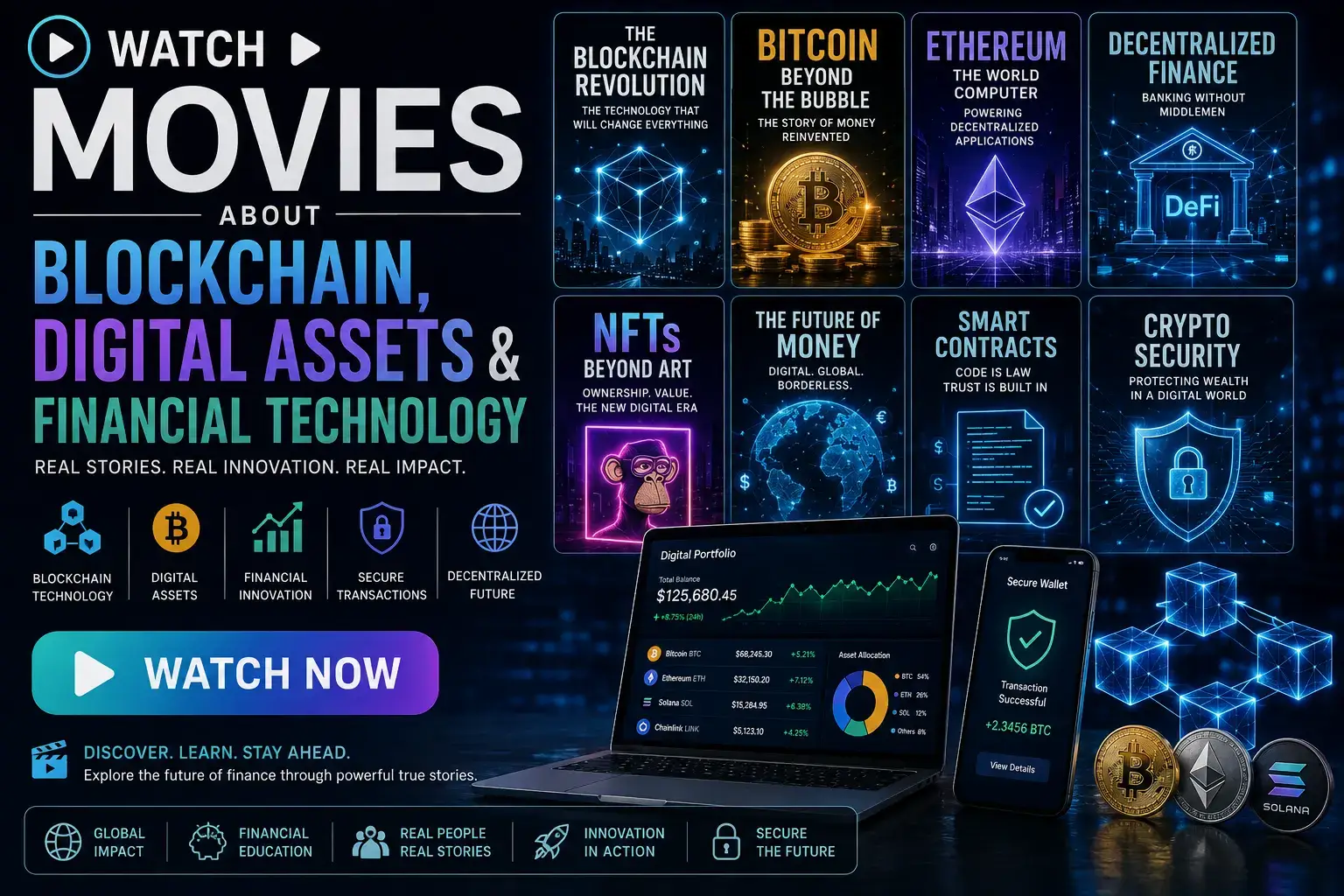
Watch Movies About Blockchain, Digital Assets & Financial Technology
Blockchain technology has evolved from a niche technological concept into an important area of discussion across financial services, payments, capital markets, digital assets and enterprise technology. Blockchain documentaries and financial technology videos can provide an accessible way to understand how distributed ledgers, smart contracts, tokenization and digital assets may influence the future of financial infrastructure.
Our collection of blockchain movies, digital asset documentaries and FinTech videos explores the technology behind distributed ledgers, digital payments, tokenized assets, Web3 applications and modern financial systems. These educational resources can help viewers understand the opportunities, challenges, risks and practical applications associated with blockchain.
Blockchain is not simply about cryptocurrency. The underlying technologies can also be used for transaction records, digital identity, asset tokenization, settlement systems, automated financial workflows and data-sharing infrastructure.
For finance professionals, technology leaders, entrepreneurs, investors, students and business owners, understanding blockchain can provide useful context for the rapidly changing financial technology landscape.
What Is Blockchain Technology?
A blockchain is a type of distributed ledger technology that allows transaction records or other data to be maintained across a network using cryptographic and consensus mechanisms.
Instead of relying entirely on a single centralized database, blockchain networks can distribute records among participating systems. Depending on the architecture, participants can validate transactions and maintain synchronized versions of the ledger.
Different blockchain networks use different technical designs, governance models and consensus mechanisms. Therefore, blockchain should be viewed as a broad technology category rather than one specific system.
Understanding Distributed Ledger Technology
Distributed ledger technology (DLT) refers to systems in which transaction or data records are distributed across multiple participants or locations.
Blockchain is one form of distributed ledger technology, but not every distributed ledger uses an identical blockchain architecture.
DLT can potentially support financial institutions and enterprises that need shared records between multiple organizations.
Why Blockchain Matters to Financial Services
Financial services depend on accurate records, trusted transactions and complex networks of intermediaries.
Blockchain technology introduces an alternative approach to recording and sharing transaction information. In some use cases, it can enable programmable transactions, shared ledgers and automated settlement processes.
Financial institutions are therefore evaluating blockchain and tokenization for areas such as payments, securities settlement, collateral management and digital asset infrastructure.
Blockchain and Financial Technology
Financial technology, commonly known as FinTech, combines financial services with software, data and digital infrastructure.
Blockchain is one technology within the broader FinTech ecosystem.
Other important FinTech technologies include artificial intelligence, cloud computing, APIs, digital identity, payment infrastructure, data analytics and cybersecurity.
Digital Assets
Digital assets are assets represented or recorded in digital form. Blockchain networks can provide infrastructure for creating, transferring and tracking certain types of digital assets.
The digital asset ecosystem can include cryptocurrencies, stablecoins, tokenized assets, digital securities and other blockchain-based representations.
Different digital assets have different characteristics, risks, legal structures and regulatory requirements.
Cryptocurrency Technology
Cryptocurrency technology uses cryptographic techniques and distributed networks to support digital value transfer.
Blockchain networks can maintain transaction histories and allow participants to verify transactions without relying on a single central database.
Cryptocurrency represents only one application of blockchain technology, while enterprise and financial applications can extend far beyond digital currencies.
Blockchain and Digital Payments
Payments are one of the most frequently discussed applications of blockchain technology.
Traditional cross-border payments can involve multiple financial institutions, payment networks and settlement processes. Blockchain-based payment systems may provide alternative infrastructure for transferring digital value.
The practical value of a blockchain payment system depends on factors including transaction speed, cost, liquidity, interoperability, security, compliance and regulatory requirements.
Cross-Border Payments
International payments can be complex because transactions may involve different currencies, financial institutions and regulatory jurisdictions.
Digital payment infrastructure based on distributed ledger technology could potentially reduce certain operational complexities by providing shared transaction infrastructure.
However, blockchain-based payments still need to address compliance, identity, liquidity, settlement and interoperability requirements.
Stablecoins
Stablecoins are digital assets designed to maintain a relatively stable value, commonly by referencing a fiat currency or other assets.
They are increasingly discussed in relation to digital payments, settlement, treasury operations and digital financial infrastructure.
Stablecoin systems can introduce new opportunities as well as risks involving reserves, governance, technology, liquidity and regulation.
Digital Currencies
Digital currency can refer broadly to value represented electronically.
Private-sector digital assets, stablecoins and central bank digital currencies can have very different designs and purposes.
Understanding these distinctions is important when evaluating digital finance and blockchain developments.
Central Bank Digital Currency
A central bank digital currency (CBDC) is a digital form of central bank money proposed or developed by a central bank.
CBDC designs can differ significantly between jurisdictions. Some concepts focus on retail payments, while others explore wholesale settlement between financial institutions.
CBDCs are an important area of research within digital financial infrastructure.
Tokenization
Tokenization involves representing an asset, right or economic interest using a digital token.
Blockchain networks can provide infrastructure for issuing, transferring and tracking tokens.
Tokenization is attracting attention in financial markets because it could potentially support new methods of managing securities, funds, collateral and other assets.
Real-World Asset Tokenization
Real-world asset (RWA) tokenization refers to representing traditional assets or financial interests through digital tokens.
Potential examples include bonds, funds, real estate interests, commodities and other financial or physical assets, depending on the legal structure.
The technology alone does not determine legal ownership. Legal rights, custody arrangements, regulatory frameworks and contractual structures remain critical.
Tokenized Securities
Tokenized securities are securities represented through digital token infrastructure.
Tokenization may potentially improve the efficiency of issuance, transfer, recordkeeping and settlement for certain financial instruments.
Financial institutions evaluating tokenized securities must consider securities regulations, investor protection, custody, market infrastructure and operational controls.
Blockchain and Capital Markets
Capital markets rely on systems for issuing, trading, clearing, settling and recording ownership of financial assets.
Blockchain technology could potentially change parts of this infrastructure by enabling shared ledgers and programmable settlement.
Financial institutions are therefore exploring blockchain for securities issuance, collateral management, fund administration and settlement.
Blockchain Settlement
Settlement is the process through which financial transactions are completed and assets and funds are transferred.
Traditional financial markets can involve multiple stages and intermediaries.
Blockchain-based settlement systems can potentially allow financial assets and payment instruments to interact through programmable infrastructure.
Smart Contracts
Smart contracts are programs deployed on blockchain networks that can execute predefined logic when specified conditions are met.
Smart contracts can automate certain financial transactions and business processes.
However, smart contracts are software and therefore can contain programming errors or security vulnerabilities. Proper testing, auditing and governance are important for high-value applications.
Programmable Finance
Programmable finance combines financial assets with software-defined rules.
For example, a digital financial instrument could potentially automate certain payment, settlement or compliance conditions.
This concept is one reason blockchain technology is attracting interest from financial institutions and technology companies.
Decentralized Finance
Decentralized finance (DeFi) refers to financial applications that use blockchain networks and smart contracts to provide financial functions.
DeFi applications can include decentralized exchanges, lending protocols, liquidity systems and other financial services.
DeFi introduces different technical, economic and regulatory considerations from traditional financial services.
DeFi Technology
DeFi applications typically use blockchain networks, smart contracts, digital wallets and blockchain-based assets.
Users can interact directly with protocols rather than relying on conventional financial intermediaries for every transaction.
However, users may face risks involving smart contracts, market volatility, liquidity, private keys and protocol governance.
Digital Asset Custody
Digital asset custody involves protecting and managing digital assets and the cryptographic credentials required to control them.
Institutional custody systems can include hardware security, multi-signature controls, access policies, transaction approval systems and compliance processes.
Custody is particularly important for financial institutions managing significant digital asset portfolios.
Institutional Digital Assets
Institutional participation in digital assets has encouraged the development of professional infrastructure for custody, trading, compliance, reporting and risk management.
Financial institutions evaluating digital assets need technology platforms capable of meeting security, governance, regulatory and operational requirements.
Blockchain Security
Blockchain security involves protecting networks, applications, wallets, private keys and smart contracts.
Security risks can arise from software vulnerabilities, compromised credentials, phishing, malicious applications and operational errors.
Organizations should use layered security controls when managing digital assets and blockchain infrastructure.
Private Keys and Digital Asset Security
Private keys can provide control over blockchain-based assets.
Loss or unauthorized exposure of private keys can create significant security risks.
Professional digital asset infrastructure may use hardware security modules, multi-signature authorization, key-management policies and transaction controls.
Blockchain Cybersecurity
Blockchain systems still require conventional cybersecurity practices.
Organizations must protect endpoints, cloud infrastructure, APIs, employee accounts, wallets and administrative systems.
Blockchain technology can provide certain security properties, but it does not eliminate cybersecurity risks.
Blockchain Analytics
Blockchain analytics platforms analyze publicly available blockchain transaction information and other relevant data.
Analytics can support transaction monitoring, compliance, fraud detection, market research and financial investigations.
Institutional blockchain analytics is becoming an important component of digital asset risk management.
Digital Asset Compliance
Financial institutions and businesses operating with digital assets may need to comply with applicable financial, tax, securities, anti-money-laundering and consumer-protection requirements.
Compliance requirements vary by jurisdiction and by the type of digital asset or financial activity.
Technology can help organizations monitor transactions and maintain compliance workflows, but regulatory obligations cannot be solved through software alone.
Blockchain and Financial Regulation
Regulatory approaches to blockchain and digital assets continue to evolve across global markets.
Regulators may consider issues involving investor protection, financial stability, market integrity, consumer protection, taxation, cybersecurity and anti-money-laundering controls.
Businesses operating in this sector must monitor applicable laws and regulatory developments in every jurisdiction where they operate.
Blockchain Identity
Digital identity is another area where distributed technology can potentially play a role.
Blockchain-based identity systems can explore methods for verifying credentials without requiring every organization to maintain independent copies of the same information.
Privacy, interoperability, user control and regulatory compliance are important considerations for digital identity systems.
Decentralized Identity
Decentralized identity concepts aim to provide individuals or organizations with greater control over digital credentials.
Verifiable credentials and cryptographic proofs can potentially allow users to demonstrate specific information without unnecessarily sharing unrelated personal data.
Enterprise identity solutions require careful attention to privacy, security and interoperability.
Web3 Technology
Web3 is a broad term used to describe applications and services built around decentralized technologies, blockchain networks and digital ownership.
Web3 applications can include decentralized finance, digital assets, tokenized communities, digital identity and blockchain-based applications.
The term encompasses a wide range of architectures and business models rather than one single technology.
Enterprise Blockchain
Enterprise blockchain refers to blockchain or distributed ledger systems designed for organizational and commercial applications.
Businesses may explore enterprise blockchain for shared records, supply-chain tracking, identity, asset management and financial transactions.
Enterprise deployments often prioritize privacy, governance, scalability, interoperability and compliance.
Blockchain for Financial Institutions
Banks and financial institutions operate highly complex technology environments.
Blockchain can potentially complement existing infrastructure in areas such as settlement, tokenized assets, payments, collateral and shared data.
Rather than replacing the entire financial system, many institutional blockchain projects focus on improving specific parts of existing financial workflows.
Blockchain and Treasury Management
Treasury departments manage corporate liquidity, cash positions, funding and financial risks.
Digital assets and blockchain-based payment infrastructure could potentially introduce new tools for cross-border settlement and corporate treasury operations.
However, treasury teams must carefully evaluate liquidity, accounting, tax, custody, regulatory and operational considerations.
Blockchain and Corporate Payments
Businesses increasingly expect faster and more integrated payment infrastructure.
Blockchain-based payment networks and digital assets can provide alternative mechanisms for transferring value across borders.
Corporate adoption depends on factors such as transaction reliability, compliance, accounting treatment, liquidity and integration with existing enterprise systems.
Financial Automation Through Smart Contracts
Smart contracts can automate certain financial rules and transaction processes.
For example, a contract could theoretically trigger a payment after predefined conditions are satisfied.
Automated financial workflows can reduce manual processing, but organizations must ensure that contract logic accurately reflects business and legal requirements.
Blockchain and Accounting
Blockchain creates transaction records that may be useful for certain accounting and audit processes.
However, blockchain records do not automatically replace accounting systems.
Businesses still need appropriate accounting policies, financial reporting procedures, tax treatment and internal controls for blockchain-based transactions.
Digital Assets and Accounting
Accounting for digital assets can involve complex considerations because different assets may have different economic and legal characteristics.
Businesses holding or transacting in digital assets should consider applicable accounting standards, tax rules, valuation requirements and disclosure obligations.
Blockchain and Financial Data
Blockchain networks can create large volumes of transaction data.
Financial analytics platforms can process blockchain data to identify transaction patterns, liquidity movements, wallet activity and other information.
Combining blockchain data with traditional financial data can create additional analytical opportunities.
Blockchain Data Analytics
Blockchain analytics can be useful for businesses, financial institutions, researchers and compliance teams.
Analytical systems can help identify transaction relationships, monitor activity and evaluate network behavior.
Data analytics also supports institutional decision-making around digital asset markets and blockchain infrastructure.
Blockchain Interoperability
Multiple blockchain networks exist with different architectures and technical standards.
Interoperability refers to the ability of different systems or networks to communicate or transfer information and value.
Interoperability is important for creating broader digital financial infrastructure because businesses generally operate across multiple technology platforms.
Blockchain Scalability
Scalability refers to a network's ability to process increasing transaction volumes while maintaining acceptable performance and cost.
Blockchain developers have explored different approaches to improving throughput, transaction costs and network efficiency.
Scalability remains an important consideration for enterprise and financial applications.
Blockchain Infrastructure
Blockchain infrastructure includes networks, nodes, wallets, custody systems, APIs, data platforms, smart contract environments and security tools.
Enterprise adoption requires reliable infrastructure that can integrate with existing financial and technology systems.
Blockchain Software
Blockchain software can include development platforms, wallet applications, smart contract tools, analytics platforms, custody systems and enterprise integration solutions.
Organizations evaluating blockchain software should consider security, scalability, interoperability, compliance and long-term maintenance.
Blockchain as Financial Infrastructure
One of the most important discussions around blockchain is whether distributed ledgers can become part of future financial infrastructure.
Financial infrastructure includes payment networks, securities settlement systems, custody platforms, clearing mechanisms and financial data systems.
Blockchain could potentially modernize selected components of this infrastructure where shared ledgers and programmable transactions provide practical advantages.
Tokenized Financial Markets
Tokenization could potentially change how certain financial assets are issued and transferred.
Digital securities and tokenized funds can use blockchain infrastructure to represent ownership and transaction rights.
The development of tokenized markets will depend on legal frameworks, institutional adoption, liquidity, interoperability and investor demand.
Digital Securities
Digital securities combine traditional financial instruments with digital issuance and settlement infrastructure.
They can potentially support more automated workflows around issuance, ownership records and settlement.
Regulatory compliance and investor protections remain essential components of digital securities infrastructure.
Blockchain and Asset Management
Asset managers are exploring digital asset infrastructure, tokenization and blockchain-based settlement.
Potential applications include tokenized funds, digital securities, collateral management and automated settlement.
Asset managers must consider custody, valuation, liquidity, regulatory obligations and operational risk.
Blockchain and Wealth Management
Wealth management firms may eventually integrate digital assets and tokenized products into broader investment technology platforms.
Portfolio management systems may need to support new asset classes, custody models, reporting requirements and compliance workflows.
Financial advisors and investors require appropriate education before using emerging digital asset products.
Blockchain and Payments Innovation
Payment technology continues to evolve through mobile payments, instant payments, digital wallets, account-to-account transfers and blockchain-based systems.
Blockchain can potentially complement these technologies by providing alternative settlement and digital asset infrastructure.
The most successful payment systems will need to balance speed, cost, security, reliability and regulatory compliance.
Digital Wallets
Digital wallets allow users to manage digital payment credentials or digital assets.
Blockchain wallets can interact directly with blockchain networks and smart contracts.
Wallet security is critical because unauthorized access can result in irreversible transactions depending on the network and asset.
Financial Innovation
Blockchain represents one part of a broader wave of financial innovation.
Cloud computing, artificial intelligence, machine learning, APIs, real-time payments and advanced analytics are also transforming financial services.
The convergence of these technologies could produce new financial products and more automated financial infrastructure.
Artificial Intelligence and Blockchain
AI and blockchain address different technical problems but can potentially complement each other.
AI can analyze large financial datasets, while blockchain can provide transaction infrastructure and verifiable records.
Potential applications include financial analytics, fraud monitoring, automated compliance and intelligent digital asset management.
Blockchain and Cloud Computing
Cloud infrastructure can provide scalable environments for blockchain applications, analytics platforms and enterprise integrations.
Organizations can use cloud services to deploy blockchain nodes, databases, APIs and monitoring systems.
Cloud architecture can therefore be an important part of enterprise blockchain strategies.
Blockchain and Cyber Risk
Digital asset systems can create new forms of technology and operational risk.
Organizations should evaluate smart contract vulnerabilities, private-key management, third-party dependencies, phishing, infrastructure security and governance risks.
Enterprise blockchain adoption should therefore be supported by comprehensive cybersecurity and risk-management programs.
Institutional Risk Management
Financial institutions need robust risk controls when evaluating new technologies.
Digital asset risk can involve market volatility, liquidity, counterparty exposure, operational risk, technology risk and regulatory uncertainty.
Risk management frameworks should be tailored to the institution's activities and applicable requirements.
Blockchain Education for Business Professionals
Business professionals do not necessarily need to become blockchain developers to understand the technology.
A basic understanding of distributed ledgers, digital assets, smart contracts, tokenization, custody and regulatory considerations can help executives evaluate technology opportunities.
Documentaries can provide an accessible introduction before moving into technical or professional-level research.
Blockchain Education for Students
Students studying computer science, finance, economics, business or information systems can explore blockchain from multiple perspectives.
Technology students can study cryptography, distributed systems and smart contracts, while finance students can explore digital assets, tokenization, payments and capital markets.
This multidisciplinary nature makes blockchain particularly relevant to modern FinTech education.
Why Watch Blockchain Documentaries?
Blockchain documentaries can help viewers understand the history, technology and economic debates surrounding digital assets.
Educational videos can make technical concepts easier to visualize and can provide context around major developments in financial technology.
Viewers should still distinguish educational content from financial promotion and verify important claims using reliable primary sources.
Why Watch Digital Asset Documentaries?
Digital asset documentaries can explore cryptocurrency technology, tokenization, institutional adoption, digital custody and the changing financial infrastructure.
These topics are particularly useful for anyone interested in the intersection of finance and technology.
Key Blockchain Topics to Explore
- Distributed Ledger Technology: Systems that maintain shared records across multiple participants.
- Smart Contracts: Programs that execute predefined logic on blockchain networks.
- Digital Assets: Digitally represented assets or economic interests.
- Tokenization: Representation of assets or rights through digital tokens.
- Stablecoins: Digital assets designed to maintain relatively stable values.
- Digital Payments: Electronic systems for transferring value.
- DeFi: Blockchain-based financial applications.
- Web3: A broad ecosystem of decentralized applications and digital ownership concepts.
- Digital Custody: Technology and processes for protecting digital assets.
- Blockchain Analytics: Analysis of blockchain transaction data.
- Enterprise Blockchain: Blockchain infrastructure designed for organizational applications.
- Tokenized Securities: Financial securities represented using digital token infrastructure.
- CBDC: Digital forms of central bank money.
- Financial Infrastructure: Systems supporting payments, settlement, custody and financial markets.
The Business Case for Blockchain
Businesses should evaluate blockchain based on measurable operational or financial benefits rather than technology trends alone.
Potential benefits can include shared transaction records, automated settlement, programmable workflows, improved transparency and new digital asset capabilities.
Organizations should also evaluate implementation costs, security, regulatory obligations, integration requirements and operational complexity.
Blockchain Adoption in Enterprises
Enterprise adoption often begins with specific use cases rather than replacing existing systems entirely.
Companies may test blockchain for asset tracking, digital credentials, payments, settlement, document verification or financial workflows.
Pilot projects can help organizations evaluate technical feasibility and business value before larger deployments.
Challenges Facing Blockchain Technology
Blockchain adoption still faces significant challenges.
- Scalability and transaction performance
- Interoperability between networks
- Regulatory uncertainty in some markets
- Cybersecurity and smart contract vulnerabilities
- Digital asset custody requirements
- Integration with legacy financial systems
- Data privacy considerations
- Governance and operational complexity
- Market and liquidity risks
- User education and adoption
The Future of Blockchain and Financial Technology
The future of blockchain is likely to be influenced by its ability to solve practical problems rather than simply generate technological interest.
Financial institutions may continue exploring tokenized assets, digital settlement, stablecoins, blockchain payments and shared financial infrastructure.
At the same time, enterprise technology companies are developing tools that make blockchain infrastructure easier to integrate with cloud applications, payment systems and financial software.
The Future of Tokenized Assets
Tokenization has the potential to connect traditional financial assets with programmable digital infrastructure.
Future financial platforms could potentially combine tokenized securities, digital payments, automated compliance and real-time settlement.
The development of these markets will depend heavily on regulation, institutional participation, technology standards and liquidity.
The Future of Digital Payments
Digital payments are becoming faster, more integrated and increasingly automated.
Blockchain-based payment infrastructure may become one component of a broader payment ecosystem alongside traditional banking rails, real-time payment networks and digital wallet technologies.
Competition between different payment technologies could encourage greater efficiency and innovation.
The Future of Financial Infrastructure
Financial infrastructure is gradually becoming more software-driven.
Cloud platforms, APIs, AI, real-time payments and blockchain can all contribute to the modernization of financial systems.
Rather than one technology replacing everything else, the future may involve multiple interconnected technologies working together.
Blockchain and the Future of Finance
Blockchain technology has created new possibilities for recording transactions, transferring digital value and representing financial assets.
Its long-term impact will depend on whether businesses, financial institutions and consumers find sustainable applications that deliver clear economic and operational value.
The technology's most important contribution may ultimately be its ability to combine digital assets, programmable transactions, shared records and financial infrastructure into new forms of financial technology.
Explore Blockchain, Digital Assets and FinTech
Our collection of blockchain documentaries and financial technology videos provides an educational starting point for exploring one of the most rapidly evolving areas of modern technology.
Watch content covering blockchain technology, distributed ledgers, digital assets, tokenization, smart contracts, digital payments, Web3, financial infrastructure, FinTech innovation and blockchain security.
Whether you are interested in enterprise technology, financial markets, digital payments, investment technology or the future of financial services, blockchain offers a fascinating intersection between software and finance.
Explore the technology, understand the financial concepts and learn how blockchain could influence the next generation of digital financial infrastructure.
Watch, learn and explore the technologies shaping blockchain, digital assets and the future of financial technology.
Educational notice: This page is intended for general educational and informational purposes. It does not constitute investment, financial, tax, accounting, legal or regulatory advice. Digital assets and emerging technologies can involve significant risks, including market, technology, security, liquidity and regulatory risks. Always conduct appropriate research and consult qualified professionals where necessary.