If you are looking for a simple, safe and completely free way to enjoy movies and series on your cell phone, tablet or TV, Tubi – Free Movies and Series stands out as one of the best options available in 2026 . With an impressive collection, a clean interface, and support for Portuguese subtitles, the app offers access to thousands of titles free of charge. And best of all, it's available for direct download from the official stores:

Tubi: Free Movies & Live TV
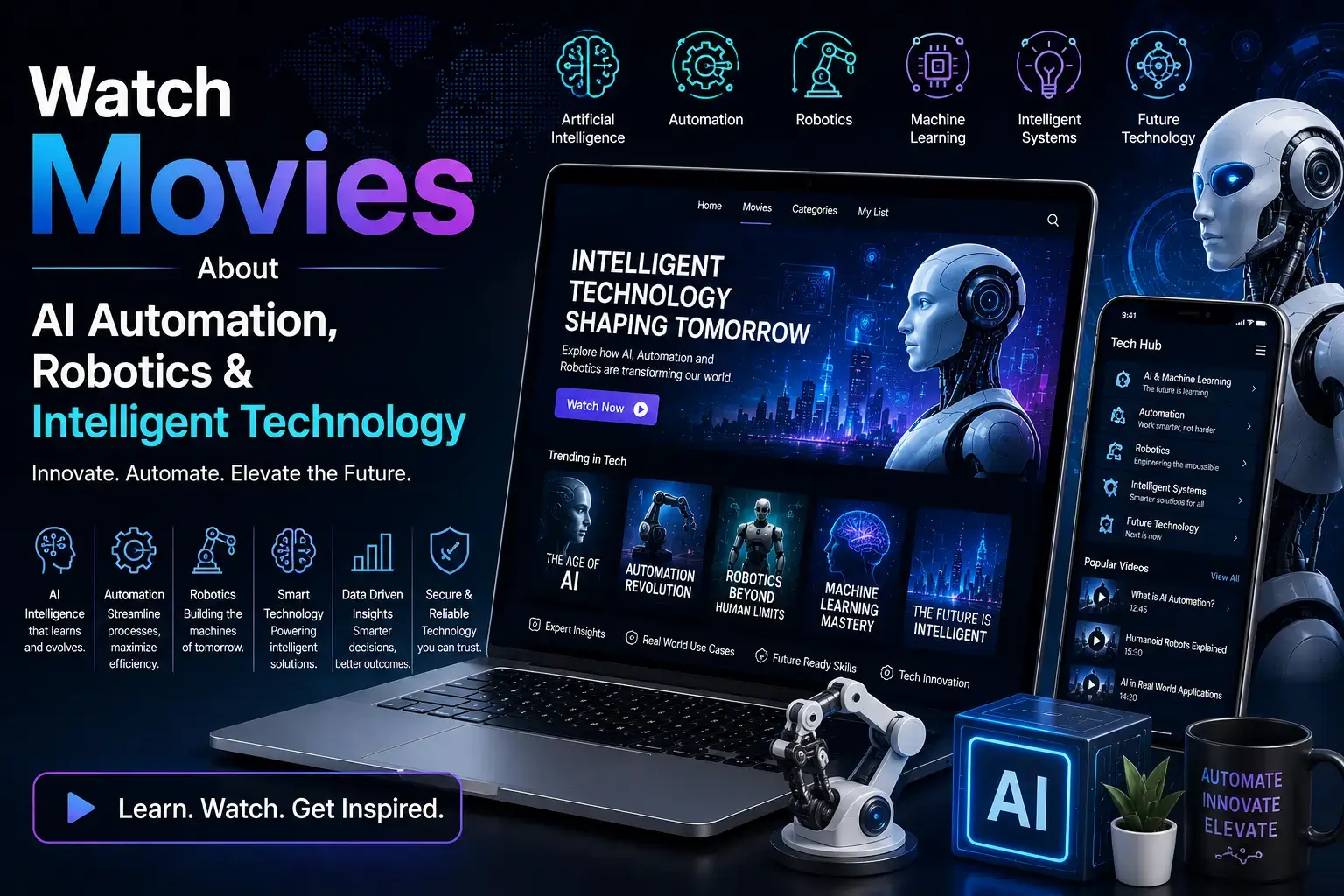
Watch Movies About AI Automation, Robotics & Intelligent Technology
Artificial intelligence and robotics are transforming the way organizations operate, manufacture products, analyze information and deliver services. From AI automation and machine learning to AI agents, industrial robotics and autonomous systems, intelligent technology is moving from research laboratories into everyday business operations.
This collection of AI automation movies, robotics documentaries and artificial intelligence videos explores the technologies behind this transformation. Discover educational content covering enterprise AI, intelligent automation, machine learning, robotic systems, computer vision, autonomous technology, AI software and the future of intelligent business.
AI is no longer limited to traditional predictive models. Modern organizations are exploring generative AI, multimodal systems, AI agents and increasingly autonomous workflows capable of interpreting information, planning tasks and interacting with software.
Robotics is evolving at the same time. Industrial robots, collaborative robots, warehouse automation and autonomous machines are becoming increasingly sophisticated as advances in sensors, computer vision, machine learning and edge computing improve robotic capabilities.
What Is Artificial Intelligence?
Artificial intelligence refers broadly to computer systems designed to perform tasks that normally require human intelligence, such as recognizing patterns, understanding language, making predictions, analyzing information and supporting decisions.
AI systems can use large datasets, algorithms and computational infrastructure to identify relationships and generate useful outputs.
Modern AI includes many different approaches, including machine learning, deep learning, natural language processing, computer vision and generative AI.
What Is AI Automation?
AI automation combines artificial intelligence with software workflows to reduce manual work and improve business processes.
Traditional automation generally follows predefined rules. AI automation can add capabilities such as classification, prediction, natural language understanding, document analysis and decision support.
This allows organizations to automate workflows that previously required significant human involvement.
Intelligent Automation
Intelligent automation combines technologies such as artificial intelligence, machine learning, robotic process automation and workflow orchestration.
For example, an intelligent automation system may receive an email, understand its contents, extract information from an attachment, determine the appropriate workflow and update an enterprise application.
These capabilities can improve efficiency across finance, customer service, human resources, operations and other departments.
AI Agents
AI agents are software systems designed to perform tasks by interpreting information, selecting actions and interacting with tools or applications.
Unlike a simple chatbot that only generates a response, an agentic system can potentially execute multiple steps toward a defined objective.
Enterprise AI agents may assist with research, customer support, software development, data analysis, document processing and operational workflows.
Agentic AI
Agentic AI describes AI systems capable of carrying out multi-step tasks with varying degrees of autonomy.
An agent may break a goal into smaller actions, use connected tools, evaluate results and continue working until a task is completed or human intervention is required.
Organizations deploying agentic AI need appropriate permissions, monitoring, security controls and human oversight.
Enterprise AI
Enterprise AI refers to the use of artificial intelligence within organizations to improve products, services and internal operations.
Businesses can use AI for customer support, sales forecasting, fraud detection, document processing, software development, marketing analytics, cybersecurity and supply chain optimization.
Enterprise AI typically requires secure infrastructure, reliable data, governance frameworks and integration with existing business systems.
AI Software
AI software includes platforms and applications that use machine learning, generative AI, computer vision or other intelligent technologies.
Enterprise AI software can be integrated into customer relationship management, enterprise resource planning, human resources, financial systems, cybersecurity platforms and productivity tools.
The commercial AI software market continues to expand as organizations look for ways to automate knowledge work and improve decision-making.
Machine Learning
Machine learning allows computer systems to learn patterns from data rather than relying exclusively on manually programmed rules.
Machine learning models can be trained to classify information, predict outcomes, identify anomalies or recommend actions.
Applications include financial forecasting, fraud detection, predictive maintenance, recommendation systems and customer analytics.
Deep Learning
Deep learning uses multi-layer neural networks to process complex patterns in large datasets.
Deep learning has contributed to major advances in computer vision, speech recognition, natural language processing and generative AI.
Modern deep learning systems often require substantial computing resources and specialized AI infrastructure.
Generative AI
Generative AI can create text, images, audio, video, software code and other forms of content based on learned patterns.
Businesses are exploring generative AI for content creation, customer service, software engineering, research, document analysis and knowledge management.
Enterprise deployment requires careful attention to data privacy, intellectual property, security, accuracy and governance.
Natural Language Processing
Natural language processing (NLP) enables software to process and analyze human language.
NLP is used in search systems, chatbots, document classification, sentiment analysis, translation, summarization and enterprise knowledge systems.
Large language models have significantly expanded the capabilities of language-based AI applications.
Computer Vision
Computer vision allows machines to interpret images and video.
Computer vision can be used for quality inspection, security monitoring, medical imaging, autonomous vehicles, retail analytics and robotic navigation.
When combined with robotics, computer vision allows machines to identify objects and understand their surrounding environments.
Robotics
Robotics combines mechanical engineering, software, sensors, control systems and increasingly artificial intelligence.
Robots can perform repetitive, dangerous or highly precise tasks in environments such as manufacturing facilities, warehouses, laboratories and logistics operations.
AI is helping robots become more adaptable and capable of operating in less structured environments.
Industrial Robotics
Industrial robots have been used for decades in manufacturing applications such as welding, painting, assembly, packaging and material handling.
Modern industrial robotics increasingly incorporates machine vision, advanced sensors and AI-based optimization.
Automation can help manufacturers improve consistency, productivity and workplace safety.
Collaborative Robots
Collaborative robots, often called cobots, are designed to operate alongside human workers in appropriate environments.
They can assist with assembly, inspection, material handling and repetitive tasks.
Cobots can provide flexibility for businesses that require automation without completely redesigning an entire production environment.
Warehouse Robotics
Warehouses are increasingly adopting robotic systems to move inventory, retrieve products, sort packages and support fulfillment operations.
Warehouse robotics can integrate sensors, computer vision, navigation systems and warehouse management software.
Automation can help organizations manage growing order volumes and labor-intensive workflows.
Autonomous Systems
Autonomous systems are designed to perform tasks with limited direct human control.
Examples include autonomous vehicles, robotic delivery systems, drones and industrial machines.
Autonomous technology depends on sensing, perception, planning, decision-making and control.
Autonomous Vehicles
Autonomous vehicles use combinations of sensors, cameras, radar, software and AI models to understand their environments.
These systems attempt to detect objects, predict movements and plan safe paths.
Autonomous mobility remains a complex technology area involving engineering, safety, regulation and infrastructure.
AI and Business Automation
AI-powered business automation can affect many departments within an organization.
Finance teams can automate document processing and reconciliation. Customer service teams can automate common requests. Sales teams can use AI for lead analysis. HR departments can automate employee workflows. IT teams can use intelligent monitoring and incident analysis.
The objective is not simply to automate individual tasks but to redesign entire workflows around intelligent software.
Workflow Automation
Workflow automation connects multiple steps in a business process.
Modern intelligent workflows can combine APIs, enterprise applications, machine learning models, large language models and business rules.
This allows organizations to automate processes that previously required employees to move information between different systems.
Robotic Process Automation
Robotic Process Automation (RPA) uses software robots to perform repetitive digital tasks.
RPA can interact with applications, enter information, copy data, generate reports and perform rule-based processes.
When RPA is combined with AI, organizations can automate more complex workflows involving documents, language and unstructured information.
Intelligent Process Automation
Intelligent process automation combines workflow management, RPA, AI and data processing.
For example, an organization could automatically receive a customer document, classify it using AI, extract relevant information, validate the data and route it to the appropriate employee or system.
This can reduce manual processing and improve operational efficiency.
AI for Financial Services
Financial institutions use AI for applications such as fraud detection, customer service, credit risk analysis, financial forecasting and transaction monitoring.
AI can process large datasets and identify patterns that may be difficult to detect manually.
Because financial services are highly regulated, AI systems often require strong governance and risk controls.
AI for Cybersecurity
Cybersecurity teams can use AI to analyze network activity, identify anomalies, prioritize alerts and detect suspicious behavior.
AI can help security professionals process large volumes of security data.
However, attackers can also use AI, making continuous security improvements important for organizations.
AI in Healthcare Technology
AI is being explored across healthcare for medical imaging, administrative automation, drug discovery, clinical research and operational optimization.
Healthcare AI involves particularly important considerations around privacy, accuracy, safety and regulatory compliance.
AI in Manufacturing
Manufacturing organizations can use AI for predictive maintenance, quality inspection, production optimization and supply chain planning.
Computer vision systems can identify product defects while machine learning models can predict equipment failures.
AI can therefore complement traditional industrial automation.
Predictive Maintenance
Predictive maintenance uses sensor data and machine learning to identify potential equipment failures before they occur.
Manufacturers can use these systems to schedule maintenance more efficiently and potentially reduce unexpected downtime.
Industrial IoT sensors can provide the data required for predictive models.
Smart Manufacturing
Smart manufacturing connects industrial machines, sensors, software and analytics.
AI can analyze production data and help organizations identify inefficiencies, optimize processes and improve quality control.
Connected manufacturing environments are an important component of modern industrial digital transformation.
AI and Supply Chain Automation
Supply chains generate large volumes of operational data involving inventory, transportation, demand and suppliers.
AI can support demand forecasting, inventory optimization, logistics planning and anomaly detection.
Combining AI with enterprise resource planning and supply chain management software can create more responsive business operations.
AI and Customer Service
AI-powered customer service platforms can handle common questions, classify requests and assist human support teams.
Generative AI can summarize conversations and help agents retrieve relevant information.
Organizations should establish appropriate escalation mechanisms for complex or sensitive customer issues.
AI Sales Automation
Sales teams can use AI to analyze leads, summarize customer interactions, generate sales materials and identify potential opportunities.
Automation can reduce administrative work and allow sales professionals to focus more on customer relationships.
AI in Enterprise Software
AI is increasingly embedded into enterprise software applications.
Business platforms can use AI to automate data entry, generate reports, summarize information, predict outcomes and assist users with complex workflows.
This creates a shift from traditional software that simply stores information toward software that can actively assist users.
AI Infrastructure
Advanced AI systems require significant computational resources.
AI infrastructure can include specialized processors, high-performance computing systems, cloud platforms, data storage, networking and model-serving infrastructure.
Organizations evaluating enterprise AI need to consider both model performance and infrastructure economics.
Cloud AI
Cloud platforms provide access to scalable computing resources for AI development and deployment.
Cloud AI services can offer machine learning infrastructure, model APIs, data platforms and specialized computing capabilities.
Cloud-based AI can allow organizations to experiment without building every component of an AI infrastructure stack internally.
Edge AI
Edge AI processes AI workloads closer to where data is generated rather than sending all information to a centralized cloud environment.
Edge AI can be useful for robotics, manufacturing, security cameras and other systems requiring fast responses.
Local processing can also reduce latency and, in some applications, reduce the amount of sensitive information transferred over networks.
AI Chips and Computing
Modern AI workloads require specialized computing architectures.
AI accelerators can improve the performance of machine learning training and inference.
The development of advanced AI computing infrastructure is an important part of the broader artificial intelligence industry.
AI Data Analytics
AI can enhance traditional business analytics by identifying patterns, generating predictions and assisting with natural-language data exploration.
Organizations can use AI analytics for financial planning, customer analysis, operational performance and risk management.
AI Decision Support
AI decision-support systems can provide recommendations based on large datasets.
These systems can help professionals evaluate information more efficiently, but important decisions may still require human judgment and organizational accountability.
AI Governance
AI governance establishes policies and controls for the responsible development and use of artificial intelligence.
Governance programs may address data privacy, security, model risk, transparency, intellectual property, human oversight and regulatory compliance.
As AI becomes more deeply integrated into enterprise operations, governance is becoming an important component of technology strategy.
AI Risk Management
AI systems can introduce risks involving inaccurate outputs, biased results, security vulnerabilities, privacy issues and inappropriate automation.
AI risk management can include testing, monitoring, documentation, access controls and human review.
Organizations should evaluate risks according to the specific purpose and impact of each AI application.
Responsible AI
Responsible AI focuses on building and deploying AI systems in ways that consider safety, fairness, transparency, privacy and accountability.
Responsible AI practices can help organizations establish confidence in AI systems while managing potential risks.
AI Security
AI security includes protecting AI models, training data, infrastructure and applications from unauthorized access and manipulation.
Enterprise AI systems may also need protection against prompt injection, data leakage, model abuse and other emerging threats.
AI and Data Privacy
AI systems often process large amounts of information, which makes data governance particularly important.
Organizations should understand what data enters AI systems, where it is stored, who can access it and how long it is retained.
Human-in-the-Loop AI
Human-in-the-loop systems keep people involved in important decisions or review processes.
This approach can be useful when AI outputs have significant financial, legal, safety or customer consequences.
Human review can provide an additional layer of accountability and quality control.
AI Automation and Workforce Transformation
AI automation is changing the nature of many jobs by reducing repetitive tasks and increasing the importance of analytical, creative and interpersonal skills.
Organizations may redesign roles around AI-assisted workflows rather than simply replacing existing processes.
Successful adoption often requires employee training, process redesign and clear governance.
Robotics and Workforce Transformation
Robotics can automate physical tasks that are repetitive, hazardous or highly precise.
As robotic systems become more flexible, businesses may use them alongside human workers rather than only in fully automated environments.
This can create new requirements for robotics engineering, maintenance, supervision and operational management.
Key AI and Robotics Technologies
| Technology | Primary Function | Business Applications |
|---|---|---|
| Machine Learning | Pattern recognition and prediction | Forecasting, analytics and risk detection |
| Generative AI | Content and information generation | Knowledge work, customer service and software development |
| AI Agents | Multi-step task execution | Workflow and enterprise automation |
| Computer Vision | Image and video analysis | Inspection, security and robotics |
| RPA | Digital task automation | Finance, operations and administration |
| Industrial Robotics | Physical automation | Manufacturing and assembly |
| Collaborative Robots | Human-machine collaboration | Flexible manufacturing |
| Autonomous Systems | Independent operation | Vehicles, logistics and industrial applications |
| Edge AI | Local AI processing | IoT, robotics and real-time systems |
| AI Analytics | Intelligent data analysis | Business intelligence and decision support |
AI Automation in Enterprise Operations
Enterprise automation is moving toward integrated systems that can understand business context and perform multiple related tasks.
For example, an AI-powered finance workflow could identify invoices, extract data, validate information against business rules and route exceptions for human review.
Similar workflows can be created for procurement, HR, customer service, compliance and IT operations.
AI Agents and Enterprise Workflows
AI agents can potentially connect different enterprise systems and perform multi-step processes.
An agent might retrieve information from a database, analyze it, use a business application and prepare a report.
Enterprise deployments require carefully defined permissions so autonomous systems cannot perform actions beyond their intended scope.
Automation in IT Operations
AI-powered IT operations, sometimes called AIOps, uses analytics and machine learning to monitor infrastructure and applications.
These systems can identify anomalies, correlate alerts and assist with incident management.
Automation can help IT teams respond to infrastructure problems more efficiently.
AI Software Development
AI coding tools can assist developers with code generation, debugging, documentation, testing and software analysis.
These tools can increase productivity but should be used with appropriate code review, security testing and engineering practices.
Robotics Software
Modern robots depend heavily on software.
Robotics software can control sensors, motors, navigation systems, perception models and task planning.
AI can make robotic systems more adaptable by allowing them to interpret complex environments.
Robot Perception
Robot perception involves understanding the physical environment using sensors such as cameras, lidar, radar and other measurement systems.
Machine learning and computer vision can help robots identify objects, obstacles and relevant environmental features.
Robot Navigation
Autonomous robots need to determine where they are and how to move safely toward a destination.
Navigation can involve mapping, localization, obstacle detection and path planning.
AI and advanced algorithms are helping robots operate in increasingly complex environments.
AI and Autonomous Manufacturing
Future manufacturing environments may combine industrial robots, computer vision, digital twins, AI analytics and connected machinery.
These technologies can allow production systems to adapt to changing demand, identify defects and optimize processes.
Digital Twins
A digital twin is a digital representation of a physical object, machine, facility or process.
Organizations can use digital twins to simulate operations, monitor equipment and evaluate potential changes.
When combined with AI, digital twins can support predictive analysis and operational optimization.
AI and Digital Transformation
AI is becoming an important component of enterprise digital transformation.
Businesses can use AI to modernize workflows, improve customer experiences and transform legacy processes.
However, successful digital transformation requires more than deploying AI software. Organizations also need strong data foundations, integration strategies, security and change management.
Challenges of AI Automation
AI automation offers significant opportunities, but it also introduces challenges.
- Data quality and availability
- Model accuracy
- Security and privacy
- AI governance
- Integration with legacy systems
- Employee adoption
- Infrastructure costs
- Regulatory requirements
- Human oversight
- Monitoring and maintenance
Challenges of Robotics
Robotics projects can involve significant hardware, software and integration requirements.
Businesses may need to evaluate equipment costs, maintenance, safety requirements, facility design, workforce training and system integration.
Robotics is most effective when the technology is matched carefully to the operational problem.
Measuring the ROI of AI Automation
Organizations evaluating AI automation can consider metrics such as processing time, labor hours saved, error rates, customer response time, revenue impact and operational costs.
A strong business case should consider both technology costs and long-term operational benefits.
AI Automation and Business Productivity
One of the most important benefits of AI automation is the ability to reduce repetitive knowledge work.
Employees can spend less time searching for information, processing documents and performing routine administrative tasks.
This can allow organizations to focus human expertise on strategy, customer relationships and complex problem-solving.
How AI and Robotics May Shape the Future
The combination of AI, robotics, cloud computing, advanced sensors and automation technology could create increasingly intelligent physical and digital systems.
Future enterprise environments may contain software agents managing digital workflows while robots perform physical operations.
The boundary between software automation and physical automation may become increasingly interconnected.
Why AI and Robotics Documentaries Are Valuable
Documentaries can provide historical context and demonstrate how technological ideas develop from research into commercial applications.
They can also help viewers understand the engineering, economic and social implications of automation.
For students, entrepreneurs, technology professionals and business leaders, educational videos can provide a useful starting point for exploring AI and robotics.
How to Explore AI Automation Movies
Start with introductory documentaries covering the history of artificial intelligence and robotics. Then explore specialized topics such as machine learning, generative AI, AI agents, industrial automation, autonomous systems and enterprise AI.
Viewers interested in business applications can explore AI in finance, cybersecurity, healthcare, manufacturing, logistics and customer service.
Technology professionals may prefer content focused on AI infrastructure, robotics engineering, computer vision, machine learning platforms and intelligent automation.
AI Automation and Intelligent Technology Education
Understanding AI requires more than learning individual tools. It involves understanding data, algorithms, computing infrastructure, business processes and organizational risks.
Similarly, robotics combines mechanical systems, electronics, software, sensing and artificial intelligence.
Educational content can help connect these areas and provide a broader perspective on intelligent technology.
The Next Generation of Intelligent Systems
The next generation of intelligent systems is likely to combine multiple capabilities rather than relying on a single AI technique.
Systems may combine language models, computer vision, planning, external tools, enterprise data and robotic control.
This convergence could create AI systems capable of supporting both digital and physical workflows.
Explore the Future of AI Automation and Robotics
Artificial intelligence and robotics are moving from specialized applications toward broader enterprise adoption. AI automation, machine learning, agentic AI, robotics, autonomous systems and intelligent software are becoming important technologies across industries.
Explore documentaries and educational videos to understand how intelligent technology is transforming business automation, manufacturing, enterprise software, logistics, cybersecurity, financial services and other industries.
Whether you are interested in AI agents, generative AI, industrial robotics, autonomous systems, computer vision or enterprise automation, this collection provides an opportunity to explore the technology shaping the future of digital and physical work.
Watch, learn and explore the technologies powering the next generation of intelligent automation.
Educational notice: This content is provided for general informational and educational purposes. AI and robotics technologies can involve technical, legal, safety, privacy and regulatory considerations. Specific technology decisions should be evaluated according to the requirements, risks and applicable regulations of the organization and industry involved.