If you are looking for a simple, safe and completely free way to enjoy movies and series on your cell phone, tablet or TV, Tubi – Free Movies and Series stands out as one of the best options available in 2026 . With an impressive collection, a clean interface, and support for Portuguese subtitles, the app offers access to thousands of titles free of charge. And best of all, it's available for direct download from the official stores:

Tubi: Free Movies & Live TV
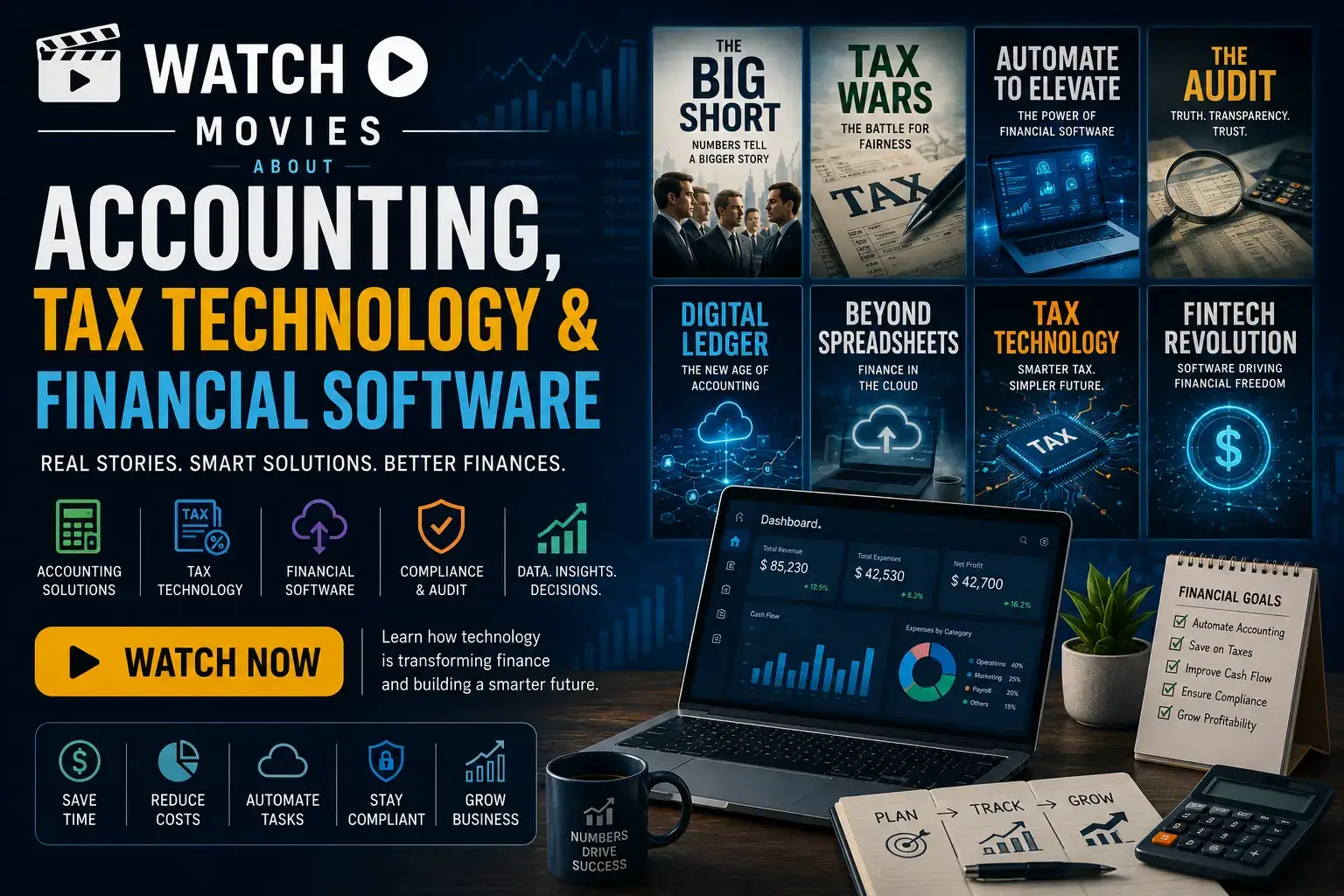
Watch Movies About Accounting, Tax Technology & Financial Software
Accounting is one of the most important functions in every modern business. Companies need accurate financial records to understand revenue, expenses, profitability, cash flow, taxes, payroll and overall financial performance. As businesses have become increasingly digital, accounting has evolved from paper-based bookkeeping into a sophisticated technology-driven discipline.
Our collection of accounting movies, accounting documentaries and financial technology videos explores the software and systems powering modern finance departments. Discover documentaries covering accounting software, cloud accounting, tax technology, bookkeeping automation, payroll systems, invoicing, accounts payable, accounts receivable, financial reporting, financial analytics, enterprise resource planning and AI-powered finance automation.
Modern financial software can connect banking systems, accounting platforms, payment processors, payroll applications, tax systems and enterprise software. These integrations allow businesses to automate repetitive financial processes and gain faster access to financial information.
Tax technology is also changing how individuals and businesses manage complex tax processes. Digital tax platforms can support tax preparation, compliance workflows, document management, reporting and calculations, while enterprise tax systems can help organizations manage obligations across multiple jurisdictions.
Accounting documentaries provide an engaging way to understand the technology behind these systems and the broader transformation of corporate finance.
Why Watch Movies About Accounting and Financial Software?
Accounting is sometimes viewed as a traditional business function, but modern accounting departments depend heavily on technology.
Cloud accounting platforms, automated bookkeeping, electronic invoicing, expense management, payroll software, financial analytics and AI-based document processing are changing how finance professionals work.
Documentaries can show how accounting evolved from manual ledgers to integrated financial platforms.
They can also explain why accurate financial information matters to businesses, investors, lenders, employees, regulators and other stakeholders.
For entrepreneurs, accounting technology can provide insight into managing business finances. For technology professionals, it offers a fascinating example of enterprise software and automation. For finance professionals, documentaries can provide context around the digital transformation of accounting and financial operations.
What Is Accounting?
Accounting is the process of recording, organizing, analyzing and reporting financial transactions and information.
Businesses use accounting information to understand financial performance, manage resources, prepare reports, meet applicable tax and regulatory obligations and support decision-making.
Accounting can involve areas such as financial accounting, management accounting, tax accounting, auditing and corporate finance.
Modern accounting technology helps automate many of the processes required to collect, organize and analyze financial information.
The Evolution of Accounting Technology
Traditional accounting relied heavily on paper documents, physical ledgers and manual calculations.
Desktop accounting software later transformed bookkeeping by moving financial records into digital systems.
The development of cloud computing created another major change by allowing businesses to access accounting platforms through internet-connected applications.
Modern finance software increasingly incorporates automation, APIs, real-time data, analytics and artificial intelligence.
Accounting Software
Accounting software provides digital tools for recording transactions, managing financial accounts and generating reports.
Depending on the platform, businesses may use accounting software for invoicing, expense tracking, accounts payable, accounts receivable, bank reconciliation, payroll integration, tax reporting and financial statements.
Accounting software reduces the need for manual calculations and can improve consistency in financial recordkeeping.
Enterprise platforms can integrate accounting with procurement, inventory, sales, human resources and other business functions.
Cloud Accounting
Cloud accounting allows businesses to access accounting systems through internet-based platforms rather than relying exclusively on locally installed software.
Cloud systems can support remote access, automated updates, data synchronization and integration with other business applications.
Cloud accounting has become particularly useful for businesses with distributed teams, multiple locations and digital operations.
Organizations adopting cloud finance platforms should still evaluate security, data protection, availability, access controls and vendor management.
SaaS Accounting Software
Software as a Service, or SaaS, accounting platforms provide financial functionality through subscription-based software services.
Businesses can access the software without maintaining the underlying application infrastructure themselves.
SaaS accounting can provide regular software updates, centralized data and integration with other cloud applications.
The subscription model also allows accounting software providers to continuously improve their products and introduce new financial automation capabilities.
Bookkeeping Software
Bookkeeping software helps businesses record income, expenses, transactions and other financial activity.
Modern platforms can automatically import transactions from connected financial institutions and categorize certain expenses.
Automated bookkeeping can reduce repetitive data entry while allowing finance professionals to focus on review and analysis.
Automated Bookkeeping
Automation is changing the way businesses maintain financial records.
Automated systems can import bank transactions, match invoices with payments, categorize expenses and identify transactions that require review.
Automation does not eliminate the need for financial oversight. Accounting professionals may still need to review exceptions, unusual transactions and complex accounting treatments.
Bank Reconciliation
Bank reconciliation compares accounting records with information provided by financial institutions.
The purpose is to identify differences, missing transactions or errors between the accounting system and bank records.
Modern accounting platforms can automate much of the reconciliation process by importing bank transactions and matching them with existing records.
Automated reconciliation can save time and help finance teams maintain more current financial records.
Accounts Payable
Accounts payable represents amounts a business owes to suppliers and other vendors.
Accounts payable processes can involve receiving invoices, verifying purchases, approving payments and maintaining payment records.
Technology can automate invoice capture, approval workflows, payment scheduling and reconciliation.
Accounts Payable Automation
Accounts payable automation can reduce manual work associated with processing supplier invoices.
Modern systems can use optical character recognition, intelligent document processing and workflow automation to extract invoice information.
Invoices can then be routed for approval according to predefined business rules.
Automated accounts payable systems can improve visibility into outstanding obligations and payment workflows.
Accounts Receivable
Accounts receivable represents amounts customers owe a business.
Businesses need efficient systems for generating invoices, tracking outstanding balances, processing payments and reconciling customer accounts.
Accounts receivable software can automate reminders, payment matching and reporting.
Accounts Receivable Automation
Automated accounts receivable systems can improve cash collection workflows by reducing manual tasks.
Businesses can automate invoice delivery, payment reminders, transaction matching and reporting.
Better accounts receivable management can improve cash-flow visibility and reduce administrative overhead.
Invoicing Software
Invoicing software helps businesses create, deliver and manage customer invoices.
Modern systems can generate invoices automatically based on contracts, subscriptions, sales orders or completed services.
Digital invoicing can also integrate with payment platforms, allowing customers to pay directly through online interfaces.
Electronic Invoicing
Electronic invoicing, commonly known as e-invoicing, replaces many paper-based invoice processes with structured digital documents.
Electronic invoices can be exchanged between businesses and integrated directly into accounting systems.
This can reduce manual data entry and improve processing speed.
Different countries and jurisdictions can have different e-invoicing requirements, so businesses should evaluate applicable local rules.
Expense Management Software
Expense management platforms help businesses capture, categorize, approve and report employee and corporate expenses.
Mobile applications can allow employees to upload receipts immediately after purchases.
Automated workflows can route expenses for approval and synchronize approved transactions with accounting systems.
Receipt Automation
Modern finance platforms can use OCR and intelligent document processing to extract information from receipts.
Automated extraction can identify dates, merchants, amounts and other relevant information.
Finance teams can then review the extracted data instead of manually entering every field.
Payroll Software
Payroll is another critical area of financial technology.
Payroll systems can calculate employee compensation, manage deductions, produce payroll reports and integrate with accounting platforms.
Automated payroll systems can reduce repetitive administrative work while helping businesses maintain consistent payroll processes.
Payroll rules and tax requirements vary by jurisdiction, making accurate configuration and professional review important.
Payroll Automation
Payroll automation can connect employee records, time tracking, benefits information and financial systems.
Automated workflows can calculate payroll based on configured rules and generate appropriate records.
Finance and human resources teams can use integrated systems to improve payroll visibility and reduce manual processes.
Tax Technology
Tax technology includes software and digital systems used to calculate, prepare, manage and report tax information.
Individuals and businesses may use tax software for preparation and filing, while large organizations may use enterprise tax platforms to manage complex tax requirements.
Tax technology can also support document management, compliance workflows and reporting.
Tax Software
Tax software helps users prepare financial information for applicable tax reporting and filing processes.
Depending on the product, tax software can provide calculations, forms, electronic filing functionality and document organization.
Businesses with complex tax situations may use specialized professional tax platforms.
Corporate Tax Technology
Large organizations can face complex tax requirements across multiple jurisdictions.
Enterprise tax technology can help manage tax data, reporting workflows, compliance processes and calculations.
Integrated tax systems can connect with accounting and enterprise resource planning platforms.
Tax Automation
Tax automation uses software to reduce repetitive work in tax-related processes.
Automation can support data collection, tax calculations, document management, reporting and workflow management.
Because tax laws change frequently and vary by jurisdiction, automated systems require ongoing maintenance and professional oversight.
Financial Reporting Software
Financial reporting software helps organizations produce financial statements and management reports.
Modern platforms can consolidate information from multiple systems and provide dashboards for financial analysis.
Automated reporting can improve the speed at which finance teams receive information about business performance.
Financial Statements
Financial statements provide structured information about a business's financial position and performance.
Common financial statements include the balance sheet, income statement and cash flow statement.
Accounting systems help businesses organize transaction data into reports that can support financial analysis.
Financial Close Automation
The financial close process involves finalizing accounting records for a reporting period.
Month-end and year-end close processes can involve reconciliations, journal entries, reviews and reporting.
Close management software can automate task assignments, approvals, reconciliation workflows and status tracking.
Automation can help finance teams complete the close process more efficiently while maintaining appropriate controls.
Month-End Close
Month-end close provides businesses with an updated view of financial performance and position.
Traditional close processes can involve significant manual work across multiple departments.
Modern finance technology can automate data collection and reconciliation while providing centralized visibility into outstanding tasks.
Financial Planning and Analysis
Financial Planning and Analysis, commonly called FP&A, focuses on budgeting, forecasting, performance analysis and strategic financial planning.
FP&A software can provide models, dashboards, forecasts and scenario analysis.
These systems help finance teams connect historical financial data with future business planning.
Budgeting Software
Budgeting software allows organizations to create financial plans and allocate resources.
Modern platforms can support departmental budgets, approval workflows and variance analysis.
Automated budgeting systems can reduce spreadsheet dependency and provide centralized financial planning.
Financial Forecasting Software
Forecasting systems help businesses estimate future revenue, expenses, cash flow and other financial metrics.
Technology can combine historical information with business assumptions to create financial scenarios.
Forecasts are estimates rather than guarantees, and businesses should regularly update assumptions as conditions change.
Cash Flow Management
Cash flow management is essential for businesses because profitability does not necessarily mean that sufficient cash is available at a specific time.
Financial software can provide visibility into expected receipts, payments and cash balances.
Cash-flow forecasting can help businesses identify potential funding requirements and manage working capital.
Treasury Management Technology
Treasury management technology helps larger organizations manage cash, liquidity, banking relationships and financial risk.
Modern treasury platforms can connect bank accounts, automate cash reporting and provide centralized visibility into financial positions.
Automation can help treasury teams manage complex financial operations more efficiently.
Enterprise Resource Planning and Accounting
Enterprise Resource Planning, or ERP, systems integrate multiple business functions into a centralized technology platform.
ERP systems can connect accounting with procurement, inventory, sales, manufacturing, human resources and other business processes.
Integrated financial information can improve visibility and reduce duplicate data entry.
Cloud ERP
Cloud ERP systems deliver enterprise resource planning functionality through cloud-based platforms.
Cloud ERP can provide centralized data, remote access and integration with other SaaS applications.
Organizations considering ERP migration need to evaluate data security, implementation complexity, integration requirements and business continuity.
Accounting APIs
Application Programming Interfaces allow accounting systems to exchange data with other software applications.
Accounting APIs can connect financial platforms with banks, payment processors, e-commerce systems, CRM platforms, payroll applications and expense management tools.
API-driven accounting ecosystems reduce the need for manual data transfer between applications.
Banking Integration
Banking integrations allow accounting platforms to receive transaction information directly from financial institutions.
Automated bank feeds can reduce manual transaction entry and help businesses maintain current financial records.
Secure authentication and appropriate data-access controls are essential for financial integrations.
Payment Reconciliation
Payment reconciliation compares payments received or made with invoices and accounting records.
Businesses processing large transaction volumes can benefit significantly from automated reconciliation.
Financial software can match transactions using identifiers, amounts, dates and other information.
Financial Analytics
Financial analytics transforms accounting information into insights that can support business decisions.
Analytics dashboards can display revenue, expenses, margins, cash flow, receivables, payables and other financial indicators.
Modern financial analytics can provide near-real-time visibility rather than requiring businesses to wait for periodic manual reports.
Business Intelligence for Finance
Business intelligence platforms can combine financial data with operational information to provide a broader view of business performance.
Finance teams can analyze sales, customer activity, costs, inventory and other business metrics alongside accounting information.
This integrated perspective can improve strategic decision-making.
CFO Technology
Chief Financial Officers increasingly rely on technology to manage financial reporting, forecasting, planning, risk and business performance.
CFO technology platforms can provide dashboards, automated reporting, scenario modeling and financial analytics.
Automation allows finance leaders to spend less time collecting data and more time interpreting financial information.
Finance Transformation
Finance transformation involves redesigning financial processes, technology and organizational practices to improve efficiency and decision-making.
Cloud software, automation, analytics and AI are important technologies in modern finance transformation programs.
Successful transformation generally requires more than installing new software. Businesses also need appropriate processes, data standards, employee training and governance.
Artificial Intelligence in Accounting
Artificial intelligence is increasingly being applied to accounting workflows.
AI can assist with document processing, transaction classification, anomaly detection, forecasting and financial analysis.
Machine learning systems can process large datasets and identify patterns that may require human review.
AI should be implemented with appropriate controls because inaccurate automated outputs can affect financial reporting.
Generative AI for Finance Teams
Generative AI can assist finance teams with document summaries, financial explanations, research and workflow support.
AI assistants may help employees interact with financial data using natural-language interfaces.
Organizations must carefully manage confidential information, access permissions, data privacy and accuracy when deploying generative AI.
Intelligent Document Processing
Financial departments process large volumes of invoices, receipts, statements and other documents.
Intelligent document processing combines OCR, machine learning and automation to extract structured information from documents.
This technology can reduce manual data entry and accelerate accounts payable and expense management processes.
OCR and Accounting
Optical Character Recognition, or OCR, converts text from scanned documents and images into machine-readable information.
Accounting platforms can use OCR to extract information from receipts, invoices and financial documents.
Modern systems increasingly combine OCR with machine learning to improve extraction accuracy and automate classification.
Accounting Data Integration
Businesses often use many financial applications. Accounting data integration connects these systems so information can move automatically between them.
Integration can connect accounting software with banking platforms, payment systems, payroll, inventory, CRM and enterprise applications.
Well-designed integrations reduce duplicate data entry and improve consistency.
Financial Data Security
Financial systems contain highly sensitive business information. Protecting accounting data is therefore a critical technology requirement.
Security measures can include encryption, access control, multi-factor authentication, backups, monitoring and secure software development.
Businesses should also consider the security practices of external software providers and integrations.
Accounting Cybersecurity
Accounting departments can be targeted by phishing, credential theft, business email compromise and other cyber threats.
Strong identity controls, employee security awareness and payment approval processes can help reduce certain risks.
Financial systems should also use appropriate logging and monitoring to identify suspicious activity.
Internal Controls
Internal controls are processes designed to reduce financial and operational risks.
Examples include approval workflows, segregation of duties, access controls, reconciliations and audit trails.
Accounting software can automate many internal controls and provide records of financial activity.
Audit Technology
Audit technology helps auditors analyze financial data and evaluate accounting processes.
Modern audit platforms can automate data analysis, document management, sampling and testing workflows.
Data analytics can allow auditors to examine larger transaction populations and identify unusual patterns for further review.
Financial Compliance Software
Businesses may need to comply with financial reporting, tax, regulatory and industry-specific requirements.
Compliance software can help manage policies, reporting tasks, documentation and approval workflows.
Automated compliance systems can provide alerts and maintain audit trails.
Accounts Payable and Accounts Receivable Automation
Accounts payable and accounts receivable represent two major areas where financial automation can produce measurable operational benefits.
Automated systems can capture invoices, match transactions, route approvals, send payment reminders and reconcile accounts.
Reducing repetitive manual work can allow finance teams to focus on analysis and exception management.
Small Business Accounting Technology
Small businesses increasingly use cloud accounting, digital payments, payroll software and automated invoicing.
These tools can provide business owners with greater visibility into revenue, expenses and cash flow.
Integrated financial software can also reduce the administrative burden associated with running a business.
Enterprise Financial Software
Large organizations often require sophisticated financial systems capable of handling multiple entities, currencies, locations and business units.
Enterprise finance platforms can support consolidation, financial reporting, tax management, treasury, budgeting and compliance.
Integration with ERP and other enterprise applications is particularly important for large organizations.
Financial Automation
Financial automation involves using software to perform repetitive financial tasks with minimal manual intervention.
Automation can cover invoicing, expense processing, bank reconciliation, accounts payable, accounts receivable, payroll, reporting and financial close activities.
Well-designed automation improves efficiency while preserving human review for complex decisions.
Real-Time Financial Reporting
Traditional financial reporting often depended on periodic data collection and manual consolidation.
Integrated cloud systems can provide more frequent access to financial information.
Real-time or near-real-time dashboards can help management monitor business performance and respond more quickly to changing conditions.
Accounting Technology for Startups
Startups often need to establish scalable financial systems early in their growth.
Cloud accounting, automated expense management, payroll platforms and digital invoicing can provide a foundation for financial operations.
As companies grow, they may adopt more advanced ERP, FP&A, treasury and financial reporting systems.
Accounting Technology for Global Businesses
International organizations can face complex financial operations involving multiple currencies, entities and tax jurisdictions.
Enterprise financial software can support currency conversion, consolidation, reporting and compliance workflows.
Global finance technology must be designed around applicable local requirements and accounting standards.
The Future of Accounting
Accounting is becoming increasingly automated and data-driven.
Routine transaction processing may continue to shift toward automated systems while accounting professionals focus more heavily on analysis, controls, financial strategy and advisory activities.
Artificial intelligence may further automate document processing and financial analysis.
Human expertise will remain important for judgment-based accounting decisions, complex transactions and financial governance.
The Future of Tax Technology
Tax technology is likely to become increasingly integrated with accounting and enterprise systems.
Automated data collection, digital reporting, electronic invoicing and real-time compliance systems may reduce manual tax administration.
Businesses will need to continuously update technology as tax regulations and reporting requirements evolve.
AI-Powered Finance Departments
AI could transform finance departments by helping employees analyze large datasets, identify anomalies and automate routine workflows.
AI assistants may provide natural-language access to financial reports and help answer routine business questions.
Organizations will need strong data governance and human oversight to ensure AI-generated financial information is accurate and appropriate.
The Role of the Modern Accountant
Technology is changing the responsibilities of accounting professionals rather than simply eliminating accounting work.
As automation handles more repetitive tasks, accountants can spend more time on financial analysis, business advisory, internal controls, compliance and strategic planning.
Technology skills are therefore becoming increasingly valuable in modern accounting careers.
Accounting Careers and Technology Skills
Modern finance professionals may benefit from understanding cloud accounting, data analytics, financial automation, ERP systems and AI.
Accountants who understand how financial systems integrate can help organizations improve processes and data quality.
Technology knowledge can complement traditional accounting expertise and create opportunities in finance transformation and financial systems management.
Financial Software Education
Students and business professionals can use accounting documentaries as an introduction to financial systems and technology.
Understanding basic accounting concepts before exploring financial software can make it easier to understand how accounting platforms process transactions.
Practical projects involving spreadsheets, accounting software, financial dashboards or simple business models can complement documentary-based learning.
Important Accounting and Finance Technologies to Explore
- Accounting Software: Digital systems for recording and managing financial transactions.
- Cloud Accounting: Online accounting platforms accessible through internet-connected devices.
- Bookkeeping Automation: Automated transaction recording and classification.
- Tax Technology: Software supporting tax calculations, reporting and compliance.
- Accounts Payable Automation: Technology for invoice processing and payment workflows.
- Accounts Receivable Automation: Systems for invoicing, collections and payment reconciliation.
- Payroll Software: Technology for employee compensation and payroll administration.
- Expense Management: Software for capturing and approving business expenses.
- Financial Reporting: Platforms for producing financial statements and management reports.
- FP&A Software: Tools for budgeting, forecasting and financial analysis.
- ERP Finance: Enterprise platforms integrating accounting with broader business operations.
- Financial Close Software: Technology for automating month-end and year-end close workflows.
- AI Accounting: Artificial intelligence applied to accounting and finance processes.
- OCR and Document Processing: Technology for extracting financial information from documents.
- Financial Analytics: Systems for analyzing financial and operational data.
- Audit Technology: Digital tools supporting financial audit and compliance processes.
- Finance Automation: Automated workflows across modern finance departments.
How Accounting Software Connects Modern Businesses
Modern accounting platforms rarely operate in isolation.
An accounting system may connect with a company's bank accounts, payment gateway, payroll provider, e-commerce platform, CRM, inventory system and expense management software.
These integrations create a connected financial ecosystem where transaction data can flow between business systems.
Integrated architecture can reduce duplicate data entry and improve the timeliness of financial reporting.
Accounting and Business Decision-Making
Accounting data provides more than a record of historical transactions. It can help management understand how a business is performing and where resources are being used.
Financial analytics can reveal changes in revenue, margins, expenses, cash flow and working capital.
When accounting data is combined with operational information, businesses can make more informed strategic decisions.
How to Get More Value From Accounting Documentaries
When watching an accounting or financial technology documentary, look beyond the basic bookkeeping process.
Consider how financial information moves through an organization and which systems are involved.
Ask how invoices become accounting records, how payments are reconciled, how financial statements are produced and how management uses financial information.
For technology professionals, pay attention to cloud architecture, APIs, automation, data security and AI.
For business owners, focus on cash flow, financial reporting, expense management, tax compliance and operational efficiency.
Explore Accounting Movies and Financial Technology Documentaries
Accounting documentaries provide a fascinating perspective on the financial infrastructure behind modern businesses.
From traditional bookkeeping and financial reporting to cloud accounting, automated tax technology and AI-powered finance systems, technology is changing how companies manage money and financial information.
These videos can help viewers understand why accounting software has become a critical component of modern business operations.
Start Exploring Accounting, Tax Technology and Financial Software
Explore our collection of accounting movies, financial software documentaries and tax technology videos covering bookkeeping software, cloud accounting, tax technology, payroll systems, invoicing platforms, accounts payable, accounts receivable, financial automation, ERP finance, FP&A, financial analytics and AI-powered accounting.
Whether you are an accountant, CFO, entrepreneur, business owner, software developer, finance professional, student or technology enthusiast, these documentaries provide an engaging starting point for understanding the technology transforming modern finance departments.
Use accounting and financial technology documentaries as educational resources and verify important accounting, tax, legal and financial information through current authoritative sources and qualified professionals.
Watch, learn and explore how accounting technology, tax software and financial automation are transforming the future of business finance.